
Search the internet with words like “galaxy redshifts” and you’ll get dogmatic statements that the cosmological redshifts are due to the expansion of the universe, as if it has been proven already. But nothing could be further from the truth. In fact, expanding space has never been observed in any laboratory experiment.
Cosmological expansion is not testable in the realm of experimental science. Besides it is bad science to assume expanding space to explain cosmological redshifts when the phenomenon has never been observed in the lab. All evidence for it is at cosmological distances and which is not testable in a local lab sense.
The Hubble–Lemaître law redshift-distance relationship is real enough but there are potentially many mechanisms that could explain that law even in a static — i.e. non-expanding — universe. Here Marmet lists 59 mechanisms https://arxiv.org/pdf/1801.07582
However to resolve tensions in cosmology some authors have proposed a tired-light contribution to galactic redshifts, [26, 27, 28] yet precise mechanisms remain unspecified and additional parameters or assumptions are needed to obtain consistency with observations.
Physicist Dr Louis Marmet has proposed a mechanism where the energy is removed from the light field resulting in a wavelength shift of its spectrum as it travels through free electrons in the intergalactic medium, without distortion of the images of the distant sources. His theory predicts a Stimulated Transfer redshift (STz) comparable to the observed redshifts of distant objects observed in astronomy.
By contrast, STz describes a mechanism that predicts astronomical observations from known physics, without any adjustable parameter.
The Stimulated Transfer redshift (STz) is a newly discovered phenomenon predicted by quantum electrodynamics. It describes how light can be redshifted through a specific interaction with matter, distinct from classical Doppler and gravitational redshift. When two light beams cross paths in the electron plasma of the Intergalactic Medium, a free electron transfers a photon from one beam to the other. This momentum transfer gives the electron a kick, which causes a tiny amount of heating and increases the electron’s temperature. As the process is repeated several times, it also removes a small amount of energy from the light beams, shifting their wavelengths toward the red end of the spectrum.
STz, while difficult to observe in a lab, has a major application in astronomy. As light travels across the universe, it causes a redshift of the light’s spectrum that mimics a Doppler redshift without blurring the images of distant objects. STz explains the observed cosmic redshift without requiring the universe to expand.
Dr Louis Marmet
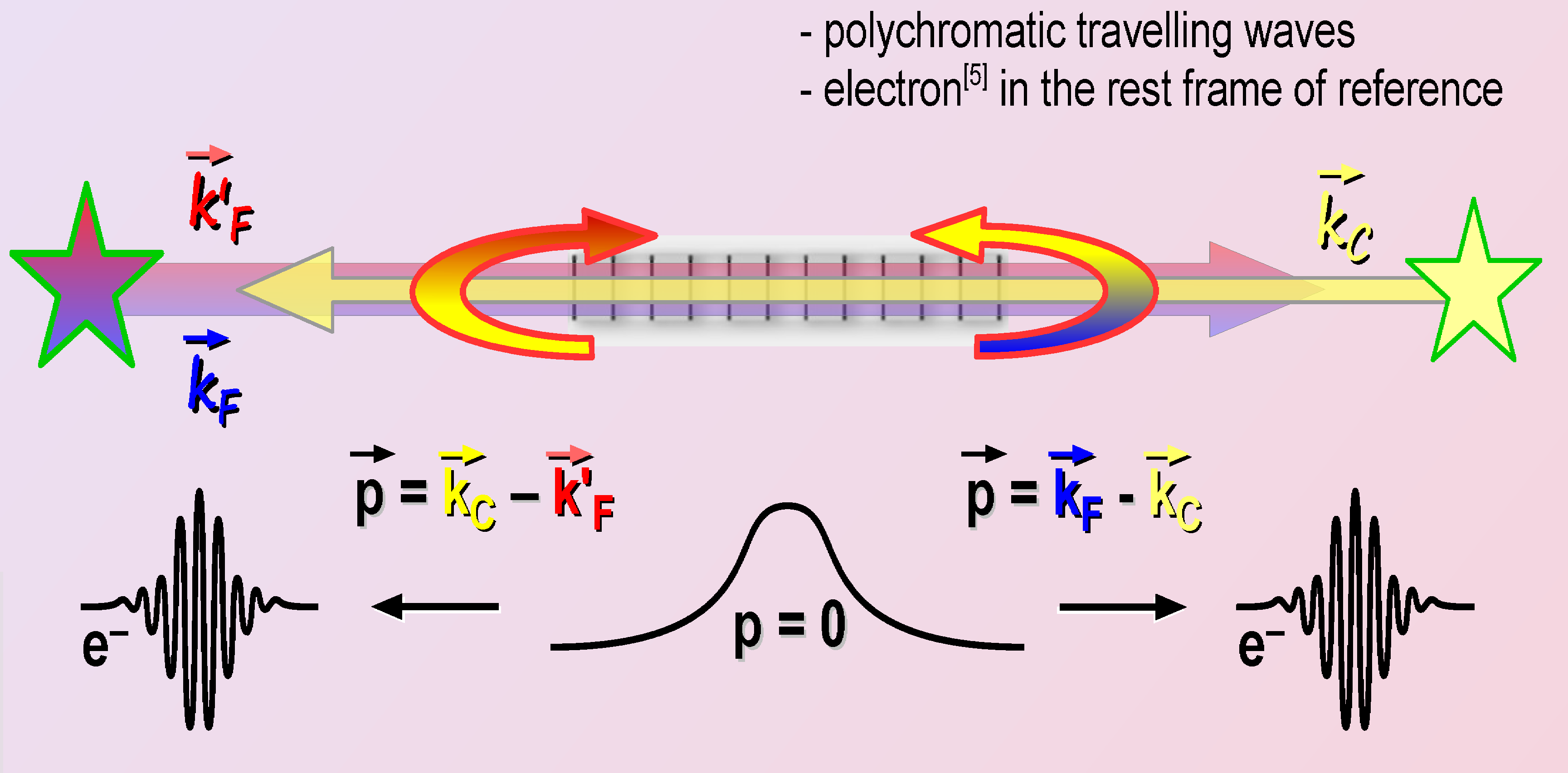
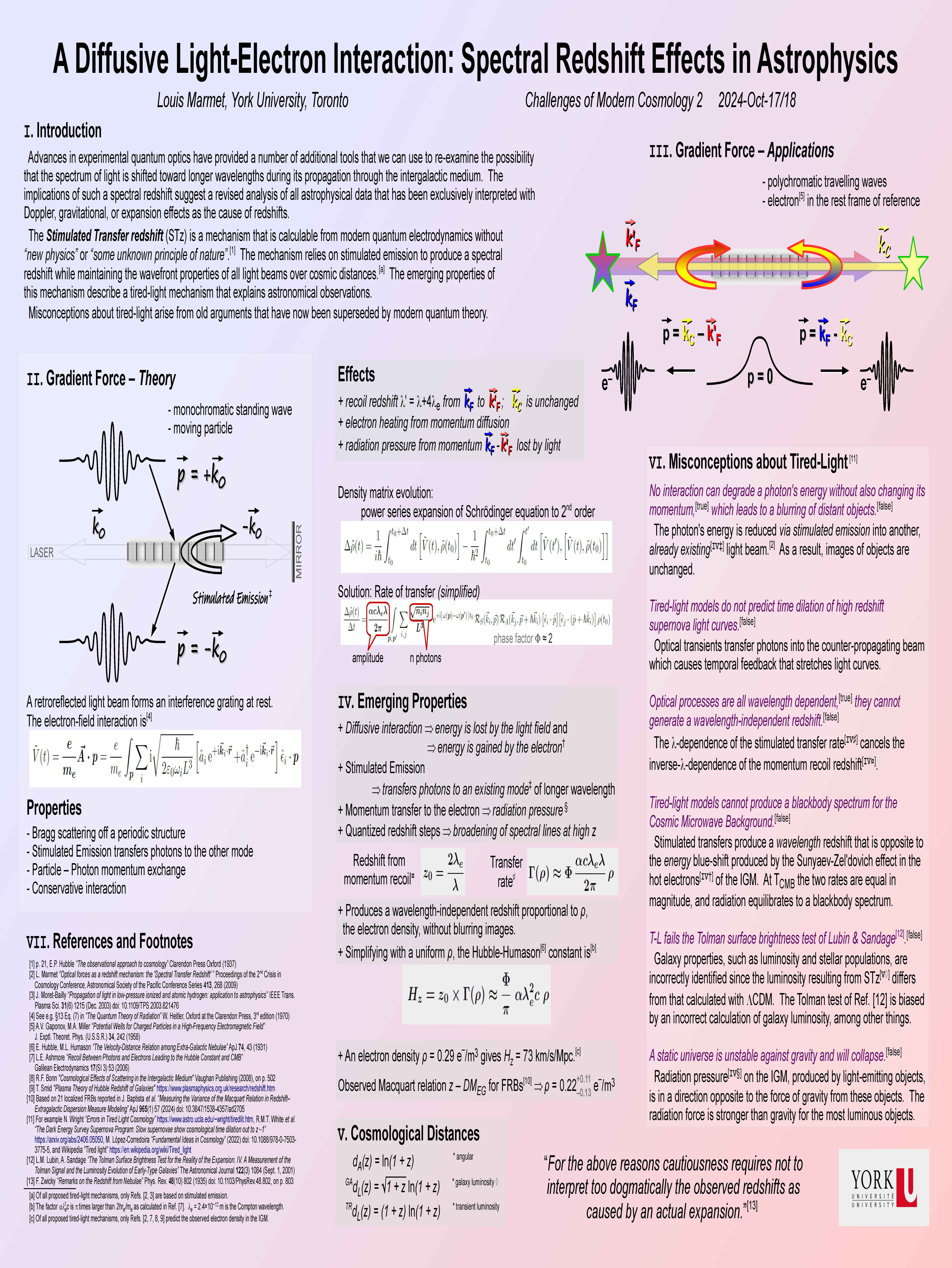
A quantum calculation of momentum diffusion that includes terms usually considered negligible accurately describes momentum diffusion in the gradient force on free electrons. The photon–electron interaction, calculable from QED,1 has diffusive properties that remove energy from the light field and increase the temperature of the electrons. The effect is based on stimulated emission and maintains the directional properties of all light beams.
The calculated heating of electrons in a plasma illuminated by intense light is confirmed by measurements of the solar corona temperature that reaches millions of Kelvins.
Intersecting light beams lose energy to the electrons of the intergalactic medium, resulting in a redshift of their spectral intensity without blurring the images of distant objects. Photons are replaced by new photons of slightly less energy propagating in the same direction as the original beam. From the measured electron density in the intergalactic medium, the Stimulated Transfer redshift predicts a redshift–distance relationship that agrees with an observed Hubble–Humason law up to z ≈ 16.
Stimulated transfers play an important role in astrophysical processes and cosmological observations, producing effects that support a very different interpretation of the universe.
In light of all this, “cautiousness requires not to interpret too dogmatically the observed redshifts as caused by an actual expansion.”[29]
L. Marmet, Diffusive interactions between photons and electrons, an application to cosmology, 2024, https://arxiv.org/abs/2410.02036
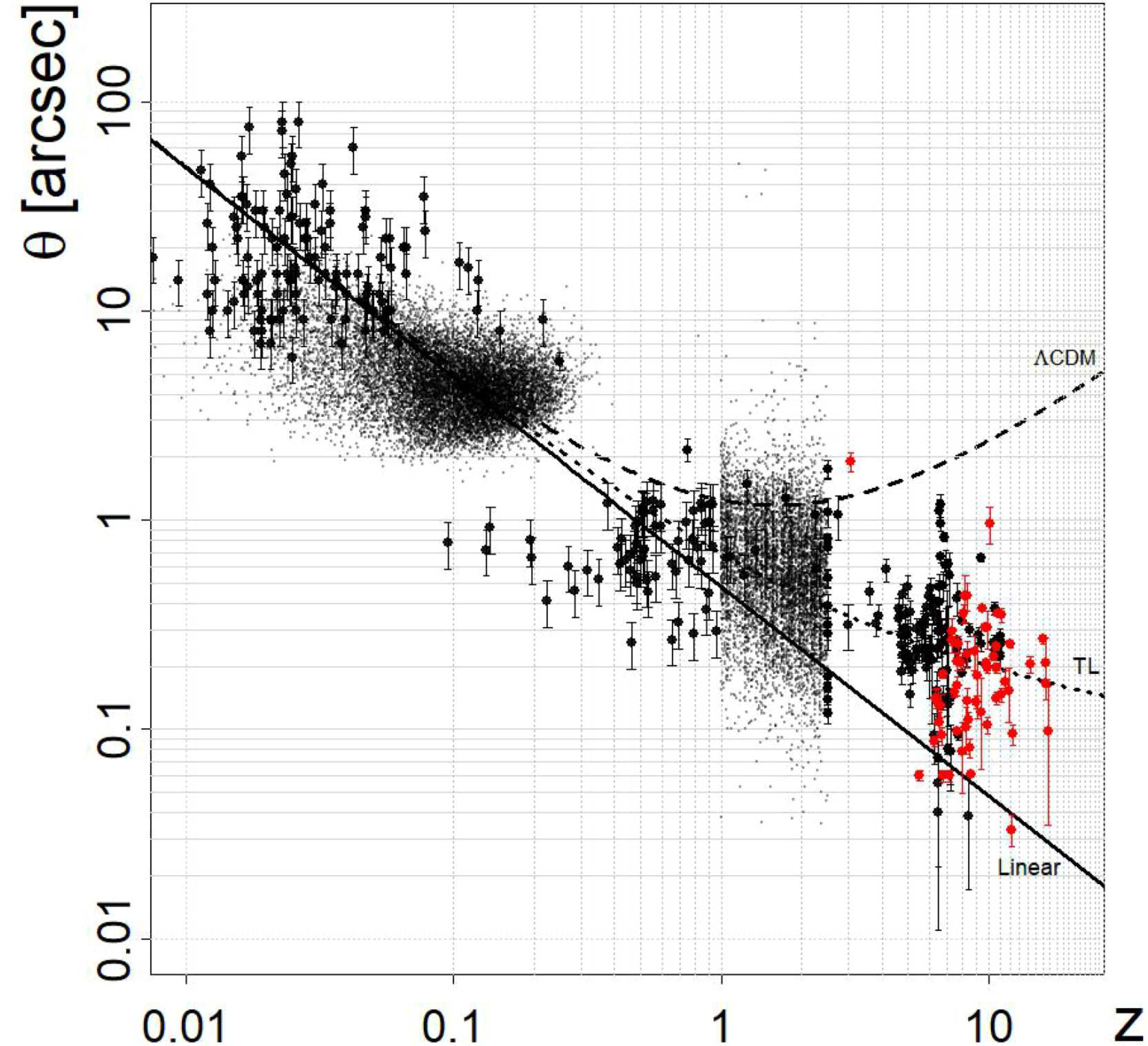
From the figure above it is clear that the standard cosmology — ΛCDM — Lambda Cold Dark Matter cosmology does not correctly predict the angular size of 10-kpc-size objects as a function of redshift. However a new Tired Light mechanism STz in cosmology (Marmet Eq. (9)) fits the observed data very precisely out to the redshift z = 16 and beyond from JWST observations.
The Tired Light model used here is in a non-expanding universe. No expansion of space is required. And all physics used in Marmet’s Stimulated Transfer redshift (STz) mechanism is known testable laboratory physics.
Therefore we do not need to assume expansion of space to explain galactic redshifts. Then why assume the universe is expanding? If it is not expanding but static then there was never any big bang origin of the universe from some singularity.
Footnote: 1. Quantum electrodynamics (QED) is the relativistic quantum field theory of electrodynamics. It describes how light and matter interact and is the first theory to get full agreement between quantum mechanics and special relativity.
References (numbered per Marmet paper)
- [24] E. Hubble and M.L. Humason. The Velocity-Distance Relation among Extra-Galactic Nebulae. ApJ, 74:43–80, 1931. doi: 10.1086/143323.
- [25] N. Lovyagin, A. Raikov, V. Yershov, and Y. Lovyagin. Cosmological Model Tests with JWST. Galaxies, 10(6):108–127, 2022. doi: 10.3390/galaxies10060108.
- [26] M. L´opez-Corredoira and L. Marmet. Alternative ideas in cosmology. Int. J. Mod. Phys. D, 31(8):2230014–1–37, 2022. doi: 10.1142/S0218271822300142; also arXiv:2202.12897.
- [27] R.P. Gupta. Testing CCC+TL Cosmology with Observed Baryon Acoustic Oscillation Features. ApJ, 964(1):55–62, 2024. doi: 10.3847/1538-4357/ad1bc6.
- [28] L. Shamir. An Empirical Consistent Redshift Bias: A Possible Direct Observation of Zwicky’s TL Theory. Particles, 7(3):703–716, 2024. doi: 10.3390/particles7030041.
- [29] F. Zwicky. Remarks on the Redshift from Nebulae. Phys. Rev., 48(10):802–806, 1935. doi: 10.1103/PhysRev.48.802.
Recommended Reading
- The James Webb Space Telescope Demolishes the Big Bang Hypothesis
- James Webb Space Telescope | Little Red Dot Galaxies are a Big Big Bang Problem
- Speculation on Redshift in a Created Universe
Free Subscribers
Subscribe to our Newsletters as a Free Subscriber and be notified by email. Just put your email address in the box at the bottom of your screen.
You’ll get an email each time we publish a new article. It is quick and easy to do and totally free. You only need do it once.
Premium Subscribers
Subscribe to our Newsletters as a Premium Subscribers at $5 USD/month or $30 USD/year (you choose).
Paid Premium Subscribers will get exclusive access to certain content I publish. That will only cost you a cup of coffee per month.
Also you’ll be able to download, for free, a PDF of my book Apocalypse Now and also a PDF of my book Physics of Creation The Creator’s Ultimate Design for Earth.
You can download them from the link below.
This is how you can support my work. I have been publishing this website for 10 years now and up to 2024 I never asked for any support.
Press the button “Premium” on the front page to find a list of Premium content. Thanks so much to all supporters.
At a minimum, please join as a Free Subscriber. It’ll cost you nothing. It may also help me beat the shadow banning of some posts.




 Bible Science Forum
Leave a comment