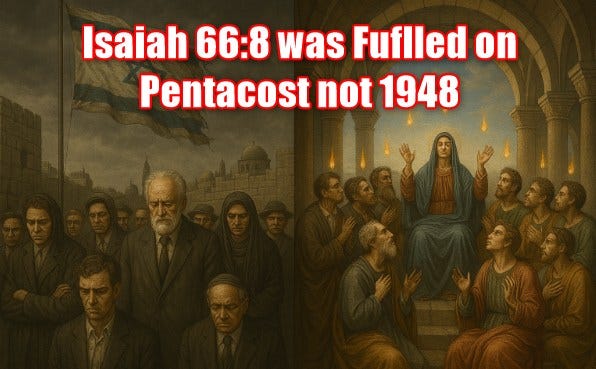
One of the biggest claims of the Christian Zionists is that the current nation called Israel is the fulfilment of a prophesy found in Isaiah 66:8 given by the prophet Isaiah over 2,700 years ago. That claim is completely erroneous! Former Christian Zionist Steven Ben-Nun published the following on his Substack for which he gave me permission to re-post.

I found Steven’s analysis both highly informative and utterly inspiring. It demolishes the argument that is so often used by the Christian Zionists when they replace Christ, who is the subject of many prophecies in Isaiah, Zechariah and elsewhere, with the current political earthly nation of Israel. Christian Zionists miss the correct understanding of the word of God and misinterpret spiritual Zion as a fleshly Zion in Israel.

I recommend you visit Steven Ben-Nun’s Substack and support his efforts. But please get out his message.


Was Israel the Fulfilment of Isaiah 66:8

by Steven Ben-Nun, December 15, 2025

A Nation Born in a Day

I want to take you on a journey—my own journey—out of Zionism and into a very different understanding of what Scripture truly means when it speaks of Zion and of a “nation being born in one day.”

Years ago, I was a committed Christian Zionist. I wore a kippah, I supported the modern State of Israel with my whole heart, and I sincerely believed the prophetic narrative so many of us were taught through the Scofield–Darby framework. During that period, I even wrote a book titled Israel: Are They Still God’s People? Refuting Israel’s Enemies, under the pen name Steven DeNoon. That book became the foundation for what would later grow into the DeNoon Institute of Biblical Research. Sadly, much of that early research was driven by assumptions rather than genuine inquiry—it was shaped by the deeply ingrained belief that the modern State of Israel was the unquestionable fulfillment of prophecy. It was not the product of critical thinking, but the result of a theological bias that had quietly infiltrated seminaries, Bible schools, and churches across the Western world.

Looking back now, I see how profoundly that system of interpretation blinded me. It took years of careful study, prayer, and reflection—much of it together with my wife, Jana—before I realized that what we now call Christian Zionism bears little resemblance to what the earliest believers understood, or to what the early church fathers taught. The deeper I dug into Scripture, the more evident it became that modern Zionism, as preached today, is a doctrinal construct—not the teaching of the apostles, nor the continuation of the faith once delivered unto the saints.

For that reason, I owe an apology to those who were influenced by my early writings and by teachings shaped by that flawed theology. Yet even in this, I can see the mercy of God. Many pro-Israel believers followed our work in those early days, and when the Lord began to open our eyes, many of those very same people started to awaken as well. They, too, came out of Zionism—just as we did—and found a deeper, more Christ-centered understanding of Scripture.

Yet there remain several “key passages” that Zionist teachers repeatedly use to argue that the modern State of Israel—especially its founding in 1948—is the direct fulfillment of biblical prophecy. Over the years, I have responded to some of these verses in individual messages and teachings, but I have never taken the time to scrutinize them, one by one, systematically. This chapter is part of a larger work in which I now begin to do precisely that.

In this chapter, I want to turn our attention to one of the most frequently quoted verses in the Zionist narrative: Isaiah 66:8—“Who hath heard such a thing? Who hath seen such things? Shall the earth be made to bring forth in one day? Or shall a nation be born at once?” This passage is routinely invoked to assert that the establishment of the modern State of Israel in 1948 is the direct fulfillment of Isaiah’s prophecy. I once taught that very thing myself. But with deeper study and a clearer understanding of the Scriptures, I can no longer uphold that interpretation; I now see it as fundamentally untrue.

Reading Isaiah 66 with Fresh Eyes

Let us begin by looking carefully at the text of Isaiah 66:

“Before she travailed, she brought forth;
before her pain came, she was delivered of a man child.
Who hath heard such a thing? who hath seen such things?
shall the earth be made to bring forth in one day?
or shall a nation be born at once?
for as soon as Zion travailed, she brought forth her children.”
—Isaiah 66:7–8 (KJV)

It is unreasonable—even impossible—to apply this prophecy to the modern birth of Israel in 1948 when, just two verses later, Jerusalem is still spoken of as a present, existing city (v. 10). The sequence laid out in Isaiah is also crucial. First, the text says that before she ever travailed, she brought forth; before her pain came, she delivered a man-child—a single male. Then the prophet asks, “Who hath heard such a thing? Who hath seen such things? Shall the earth be made to bring forth in one day? Or shall a nation be born at once?” Finally, the passage concludes that after Zion has travailed, she brings forth her children, plural. The flow of events here does not align with the modern Zionist claim.

The passage clearly distinguishes between the birth of a single male child and, later, the emergence of children—plural. It also raises the question of the earth, or land, bringing forth in one day, and a nation being born at once. Zionist interpretation typically overlooks these details and leaps directly from the phrase “a nation born at once” to May 14, 1948, when the modern State of Israel declared independence and gained political recognition. I did the same in my earlier years. Yet when we slow down and allow the text to speak for itself, the prophecy begins to raise entirely different questions than the ones the Zionist narrative assumes.

Who is this man-child? Who are her children? What does it mean for the earth to bring forth in one day? Is this really talking about a twentieth-century political state, or is it pointing to something far deeper and more spiritual?

It is remarkable to note that some of the earliest church fathers—Origen in the third century and Augustine near the end of the fourth—did not interpret Isaiah 66 as pointing to a future political state, but rather to the spiritual birth of God’s people in Christ. Origen wrote plainly, “The prophecies concerning Zion and Jerusalem are not fulfilled in the earthly city, but in the Church of Christ, the heavenly Jerusalem.” Augustine likewise understood these passages as describing the formation of the Christian people, not a geopolitical nation. Long before I ever read their comments, I had already begun to see, through my own study, that Isaiah 66 reaches its fulfillment in the book of Acts, particularly in Acts 2 at Pentecost. Discovering that early Christian writers recognized the same truth only confirmed what the Lord had already been revealing to me.

The Man Child and the Children of Zion

This is the context in which the prophet then raises his astonishing questions. After first declaring, “Before she travailed, she brought forth; before her pain came, she was delivered of a man-child,” Isaiah describes an event so extraordinary that it defies natural expectation. The “man-child” is explicitly a male—the Hebrew zakar (זָכָר)—and while Isaiah never names the mother, the language unmistakably points toward the singular birth through which God would bring forth His Messiah. Yet the prophet is not merely observing the birth of a child; he is perplexed by what that birth sets in motion. His tone shifts as he exclaims, “Who hath heard such a thing? Who hath seen such things?” A child may indeed be born in a single day—but Isaiah suddenly perceives that a land is being born with Him. “Shall the earth be made to bring forth in one day?” he asks, realizing that this birth carries implications far beyond the arrival of an infant.

Then the prophet presses the matter even further: “Shall a nation be born at once?” Lands and nations do not emerge in a moment; whole peoples are not born in a single day. Yet Isaiah sees that this is precisely what will happen. The verse itself explains it: “for as soon as Zion travailed, she brought forth her children.” The singular child of the first clause becomes the multitude of the second. What Isaiah witnesses is unprecedented—a single birth that initiates the birth of an entire people. The miraculous arrival of the man-child becomes the catalyst for the sudden appearance of a nation.

And there is only one moment in redemptive history that fulfills this outlandish prophetic vision: the day of Pentecost. On that day, Judeans “out of every nation under heaven” returned to Jerusalem; the Spirit was poured out; thousands believed; and in a single, Spirit-filled moment, the people of God—the true nation of Zion—came into being. Only then was a nation, in the truest sense, “born at once,” just as Isaiah had foreseen.

As we have already seen in Isaiah 66, the “land” that is born in one day finds its fulfillment not in a political declaration, but in the miraculous outpouring of Acts chapter 2. Pentecost becomes the moment when the true people of God—the nation Isaiah foresaw—were brought forth at once. Yet this realization forces us to revisit another central biblical theme: the promise of the land itself. Scripture speaks repeatedly of a land “flowing with milk and honey,” the inheritance God swore to give His people. The Lord said plainly:

“And I am come down to deliver them out of the hand of the Egyptians,
and to bring them up out of that land unto a good land and a large,
unto a land flowing with milk and honey.”
—Exodus 3:8

But there is something far more profound in this promise than we often recognize. The New Testament book of Hebrews reveals that the true meaning of the “promised land” was never merely geographical. In fact, Hebrews 3 and 4 reinterpret the entire concept, showing that the physical territory the Israelites journeyed toward was only a shadow of a greater reality.

The writer of Hebrews—even if anonymous, traditionally understood as Paul—points us first to the tragedy of the wilderness generation. He reminds us:

“For some, when they had heard, did provoke:
Howbeit not all that came out of Egypt by Moses.
But with whom was he grieved forty years?
Was it not with them that had sinned,
whose carcases fell in the wilderness?
And to whom sware he that they should not enter into his rest,
but to them that believed not?
So we see that they could not enter in because of unbelief.”
—Hebrews 3:16–19

Although the people were physically headed toward the promised land, the author of the book of Hebrews insists that what they ultimately failed to enter was God’s rest. Their unbelief prevented them from receiving the spiritual fulfillment of that promise.

This brings us to a striking realization: the author uses the language of rest, Sabbath, and inheritance, but not in a way that points back to Canaan. He speaks as though the promise remained unfulfilled, even after Joshua brought the tribes into the land. If the physical land of Israel had been the true inheritance, the author of Hebrews would have no reason to say otherwise. Yet the very next chapter makes an astonishing claim:

“For if Jesus had given them rest,
then would he not afterward have spoken of another day.”
—Hebrews 4:8

According to Hebrews, Joshua (here rendered “Jesus” in the KJV) did not give them the promised rest. The “land” they entered was not the fulfillment of God’s true promise. Something greater—something other—remained. The writer continues:

“There remaineth therefore a rest to the people of God.”
—Hebrews 4:9

A rest remained. A land remained. An inheritance remained.

Hebrews is telling us plainly that the promised land, the place flowing with milk and honey, was never ultimately about a strip of soil between the Jordan and the Mediterranean. That physical land was a shadow pointing forward to Christ, the proper Sabbath rest of God, and to the people born of His Spirit.

In other words, just as Isaiah foresaw a land and a nation being born in one day, Hebrews declares that the true “land,” the proper “rest,” and the true “inheritance” is entered not by crossing a border, but by faith in Jesus Christ. The promised land is not reached by geography—it is reached by believing. And the nation Isaiah saw brought forth at once is the very nation born on the day of Pentecost, when thousands entered that rest and became the children of Zion.

Entering the True Rest – Hebrews 4

As we move deeper into Hebrews chapter 4, the writer expands on the theme of proper rest. He reminds us that God rested on the seventh day from all His works, and then again cites the divine warning, “If they shall enter into my rest.” He explains that although the promise was first preached to Israel, they did not enter in because of unbelief. Yet he adds something remarkable: God appointed another day, calling it “To day,” using the words of David long after Israel had already entered the physical land under Joshua. This proves that the actual rest had not been fulfilled in Canaan. Then the author declares: “For if Jesus had given them rest, then would he not afterward have spoken of another day. There remaineth therefore a rest to the people of God” (Hebrews 4:8–9). The point is unmistakable—Joshua did not bring Israel into God’s actual rest; the real rest was still future.

At first glance, the language seems to describe nothing more than the Sabbath day. But Hebrews makes it clear that this “day” is not a date on a calendar. The writer ties the promised rest to God’s own seventh-day rest—a rest that Scripture elsewhere compares with a thousand years in God’s reckoning. Yet even that thousand-year symbolism is not meant to confine the rest to a literal millennial period. Many assume that the “millennial reign” must be a fixed period of 1,000 years. Still, the Greek in Revelation speaks of “thousand years” in the plural, pointing more to an undefined span under Christ’s reign than to a mere stopwatch measurement. The deeper point of Hebrews is that the true Sabbath, the true land, the true inheritance, is not chronological at all. It is Christ Himself. The promised land was never ultimately a geography; it was always a Person.

The nation Isaiah saw born in one day—on the day of Pentecost—entered that rest the moment they believed. They stepped into the true land flowing with milk and honey, into the true inheritance, into the true Sabbath of God. This is the rest Hebrews speaks of—not a territory to conquer or a millennium to await, but the finished work of Christ in which the believer now ceases from his own works, even as God did from His.

“We Will Go with You” – Zechariah 8:23

To deepen our understanding of Isaiah 66, it helps to look at another prophetic passage that parallels this theme: Zechariah 8:22–23.

“Yea, many people and strong nations shall come to seek the LORD of hosts in Jerusalem, and to pray before the LORD.
Thus saith the LORD of hosts; In those days it shall come to pass, that ten men shall take hold out of all languages of the nations,
even shall take hold of the skirt of him that is a Jew, saying, We will go with you:
for we have heard that God is with you.”
—Zechariah 8:22–23

We have covered this more extensively in a previous chapter, but it is worth touching on again here to provide context for Isaiah 66.

Several details here are crucial. Many people and strong nations come to seek the LORD in Jerusalem. Ten men from all languages of the nations take hold of the “skirt”—the edge or wing of the garment—of a man who is called a Jew, more precisely a Judean (Yehudi, יְהוּדִי), and they say, “We will go with you: for we have heard that God is with you.”

In Hebrew, it is even more precise. They take hold of the kanaf (כָּנָף), the wing or edge of the garment, of an ish Yehudi (אִישׁ יְהוּדִי)—a Judean man, singular. Then they say, “We will go with you,” and that “you” in Hebrew is plural. They lay hold of one man, but they speak as though they are joining themselves to a larger group in whom they recognize the presence of God.

Prophetically, that one Judean man is Jesus, the Judean Messiah. The nations take hold of Him—of the wing, the hem of His garment—and by doing so they are joined to His body, His people. These lines up perfectly with the pattern in Isaiah 66: first the man child, then the children of Zion.

Just as Isaiah foresaw the man child followed by the children of Zion, the prophets also spoke of the way God would gather His people—not all at once, but through a remnant. Again and again Scripture declares, “The remnant shall return… for though thy people Israel be as the sand of the sea, yet a remnant of them shall return” (Isaiah 10:21–22). The gathering would not consist of every tribe in full number, but of a representative portion whom God Himself would draw back. This remnant embraces both houses, for Isaiah also prophesied the day when, “The envy also of Ephraim shall depart, and the adversaries of Judah shall be cut off: Ephraim shall not envy Judah, and Judah shall not vex Ephraim” (Isaiah 11:13). Christ affirmed this mission when He instructed His disciples, “But go rather to the lost sheep of the house of Israel” (Matthew 10:6).

We see the beginning of this prophetic fulfillment in Acts 2. When Peter stands up on the day of Pentecost, he does not address them as strangers or mere visitors from the nations; he declares plainly, “Therefore let all the house of Israel know assuredly…” and then adds, “that God hath made that same Jesus, whom ye have crucified, both Lord and Christ” (Acts 2:36). Peter could not have spoken these words unless those standing before him had been present in Jerusalem at the time of the crucifixion and had been influenced—whether directly or indirectly—by the demands of the Pharisees for Christ’s death. This identifies the Pentecost assembly as the returning remnant of the house of Israel: men who had come back from the nations, had witnessed or consented to Jesus’ execution, and now, through the outpouring of the Spirit, believed upon Him. In this remnant returning to Zion and embracing the Messiah, the prophets’ words are fulfilled: the man-child is born, and the children of Zion begin to appear.

In this renewed understanding of the remnant’s return, the imagery of Isaiah 66 falls into perfect prophetic order. First comes the man-child, the singular male born “before she travailed,” the One through whom all the promises of God would be fulfilled. Then, immediately after, Isaiah sees children—the sons and daughters who would be brought forth once Zion travailed. Pentecost reveals precisely this sequence. Christ, the man-child, had already been born, crucified, risen, and glorified. And on that appointed day, when the remnant of the house of Israel returned to Zion, and the Spirit was poured out upon them, Zion “travailed,” and her children came forth at once. The prophet’s astonished questions suddenly make sense: “Shall the earth be made to bring forth in one day? Shall a nation be born at once?” What Isaiah struggled to describe is precisely what took place in Acts 2: within a single day, by a single act of God, a nation—not political, but spiritual; not territorial, but redeemed—was born. The house of Israel, returning as a remnant, believing in the Messiah, receiving the Spirit, became the firstfruits of the new creation. In them, the man-child and the children of Zion appear together, and the promised nation is indeed “born in one day.”

Adam, Eve, and the Fire of God

To go even deeper into the mystery of this, we need to go back to the opening chapters of Genesis and look again at how man and woman are described.

In Genesis 1:27, we read:

“So God created man in his own image,
in the image of God created he him;
male and female created he them.”

Here, God creates ha-adam (הָאָדָם), the man, in His image, and yet this man is described as “male and female.” In some sense, at the beginning, there is a unity that contains both the masculine and the feminine.

Then, in Genesis 2, the woman is taken out of the man. Adam declares:

“This is now bone of my bones, and flesh of my flesh: she shall be called Woman [ishah, אִשָּׁה], because she was taken out of Man [ish, אִישׁ].”
—Genesis 2:23

The first time the word ish is used in this way is when the woman is described as being taken out of him. In a spiritual sense, the woman is like the fire or light of God taken out of that original human. Before that separation, they had been one being. This becomes a powerful picture of Christ and His Bride. The original Adam and Eve are a type of you and Christ together. As noted in Genesis and later quoted by Paul, “For this cause shall a man leave his father and mother, and shall be joined unto his wife, and they two shall be one flesh” (Genesis 2:24; Ephesians 5:31). Paul then adds, “This is a great mystery: but I speak concerning Christ and the church” (Ephesians 5:32). In other words, the union of Adam and Eve points to a greater union yet to come—Christ and His people becoming one. A nation, in that sense, is indeed born in a day.

Some early Christian writings hint that if that original feminine part were ever fully restored to the masculine, death would cease to be. Spiritually, that restoration happens when we are made one with Christ, the second Adam. When we are united with Him, the division that began in the garden is overcome in the new creation.

Why does this matter here? Because the language of birth, travail, and children in Isaiah 66 is not merely about physical ethnicity or geography, it is about the restoration of what was lost, the reunion of God and man in Christ. The male child and the children of Zion point to a spiritual people being birthed by the Spirit of God.

Pentecost and the Birth of a Nation

All of this comes to a head in Acts chapter 2, on the day of Pentecost, after the death, burial, and resurrection of Jesus.

Paul writes:

“And when the day of Pentecost was fully come, they were all with one accord in one place.
And suddenly there came a sound from heaven as of a rushing mighty wind, and it filled all the house where they were sitting.
And there appeared unto them cloven tongues like as of fire, and it sat upon each of them.
And they were all filled with the Holy Ghost, and began to speak with other tongues, as the Spirit gave them utterance.”
—Acts 2:1–4

The imagery here should catch our attention. There is the sound from heaven “as of a rushing mighty wind,” and tongues like fire resting on each one. Earlier, we noted that the Hebrew underlying the phrase in Isaiah about the earth bringing forth can carry the idea of a twisting, whirling motion. The sound that comes on Pentecost resembles a divine whirlwind from heaven, marking a sudden, powerful birth.

We then read:

“And there were dwelling at Jerusalem Jews [Judeans], devout men, out of every nation under heaven.
Now when this was noised abroad, the multitude came together, and were confounded, because that every man heard them speak in his own language.”
—Acts 2:5–6

Notice who is present. These are Judeans, but they have come out of every nation under heaven. They are devout men, respected among those nations. The miracle is not merely that the apostles speak, but that every man hears in his own language. This ties directly back to Zechariah’s prophecy: “We will go with you: for we have heard that God is with you.” In Acts 2, they literally hear the wonderful works of God in their own tongues.

Paul lists them: “Parthians, and Medes, and Elamites, and the dwellers in Mesopotamia, and in Judaea, and Cappadocia, in Pontus, and Asia, Phrygia, and Pamphylia, in Egypt, and in the parts of Libya about Cyrene, and strangers of Rome, Jews and proselytes, Cretes and Arabians” (Acts 2:9–11). From the north, south, east, and west—the four corners of the earth—Israel’s scattered children and the nations are represented.

This is precisely what Isaiah 11 spoke of:

“And in that day there shall be a root of Jesse,
which shall stand for an ensign of the people;
to it shall the Gentiles seek:
and his rest shall be glorious.
And it shall come to pass in that day,
that the Lord shall set his hand again the second time
to recover the remnant of his people…
And he shall set up an ensign for the nations,
and shall assemble the outcasts of Israel,
and gather together the dispersed of Judah
from the four corners of the earth.”
—Isaiah 11:10–12

Notice again the word “rest” used in verse 10—just as Hebrews speaks of a rest that remains for the people of God. It is not a mere physical day, but a rest in Christ, a people and a nation being born at once.

In Romans 15, Paul tells us plainly that Jesus is the root of Jesse:

“And again, Esaias saith, There shall be a root of Jesse,
and he that shall rise to reign over the Gentiles;
in him shall the Gentiles trust.”
—Romans 15:12

Isaiah says that in that day the Lord will set His hand the second time to recover His people and gather both Israel and Judah from the four corners of the earth. On the day of Pentecost, after Christ’s resurrection, we find Judeans “out of every nation under heaven” gathered in Jerusalem. They hear the gospel preached in their own tongues.

Peter addresses them as “Ye men of Israel” and proclaims that God hath made this same Jesus, whom they crucified, both Lord and Christ. Thousands believe in a single day. The house of Israel is present. The Spirit is poured out. Zion brings forth her children.

That is the day when a nation was truly born at once—when the people of God in Christ came into being as a Spirit-baptized body, in one great act of God. That is the fulfillment of Isaiah 66, not a political declaration in 1948.

Jerusalem Below and Jerusalem Above

One of the main reasons people struggle to let go of Zionism is that they do not distinguish between the earthly Jerusalem and the heavenly one.

Jesus told the Samaritan woman:

“Woman, believe me, the hour cometh, when ye shall neither in this mountain, nor yet at Jerusalem, worship the Father.
Ye worship ye know not what: we know what we worship: for salvation is of the Jews [Judeans].
But the hour cometh, and now is, when the true worshippers shall worship the Father in spirit and in truth: for the Father seeketh such to worship him.
God is a Spirit: and they that worship him must worship him in spirit and in truth.”
—John 4:21–24

Paul takes this further in Galatians 4, where he explains that the present, earthly Jerusalem corresponds to Hagar, the bondwoman:

“For this Agar is mount Sinai in Arabia, and answereth to Jerusalem which now is, and is in bondage with her children.
But Jerusalem which is above is free, which is the mother of us all.”
—Galatians 4:25–26

The writer of Hebrews says:

“But ye are come unto mount Sion, and unto the city of the living God, the heavenly Jerusalem, and to an innumerable company of angels,
To the general assembly and church of the firstborn, which are written in heaven, and to God the Judge of all, and to the spirits of just men made perfect,
And to Jesus the mediator of the new covenant…”
—Hebrews 12:22–24

That New Covenant is not a return to Levitical law; it is not the fruit of the tree of the knowledge of good and evil. It is the tree of life—what Adam and Eve had in the beginning when they were one. When we enter Christ, we do not live under law but under love, the law of Christ written in our hearts.

Finally, John in Revelation sees:

“And I John saw the holy city, new Jerusalem, coming down from God out of heaven, prepared as a bride adorned for her husband.”
—Revelation 21:2

The New Jerusalem is described as a bride. It is a people, filled with the presence of God, in whom He dwells. “Behold, the tabernacle of God is with men.” Christ in you is the hope of glory. The true Zion is not a state; it is Christ in His people, the heavenly Jerusalem, the assembly of the firstborn whose names are written in heaven.

True Zionism and Freedom in Christ

So when Isaiah asks whether the earth can bring forth in one day and whether a nation can be born at once, we can now answer from the Scriptures: yes, this took place on the day of Pentecost. Christ, the man-child, having died and risen, poured out the Holy Spirit, and Zion brought forth her children in a single day. The house of Israel and the house of Judah, represented among those devout Judeans out of every nation under heaven, heard the gospel, believed, and were joined into one body in Christ.

That was the birth of the true nation—the people of God in Christ—the land born in one day.

Modern Zionism, by contrast, binds the believer’s hope to the earthly Jerusalem and to a worldly, political state. Paul warns that if we place ourselves under that, we are identifying with Hagar, the bondwoman, and with a covenant of bondage. But he reminds us that we, like Isaac, are the children of promise.

True Zionism, if we may use that word in its redeemed sense, is not about supporting a modern state. It is about being in Christ, the root of Jesse, the man-child of Isaiah 66. It is about belonging to the nation that was born in a day at Pentecost. It is about living as citizens of the heavenly Jerusalem and leading others, not to a political ideology, but to the person of Jesus Christ.

In Him, you are Zion. In Him, you are the New Jerusalem, because He dwells in you. The land has already been born in one day. The kingdom has already broken in. You are invited to enter fully into that reality.

My desire in sharing this is to help loosen and, by God’s grace, remove the choking noose of modern Zionism so that you can walk in the freedom of the New Covenant. You do not have to remain under Hagar and under bondage. You can stand in the liberty of the children of promise, as part of that nation that was truly born in one day.

God bless you, and may the Spirit of truth lead you into all truth as you seek Him with your whole heart.


Related Reading


Free Subscribers

Subscribe to our Newsletters as a Free Subscriber and be notified by email. Just put your email address in the box at the bottom of your screen.

You’ll get an email each time we publish a new article. It is quick and easy to do and totally free. You only need do it once.


Premium Subscribers

Subscribe to our Newsletters as a Premium Subscribers at $5 USD/month or $30 USD/year (you choose). Cancel anytime.

Paid Premium Subscribers will get exclusive access to certain content I publish. That will only cost you a cup of coffee per month.

Also you’ll be able to download, for free, a PDF of my book Apocalypse Now and also a PDF of my book The Physics of Creation The Creator’s Ultimate Design for Earth.

You can download them from the link below.

This is how you can support my work. I have been publishing this website for 10 years now and up to 2024 I never asked for any support.

Press the button “Premium” on the front page to find a list of Premium content. Thanks so much to all supporters.


At a minimum, please join as a Free Subscriber. It’ll cost you nothing. It may also help me beat the shadow banning of some posts.


Comments Welcome Below

Leave a comment

Trending