
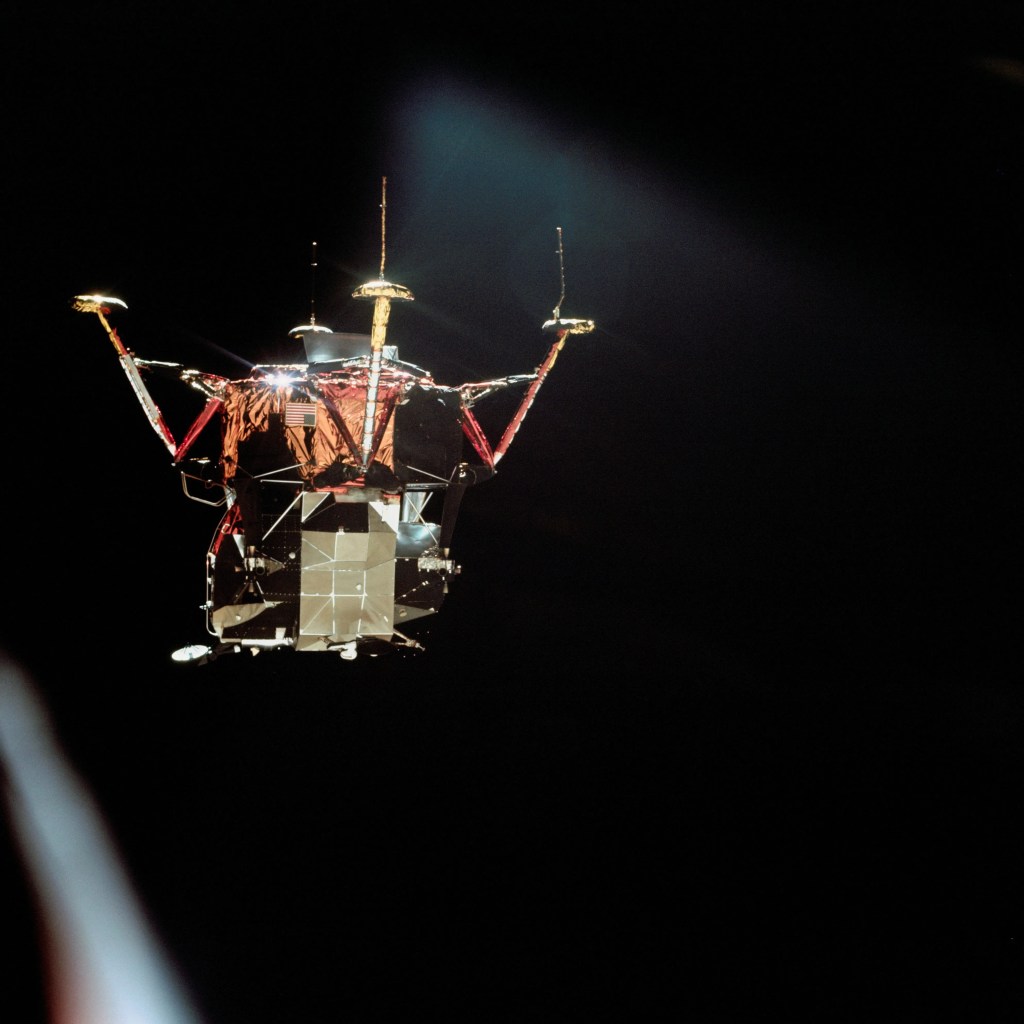
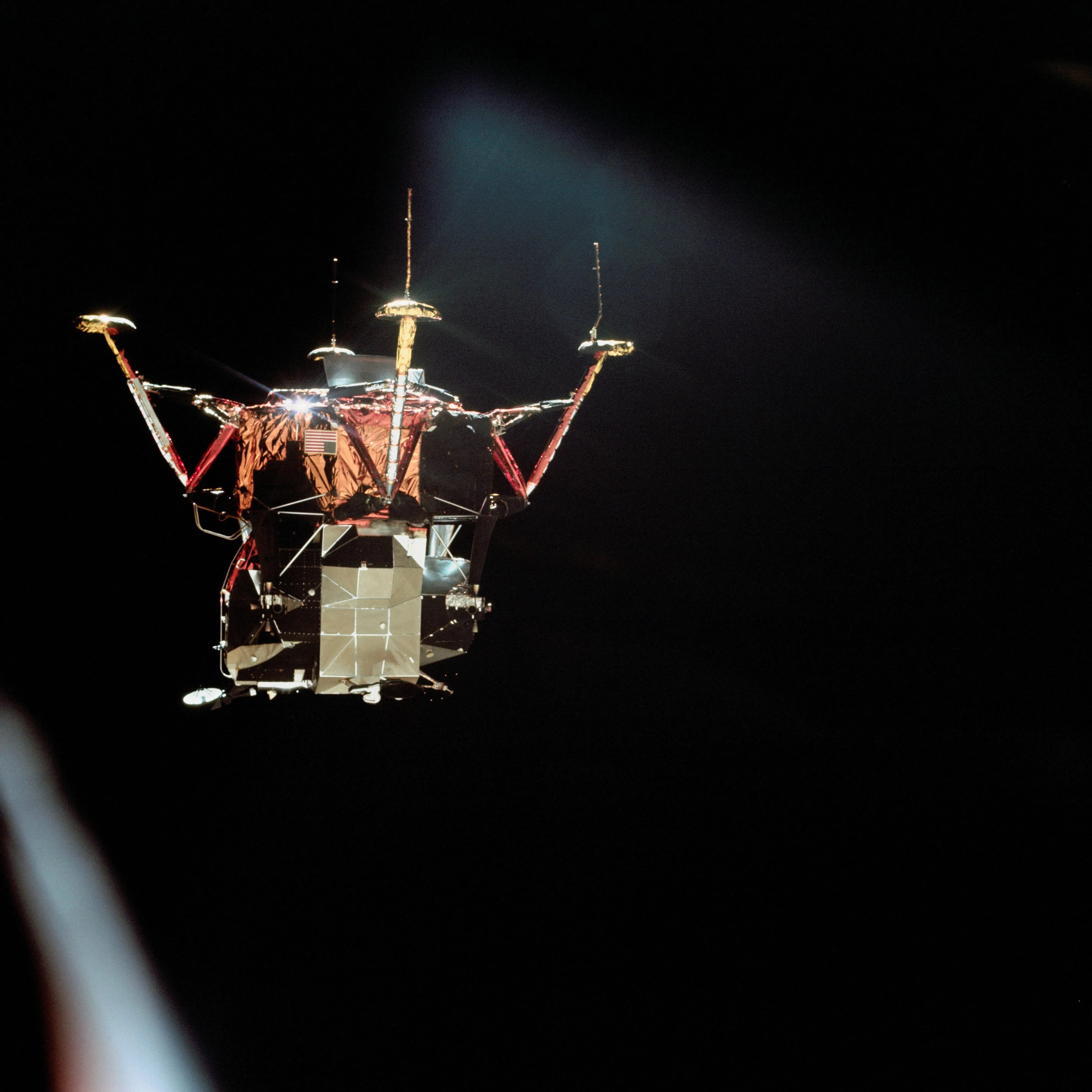
I sometimes hear from the “Moon Landing Hoax” crowd, as evidence that man never landed on the Moon, is the claim NASA and other space agencies have admitted that they don’t know how to do it. They produce a sound bite from some current ISS astronaut or a former NASA engineer stating that “we don’t know how to do it”. Ha! There’s proof they say. But when you examine the reasons why such a person would say that, the argument falls apart.
Half a century ago, on 20 July 1969, Neil Armstrong was in the final stages of the lunar descent, just a few thousand feet above the surface, when suddenly his on-board computer indicated a critical alarm. For three nail-biting seconds it looked as if the mission would have to be aborted. However, Armstrong was given a “go” to continue, and after several more alarms the Eagle touched down safely on the Moon.
This remarkable achievement was the direct result of the robust operation of the Apollo Guidance Computer (AGC) and quick thinking by those who understood it. The AGC was designed for guidance, navigation and control of the spacecraft from Earth to the Moon and back and it worked flawlessly despite 5 times giving critical warning messages of potential failure in the final critical descent stage.
In the follow video using PowerPoint Robert Wills introduces the amazing hardware and software that made up the Apollo Guidance Computer, walks you through the landing procedure step-by-step, and talks about the pioneering design principles that were used to make the landing software robust against any failure. He also explains the problems that occurred during the Apollo 11 landing, and shows you how the AGC played its part in saving the mission.
Another criticism of the “Moon Landing Hoax” crowd is literally that the AGC could not have accomplished such a job because it had so few resources like RAM memory. The AGC had in hardware an erasable memory (RAM) of 2048 bytes of 15-bit words. That is just 2 kilobyte, sounds tiny but was sufficient. The AGC had only 36,000 bytes or words of fixed memory, today what we’d call ROM (Read Only Memory).
For comparison my current Dell laptop computer has 16 GB (gigabyte) of RAM, uses 64-bit words, and has a 477 GB solid state hard drive for stored memory.

Remarkably the fixed memory was constructed with very thin copper wires passed through a copper ring for a 1 or not for a 0. The software was literally woven together to form the fixed memory. For someone who understands how fixed ROM memory is made nowadays or even how a magnetic hard drive is made this is truly mind-boggling.
The guidance program for the entire trip was stored in those 36 kilowords (kilobyte) of fixed memory. That included all stages after a successful launch from Earth to the Moon, undocking from the Command Module, landing on the Moon, relaunching from the Moon, rendezvousing with the Command Module and then the return journey back to Earth, reentry to Earth’s atmosphere and the final landing.
My Dell laptop is not as fast as others are yet it runs at 1.30 GHz, which means 1.3 billion instructions per second. The AGC was very slow and ran at most at 100 thousand instructions per second. Very slow by comparison but it was the best that could be built in that time. It consumed only 55 W of power, which is very important, on Earth weighed only 32 kg, and was very compact with a volume of 1 cubic foot or 0.028 cubic meters, when most computers back then filled entire rooms and consumed kilowatts of power.
The AGC computer was purpose built for the mission, not like a modern day reconfigurable computer. A few hundred of the units were made and tested but very few of them survive today. Very few people today know much about how the AGC operated. Most have passed on but those who knew it back 60 years ago were extremely familiar with it. So it would be correct to say that knowledge of the software and hardware of the AGC has been lost and it would be very difficult to reconstitute it since it was a computer nothing like those used today.

Hardware and software engineers today would have very little knowledge that could be applied to the AGC. The Cisco software engineer Robert Wills who presented in the video spent 10 years studying it. Perhaps he is the most knowledgeable person alive today. This explains why astronauts and engineers who currently work in space programs would say that the knowhow has been lost. It is largely true. Therefore to go back to the Moon would be like “reinventing the wheel”. But this time it needs to be done in new ways and make use of new technology. I suggest that this answers the question quite comprehensively.
So why is the US struggling to land on the Moon again?
Only a few countries have landed on the Moon since the Apollo program. The Indian Space Research Organisation (ISRO) successfully landed its unmanned Chandrayaan-3 mission on the Moon on 23 August 2023, marking India’s first lunar landing and making India the fourth nation to achieve a soft landing on the lunar surface after the United States, the Soviet Union, and China. That was a remarkable achievement which also deployed a rover onto the surface, at their landing site near the South pole.
Russia attempted a landing with its autonomous Luna-25 probe on August 20, 2023. However, the spacecraft crashed into the Moon’s surface after losing control during descent.
In 2019 SpaceIL , a private Israeli company, attempted to land on the Moon but failed, due to engine failure, even though they got very close. The lander crashed landed only in the final stage.
New lunar landers are current under development by US engineering research teams from 5 different commercial companies. Under US government funded grants these companies are working on new lander designs that are intended to travel to the Moon and land autonomously.
The unmanned Odysseus lunar lander, developed by Intuitive Machines, successfully touched down on the Moon on February 22, 2024, becoming the first U.S.-built spacecraft to land on the lunar surface since 1972 and the first privately operated lander to achieve a soft landing.
However, during its final descent, the lander tipped over onto its side, likely due to one of its six landing legs catching on the surface, resulting in a sideways orientation that hindered communication and solar power generation. Despite this, the lander remained operational for approximately one week, transmitting data and images before its power systems were depleted as the lunar night approached.
The following video presentation takes you through the current developments and gives you an idea of the problems faced by the current developers who aim to successfully land on the Moon again.
The United States has set a goal to land astronauts on the Moon by 2028, as established in a recent executive order signed by President Donald Trump. This target follows earlier plans that aimed for a lunar landing as early as 2024, which was deemed unrealistic by many in the industry.
More recently, NASA had been targeting a 2026 launch for Artemis II, the first crewed mission to orbit the Moon, and a mid-2027 date for Artemis III, which would land humans on the lunar surface. However, concerns have been raised about delays in developing the Human Landing System, particularly due to setbacks with SpaceX’s Starship, leading to skepticism about meeting the earlier timelines.
The current administration’s policy emphasizes returning to the Moon to establish a sustainable presence, including plans for initial components of a permanent lunar outpost by 2030.
From the two videos shown here, compare the technology separated by about 60 years and it becomes apparent why NASA could not turn the clock back to the old ways and has had to re-engineer it all over again. To me that answers the question.
Related Reading
- Can We See the Apollo Landing Sites from Earth?
- Understanding Heaven | Biblical and Scientific Perspectives
- The First Moon Landing
- Apollo Moon Landing Hoax and the ‘Face on Mars’
- Apollo Missions and Equipment Left on the Moon
- Israel’s Lunar Lander Crashed on the Moon
The Good News – the Gospel
- Do You Know Him?
- The Salvific Power of Christ
- How Do You Know You Are Saved?
- Can You Do Anything To Be Saved?
Free Subscribers
Subscribe to our Newsletters as a Free Subscriber and be notified by email. Just put your email address in the box at the bottom of your screen.
You’ll get an email each time we publish a new article. It is quick and easy to do and totally free. You only need do it once.
Premium Subscribers
Subscribe to our Newsletters as a Premium Subscribers at $5 USD/month or $30 USD/year (you choose). Cancel anytime.
Paid Premium Subscribers will get exclusive access to certain content I publish. That will only cost you a cup of coffee per month.
Also you’ll be able to download, for free, a PDF of my book Apocalypse Now and also a PDF of my book The Physics of Creation The Creator’s Ultimate Design for Earth.
You can download them from the link below.
This is how you can support my work. I have been publishing this website for 10 years now and up to 2024 I never asked for any support.
Press the button “Premium” on the front page to find a list of Premium content. Thanks so much to all supporters.
At a minimum, please join as a Free Subscriber. It’ll cost you nothing. It may also help me beat the shadow banning of some posts.






Leave a Reply