
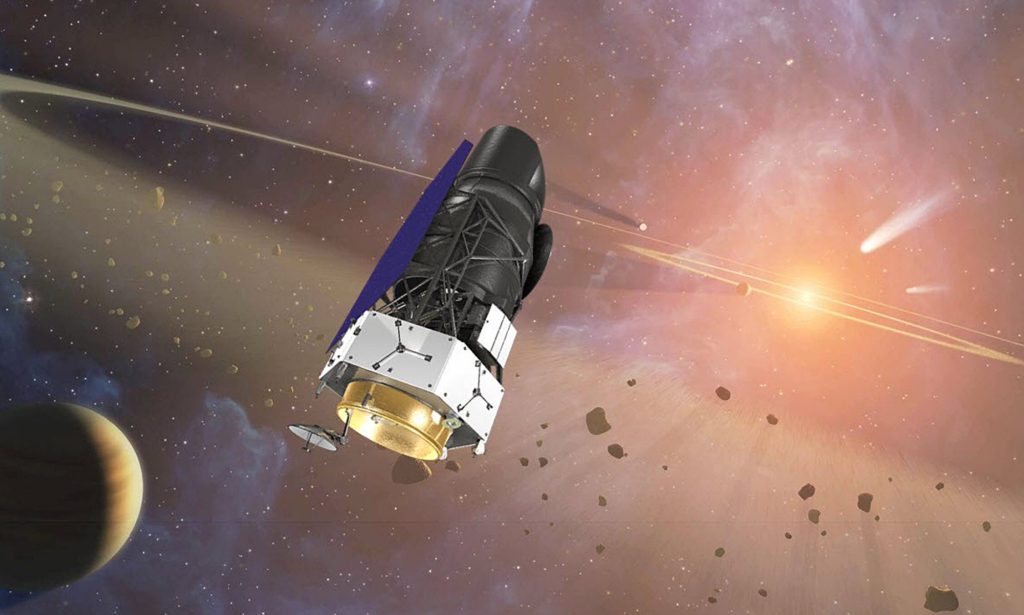
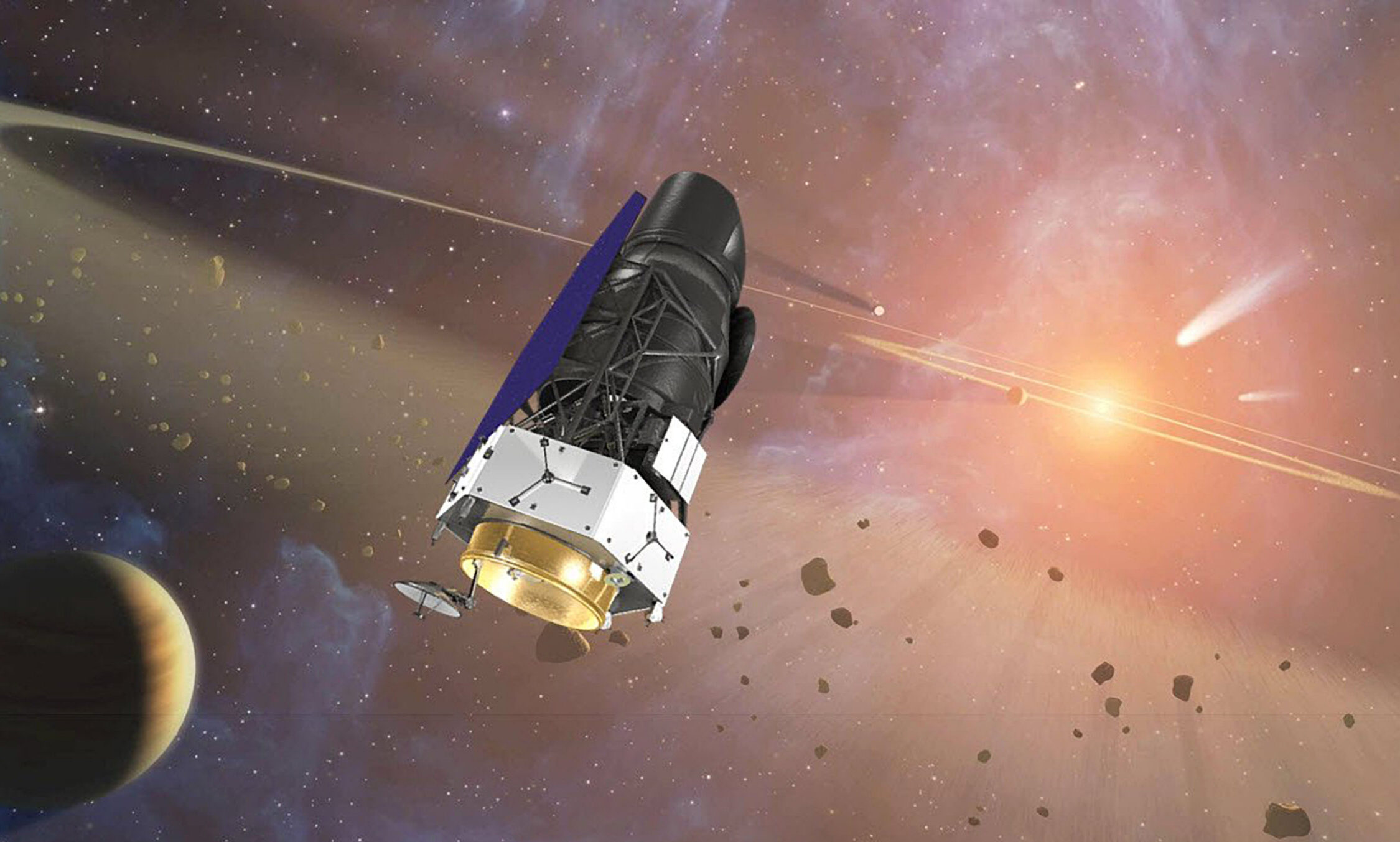
Soon the Nancy Grace Roman Space Telescope will be launched and placed in a stable orbit at the L2 point, a distance of 1.5 million kilometers from Earth. Its stated goal is to investigate the alleged entities known as dark energy and dark matter. I have always called them fudge factors. See Big Bang Fudge Factors.
The proponents of this new telescope believe it may solve one of the biggest mysteries in modern cosmology — the Hubble Tension. That is, the tension or mismatch between calculations of the matter density of the universe and the Hubble parameter when one uses the Cosmic Microwave Background (CMB) data and the high redshift type Ia supernovae (SNe Ia) measurements.
The Hubble parameter is usually called Hubble’s constant, which it is not. Two different methods of calculating it do not agree on its value. The Hubble constant allegedly defines the rate of expansion of the universe. I say allegedly because there are many unprovable assumptions that are required to get its value and the biggest is the assumption of the standard big bang ΛCDM cosmology and that that means the universe is expanding.
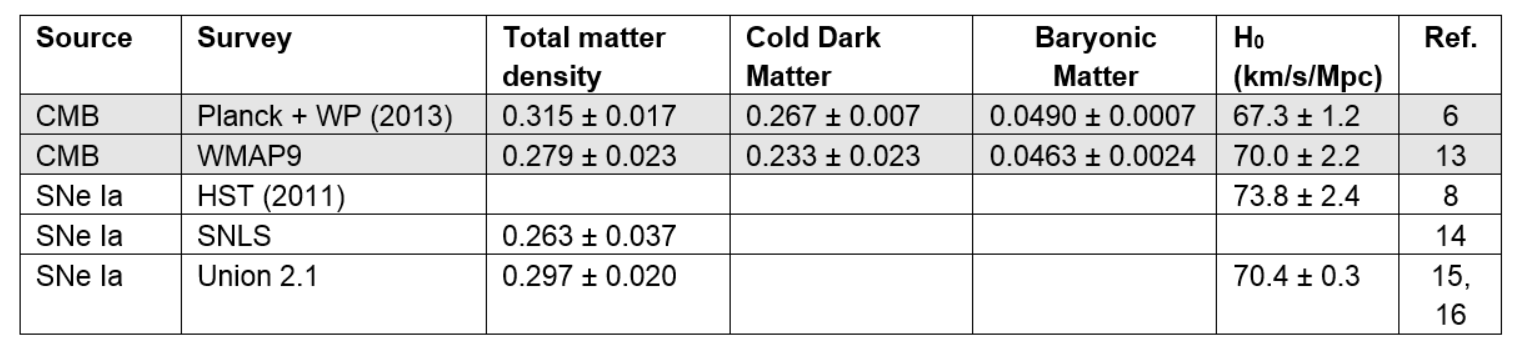
We also see a total disagreement between the determination of the total matter density (the sum of dark matter and normal atomic matter) when using data from high redshift supernova measurements (SNe Ia) and Planck CMB measurements, which were allegedly more precise than the former WMAP data. Even the claimed errors do not help the values to coincide. See Table I and Fig. 1 in A Missing Neutrino–Dark Radiation. I have reproduced the Table I below.
Table 1: Matter density and Hubble’s constant from different surveys
Those results were published more than 12 years ago. And the tension still has not been resolved.
In an Aerospace America piece dated July 1, 2026, the author suggests that NASA’s Roman telescope could help solve this cosmic mystery. But I don’t agree.
The first problem is that according to experimental cosmologist says Charles Bennett, at Johns Hopkins University and its Applied Physics Laboratory,
“The discrepancy is not marginal.”
Using high redshift type Ia supernovae measurements the current value of the Hubble constant is calculated to be H0 = 73 ± 1 km/s/Mpc, but when its value is extrapolated from CMB measurements cosmologists get a number for H0 = 68 ± 1 km/s/Mpc. The claimed errors in the so-called age of precision cosmology are too small to allow the two values to overlap. Hence the continued tension.
Charles Bennett said:
“It’s been over 10 years now since we’ve known there was a conflict, and it gets more and more significant every year.”
The Hubble Tension is unresolved and so the cosmology community is panicking.
What is the solution?
According to Julie McEnery, Roman’s senior project scientist at NASA’s Goddard Space Flight Center, either there’s some subtle, as-yet-undiscovered flaw in the different methods used to measure the expansion rate, or “our standard model of the universe is incorrect” and there’s new physics to discover.
The latter is what I have been writing for more than a decade. The standard big bang expanding universe cosmology is wrong. And when there is violent disagreement between the calculations of important parameters such as the Hubble “expansion” rate and even the matter density of the universe from different methods the model should be tossed out and new physics sought.
Either solution to the Hubble Tension will move science forward, says Roman Program Scientist Dominic Benford, who oversees the science mission from NASA Headquarters. Discovering the measurement methodologies are subtly flawed would lead to more accurate astronomy, and “if it turns out that there is something fundamentally wrong in our understanding of the universe, we really ought to find out what that is,” Benford says, “because its ramifications could be enormous” — and not just for astrophysicists.
But it’s not guaranteed Roman will solve the Hubble Tension. If its observations also generate the same conflicting measurements with greater precision, “the mystery could get deeper,” Bennett notes.
Still, McEnery remains optimistic. “I think there’s a very good chance that Roman is going to confirm that our standard cosmological model doesn’t work,” she says, “and put us on a path to understanding how the universe is actually working.”
AerospaceAmerica [my emphases added]
Here Julie McEnery is correct.
But she said to solve this puzzle requires “a mission or an experiment that can probe the universe to about a factor of 10 better than we did before.” Her hope is in the new Nancy Grace Roman Space Telescope.
I predict its operation will not solve the problem but in fact it will more than likely show how fundamentally wrong the standard big bang cosmology is.
I think a new space telescope with a wider and deeper view is an excellent addition to our tool kit for studying the universe. But by using it cosmologists will only dig a deeper hole for their “expanding universe” paradigm.
The standard model is fundamentally flawed and recent observations with the James Webb Space Telescope have continued to confirm that fact. See James Webb Space Telescope | Little Red Dot Galaxies are a Big Big Bang Problem.
Free Subscribers
Subscribe to our Newsletters as a Free Subscriber and be notified by email. Just put your email address in the box at the bottom of your screen.
You’ll get an email each time we publish a new
Premium Subscribers
Subscribe to our Newsletters as a Premium Subscribers at $5 USD/month or $30 USD/year (you choose). Cancel anytime.
Paid Premium Subscribers will get exclusive access to certain content I publish. That will only cost you a cup of coffee per month.
Also you’ll be able to download, for free, a PDF of my book Apocalypse Now and also a PDF of my book The Physics of Creation The Creator’s Ultimate Design for Earth.
You can download them from the link below.
This is how you can support my work. I have been publishing this website for 10 years now and up to 2024 I never asked for any support.
Press the button “Premium” on the front page to find a list of Premium content. Thanks so much to all supporters.
At a minimum, please join as a Free Subscriber. It’ll cost you nothing. It may also help me beat the shadow banning of some posts.




 Bible Science Forum
Leave a comment