
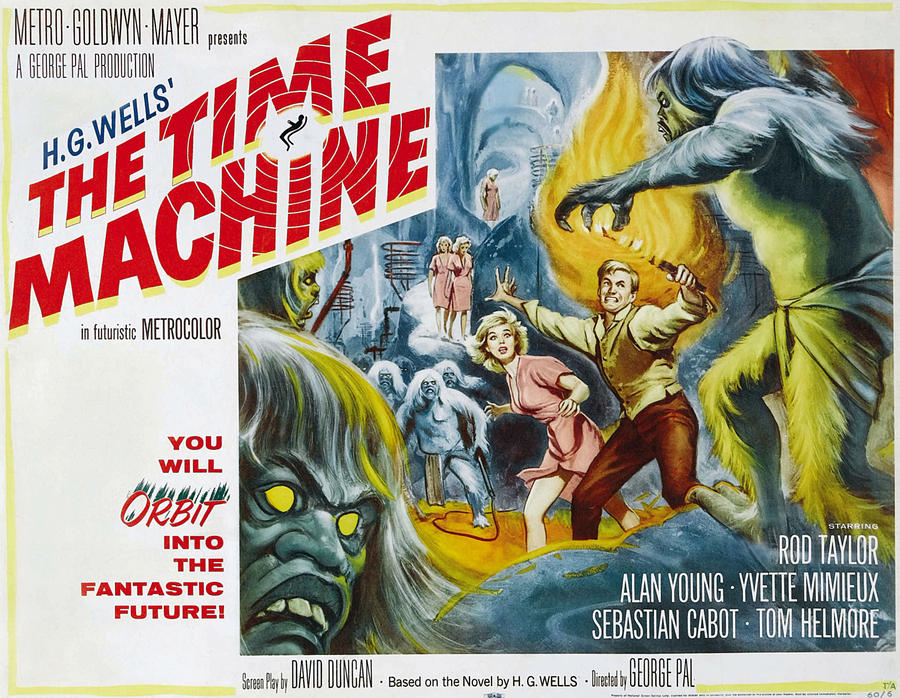
Many sci fi movies have plots that involve time travel. Some involve a machine that transports people forward or backward in time to another epoch. H.G. Wells wrote his famous story ‘The Time Machine’ where the main character travelled forward in time to the distant future. The 1960 movie adaption was even filmed in futuristic Metrocolor (ha!).
Going backward in time to a period before you were born creates a temporal paradox. If you prevented your own birth then you never existed and hence the paradox. But is anything like this even wildly theoretically possible?
The way time is treated in many of these stories is as if we live on only one timeline of a multiverse. In the multiverse there are a plethora of timelines past, present and future. Even the present can be different depending which timeline you are on. The Back to the Future movies are good examples of this.

From that viewpoint the present is not unique. The implication is that if one could crack some theoretical physics problem (they often show lots of mathematical equations in the movies) one could jump to a different time.
Up until a few hundred years ago there was no concept like illustrated in these time-travel movies. Only the present ‘now’ was understood to be real and the physics of the day treated time as a universal concept. What that means is that time at the observer was the same everywhere else in the universe. It was always a universal ‘now’.
But after Einstein and relativity theory was introduced that view changed. The past and even the future were treated on the same basis as the present, and time is an illusion. That viewpoint treats time as a spatial dimension that could be manipulated, if only one was smart enough.
Relevant to this discussion are two philosophies on time.
Philosophies on Time: Presentism and Eternalism
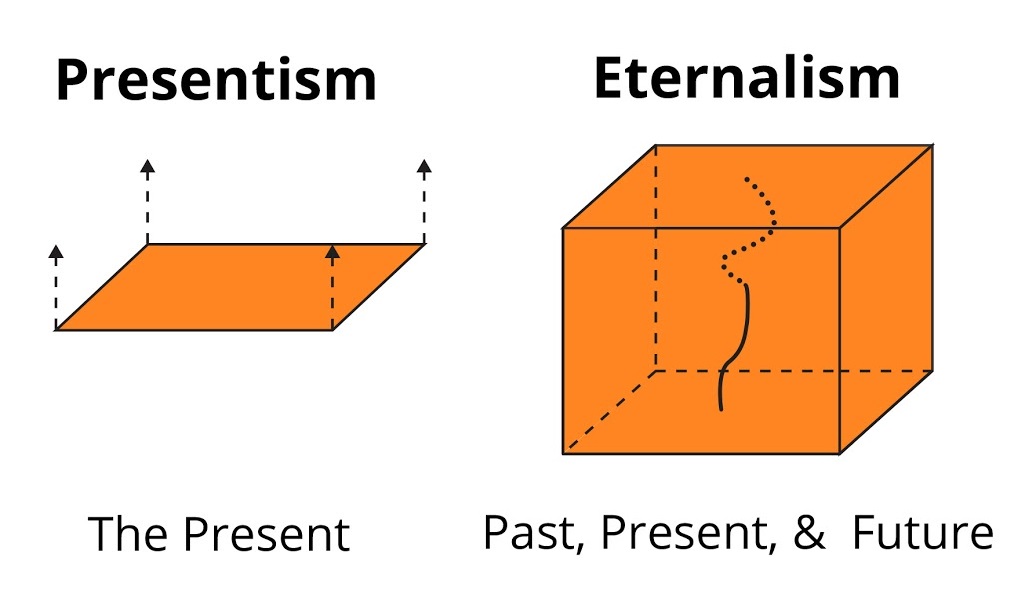
In an article I wrote in 2018 New Cosmologies Converge on the ASC model I discussed these two philosophical positions — Presentism and Eternalism.
Under Presentism time is real and the present we experience is universal. This view rejects the idealist viewpoint of relativity theory and the flow of time as reality. It accepts the existence of a single cosmological ‘now’.
Under Eternalism time is an illusion and the past, present and future all exist together. The philosophy is quite recent and has almost been universally adopted in all these time travel stories. It recognises the idealist viewpoint of relativity theory and the reality of the flow of time.
In that 2018 article I discuss views by one author P. W. Dennis who
… concludes with the biblically uncontroversial view that time is real and that only the present ‘now’ is real. This view is termed ‘presentism’.
And he writes
… that there is an actual real moment called ‘now,’ a present moment that continually passes. The past is forever gone, the future will be.
On the philosophy of Eternalism he wrote
… that past, present and future events are eternally existing in a universe in which time has been ‘spatialized.’ It is a universe in which there is no ‘now’ – no unique ‘present’. It is sometimes called a ‘block-house’ universe in which nothing really happens.
Einstein was an advocate of Eternalism. Einstein’s relativity theory is based on treating time like a spatial dimension. And Dennis quotes Einstein:
For us believing physicists, the distinction between past, present and future is only a stubbornly persistent illusion.
The four-dimensional continuum is now no longer resolvable objectively into sections, which contain all simultaneous events; ‘now’ loses for the spatially extended world its objective meaning. It is because of this that space and time must be regarded as a four-dimensional continuum that is objectively unresolvable.
A. Einstein
Yet, as Dennis correctly points out, this does not mean that the present is not real, i.e. that such a concept does not exist in spacetime. What it means is that it cannot be operationally empirically determined.
In short, an unknown and operationally indeterminable ‘now’ does not imply the nonexistence of ‘now’ .
The Language of the Bible
And this is related to another question which I discussed in this article: Can We See Into the Past? If the past does not exist then it is self evident, that we can’t see into the past.
The question brings up the issue of the speed of light and how can we measure the speed of light coming from the cosmos. See also my video presentation Video: Can We See Into the Past?
What does the word of God have to say on the flow of time? For starters …
9 Remember the former things of old: for I am God, and there is none else; I am God, and there is none like me, 10 Declaring the end from the beginning, and from ancient times the things that are not yet done, saying, My counsel shall stand, and I will do all my pleasure.
Isaiah 46:9-10
The Creator is not the creation. He exists eternally outside of space and time. His Name is I AM, which means He is eternally existent — never created and never ending.
God sees the end from the beginning of time because He created everything and He exists in the spiritual realm outside of time and space.
Man’s developments in physics cannot describe this. No concepts of higher dimensions will ever describe the spiritual world. It does not matter how much reason and logic you apply. The spiritual heavens are not even in the same category as the physical heavens.
God created the physical heavens and populated them with planets, stars and galaxies and everything they contain. This what we call the cosmos (from the Greek word kosmos). On the fourth day of creation:
14 God said, Let luminaries be in the expanse of the heavens, to divide between the day and between the night. And let them be for signs and for seasons, and for days and years. 15 And let them be for luminaries in the expanse of the heavens, to give light on the earth. And it was so. 16 And God made the two great luminaries: the great luminary to rule the day, and the small luminary and the stars to rule the night. 17 And God set them in the expanse of the heavens, to give light on the earth, 18 and to rule over the day and over the night; and to divide between the light and between the darkness. And God saw that it was good.
Genesis 1:14-18
There is no suggestion other than the present ‘now’. By God saying that He ‘saw that is was good’ means that there is no delay between creation of the stars and their light reaching the Earth the same day, which was 24-hours long.
13 My hand also has laid the foundation of the earth, and my right hand has spanned the heavens: when I call to them, they stand up together.
Isaiah 48:13
The word ‘heavens’ here is translated from the Hebrew shamayim. It means the sky but perhaps alluding to the visible arch in which the clouds move, as well as to the higher ether (space) where the celestial bodies revolve.
The tense is the present ‘now’. In every sense the biblical texts refer to the present. No concept is offered in regards to Eternalism within the physical creation.
The biblical texts speak in the universal ‘now’.
7 But the heavens and the earth, which are now, by the same word are kept in store, reserved to fire against the day of judgment and perdition of ungodly men.
2 Peter 3:4
This prophecy from the Apostle Peter speaks of a future coming event, the day of judgment, but describes the reality of the present as existing now.
10 And I heard a loud voice saying in heaven, Now is come salvation, and strength, and the kingdom of our God, and the power of His Christ: for the accuser of our brothers is cast down, which accused them before our God day and night.
Revelation 12:10
Even though this is a prophecy about future events the Apostle John records it as happening now.
13 And I heard a voice from heaven saying to me, Write, Blessed are the dead which die in the Lord from now on: Yes, said the Spirit, that they may rest from their labors; and their works do follow them.
Revelation 14:13
All reference is to the present actions.
8 Again, a new commandment I write to you, which thing is true in Him and in you: because the darkness is past, and the true light now shines.
1 John 2:8
Here we see a past darkness reference but the light of God is referred to in the present tense. Another like this is:
9 But you are a chosen generation, a royal priesthood, an holy nation, a peculiar people; that you should show forth the praises of Him who has called you out of darkness into His marvelous light; 10 Which in time past were not a people, but are now the people of God: which had not obtained mercy, but now have obtained mercy.
1 Peter 2:9-10
When being examined by Pontius Pilot,
36 Jesus answered, My kingdom is not of this world [kosmos]: if My kingdom were of this world [kosmos], then would My servants fight, that I should not be delivered to the Jews: but now [nun] is My kingdom not from hence.
John 18:36
In this text the Greek word kosmos translated world has the meaning of orderly arrangement, i.e. decoration and (by implication) the world including its inhabitants. The Greek word nun translated now, is an adverb of date, a transition or emphasis; also as noun or adjective present or immediate. It is a primary particle of present time.
Jesus is saying His kingdom, in the hearts of men who trust in Him, exists now. That existence is immediate. It is not a future pie-in-the-sky promise. It is present always in everyone throughout history who put their trust in Him.
Is Time Travel Possible?
It is not in any sense like the movies portray because there is only the present existence. The past is a memory that no longer exists and the future is only imagined in the human mind. We are not God and will never have god-like powers to see the future.
Relativity theory has been very successful and as such is a good theory. I am a strong advocate of its utility. But the theory is a mathematical construct to describe an experimental outcome, which it does very well in the lab.
However it fails to describe the imagined big bang history of the universe. See Cosmology’s Fatal Weakness—Underdetermination.
It also fails philosophically because the measurements of intervals of time require an assumption on clock synchronisation that must chosen by convention. A convention means it is not experimentally testable. Therefore all determinations of alleged past events must include the assumed convention. It is not empirical science.
The nature of time therefore is beyond human knowledge, logic and reason. The present is all there is. Only God can see beyond the present.
Related Content
- Einstein’s Physics Says There is No Biblical Creationist Starlight Travel-Time Problem
- Questions on the Conventionality Thesis and the One-Way Speed of Light
- Stephen Hawking and Imaginary Time
Recommended Reading
- Book: Apocalypse Now: On the Revelation of Jesus Christ
- Book: Merchants of Death: Global Oligarchs and Their War On Humanity
Follow me
- Telegram.org: @GideonHartnett
- Facebook: Gideon Hartnett
- X (Twitter): @gideon195203
To be notified by email put your email address in the box at the bottom of your screen. You’ll get an email each time we publish a new article.

Click this image to make a secure Donation (Stripe) !




 Bible Science Forum