
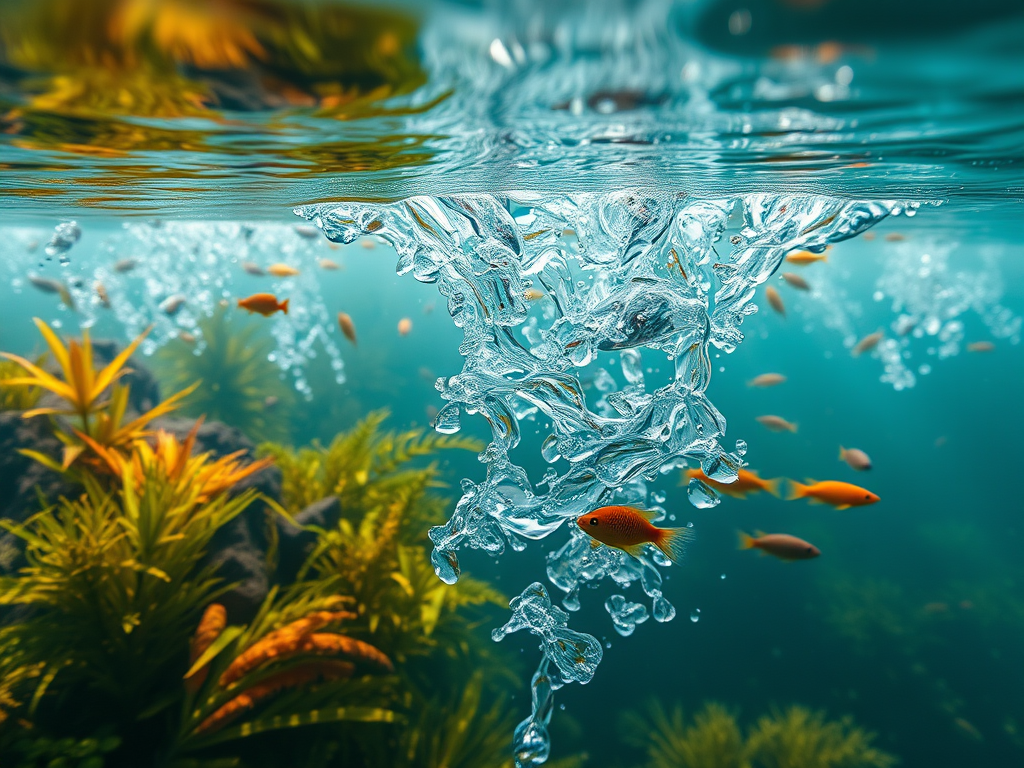
Water is liquid at room temperature. That is at about 25°C (or 77°F) and 1 atmosphere of pressure it is found in the liquid state. This is the miracle of liquid water, which supports life on this planet.
Don’t be fooled into believing that it was all by accident that because liquid water is found on Earth life just had to have spontaneously arose by chance in a warm pond and then evolved from the resulting pond scum 3.8 billion years ago. No, that is the wrong logic. The Creator providentially provided Earth with plenty of liquid water (Genesis 1:2) because He created it to support life. The properties of water are unique in this regard.
Liquid water is the basis of what astronomers call the habitable zone around any central star.
The definition of “habitable zone” is the distance from a star at which liquid water could exist on orbiting planets’ surfaces. Habitable zones are also known as Goldilocks’ zones, where conditions might be just right – neither too hot nor too cold – for life.
If the Earth was farther out of the habitable zone from the sun the planet would be too cold to support life. Farther in, closer to the sun, the planet would be too hot to support life. Hence the label Goldilocks’ zone.
This is because within this zone water is found to exist in all three states, solid (ice), liquid (water) and gas (steam, vapour). All three states or phases of water are essential to life.
The physics of water molecules was providentially provided by the Creator to support life on Earth.
Water is a transparent, tasteless, odourless, and nearly colourless inorganic compound with the chemical formula H2O, meaning an oxygen (O) atom covalently bound to two hydrogen (H) atoms.
It is the main constituent of Earth’s hydrosphere and of the fluids in all known living organisms. It is essential to all life.
Earth’s temperature and pressure means water exists on Earth in all three phases as solid, liquid, and gas. It forms precipitation in the form of rain and aerosols in the form of fog. Clouds consist of suspended water droplets and ice, its solid state. Finely divided, crystalline ice may precipitate in the form of snow. The gaseous state of water is steam or water vapour.
Water covers about 70% of the Earth’s surface, with seas and oceans making up most of the water volume (about 96.5%). Small portions of water occur as groundwater (1.7%), in glaciers and the ice caps of Antarctica and Greenland (1.7%), in the air as vapour, clouds (consisting of ice and liquid water suspended in air), and precipitation (0.001%).
The water cycle continually runs water through evaporation, condensation, precipitation, and runoff processes, eventually reaching the sea.
It has been estimated by some that the crustal rocks contain 5–10 times the amount of water that we find in the oceans.
One discovery produced evidence of a large body of water found deep in Earth’s mantle with at least the volume of the Arctic Ocean. The water is locked in moisture-containing rocks 700 km to 1,400 km beneath the surface—a subterranean ‘ocean’.
Now due to the physics of the atomic bonds between the hydrogen (H) and the oxygen (O) atoms the geometry of the water molecule is nearly tetrahedral.
The occupation of the quantum mechanical orbitals, the regions of space where pairs of electrons spend most of their time, essentially determines the bond angles. Below a methane molecule (CH4) is illustrated, which has a central carbon atom and 4 hydrogen atoms bound equidistant in 3D space.
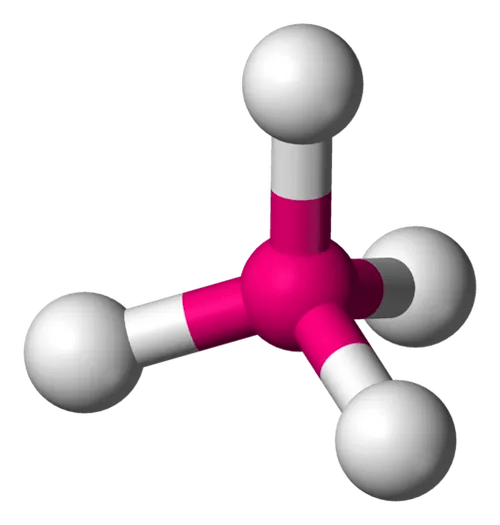
The tetrahedral bond angle is approximately 109.5°. This angle is characteristic of molecules with a tetrahedral molecular geometry, where four atoms or groups are arranged around a central atom in a three-dimensional shape resembling a tetrahedron. By joining the H atoms you would get a tetrahedron.
In a tetrahedral molecule, the bond angle is determined by the repulsion between the electron pairs (both bonding and non-bonding) surrounding the central atom. When all four pairs of outer electrons repel each other equally, the bond angle is 109.5°. This angle is observed in molecules like methane (CH4), where all four hydrogen atoms are arranged tetrahedrally around the central carbon atom.
In the case of the water molecule the 4 tetrahedral p-orbitals also exist around the oxygen atom, but two of them have no electrons in them. They are empty orbitals.
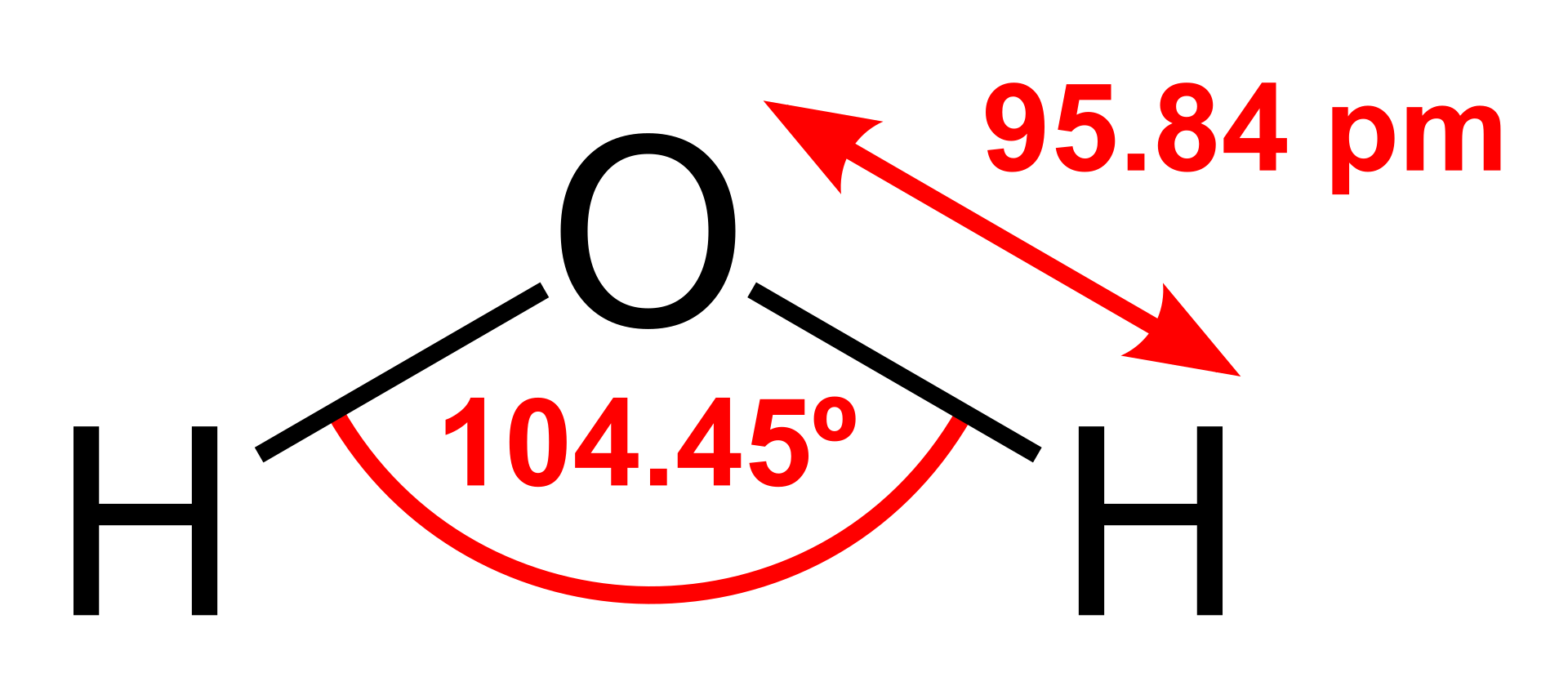
As a result the bond angle is slightly reduced to 104.45°. Because of this fact and the imbalance of the electron cloud spatially more on one side of the oxygen atom than on the other, the water molecule has some special properties.
The O atom becomes slightly more negative than the H atoms because of a lone pair of s-orbital electrons, which are repelled by the p-orbital electrons connected to the H atoms.
The whole structure is way more complex and interesting than that but in essence this is the picture.
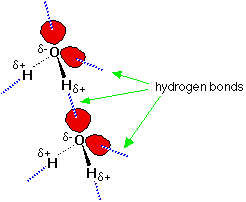
The result is a weak attractive dipole-dipole force called hydrogen bonding. It is responsible for the surface tension of liquid water.
Surface tension supports water droplets and bubbles but also capillary action, which means trees can draw up water to great heights and where they respire and photosynthesize oxygen and food.
Most importantly water expands as it cools below 4°C. Thus ice is less dense than liquid water, resulting in ice floating on the surface of the liquid.
Ice floating on the liquid permits fish to live in water, even under frozen ice caps. Liquid water also has solubility to oxygen permitting fish to breath in it. This is all by design of the Creator.
The size of the planet is also very important. It must be very close to Earth’s mass. Double the mass of the planet and you double the acceleration due to gravity and the concomitant air pressure.
The boiling point of a liquid depends on its vapour pressure. If you increase the air pressure it increases the boiling point and visa-versa. At zero pressure all water would boil off.
Imagine a planet of low air pressure, Mars for example, which is smaller than Earth. Low pressure and practically no water. A dry desert. See below for a comparison between Mars and Earth, the latter being the only planet in the universe where life is known to exist.
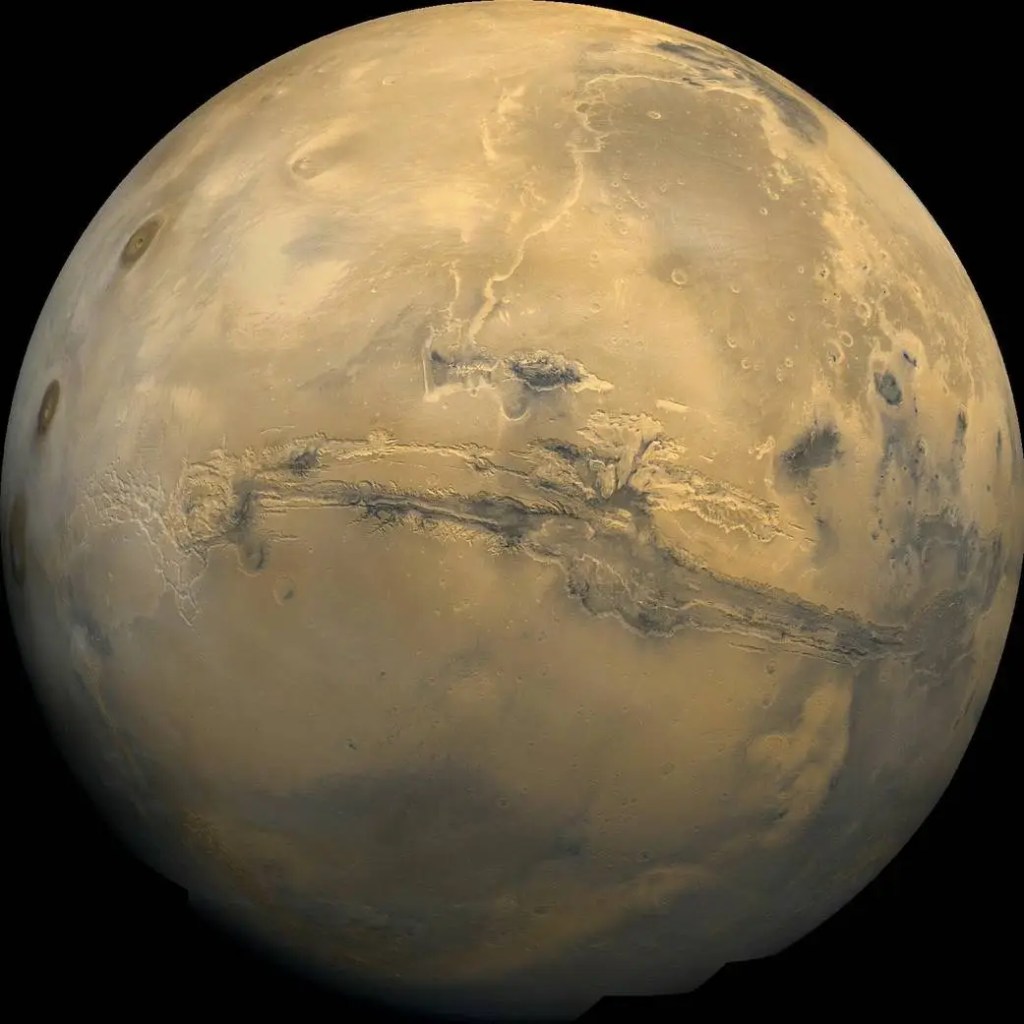
Valles Marineris on Mars with no water. NASA 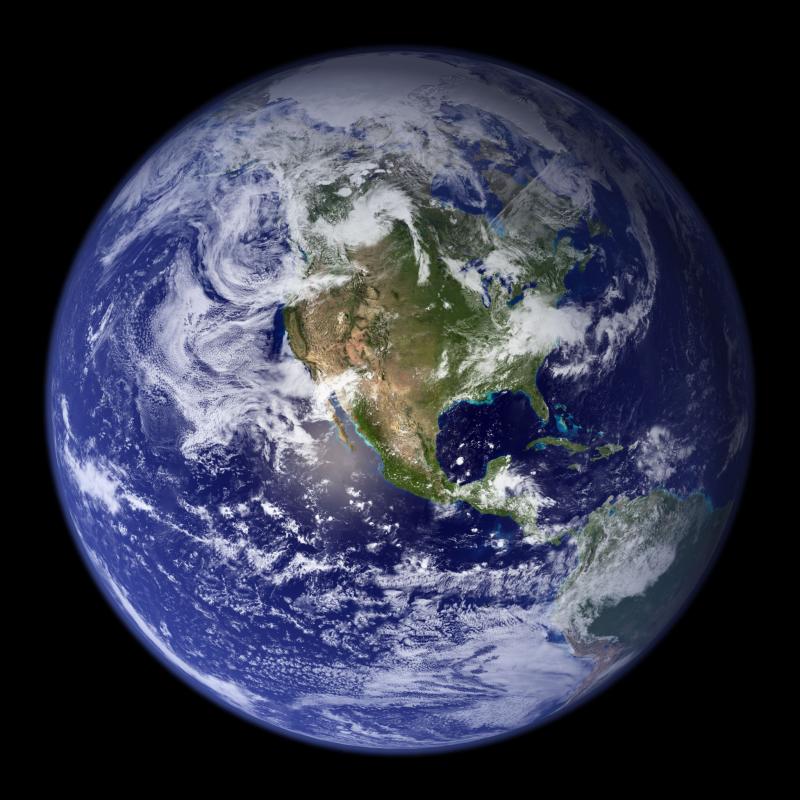
Earth covered with water. NASA
On Mars you can see Valles Marineris, a massive canyon system, stretching over 4,000 kilometers (2,500 miles) long, up to 200 kilometers (120 miles) wide, and reaching depths of up to 7 kilometers (23,000 feet). It is the largest canyon in the Solar System and is often referred to as the ‘Grand Canyon of Mars’.
Yet the irony is that some unbelievers in biblical history say that in the past Mars was inundated with a global flood as evidenced by its surface features, yet they deny that a global flood could have ever occurred on Earth, which is covered in water.
Secular scientists admit that they do not really know how this massive canyon, some 60 times greater than Grand Canyon, could have formed.
Nevertheless, Mars has very little atmosphere and very little water (though not zero), which means there no life on Mars, even though Mars probes and rovers have been looking for it in vain. No water, no life!
The miracle of water is life. It was from the original created water that the Creator first created life, the sea creatures and birds, and probably Pteranodons and other flying Dinosauria (Genesis 1:20).
However God also used the global flood waters in Noah’s day to judge mankind and destroy all air breathing land creatures, including humans, except Noah and his family on the Ark.
That was judgment due to mankind’s rebellion against his Creator. But all was not lost because God the Father supplied His own Son to take man’s sin on the cross and provide for us the water of eternal life. This was symbolised by blood and water out of His pierced body on the cross (John 19:34).
When Jesus was speaking to woman at a well about her life He said:
14 But whoever drinks of the water that I shall give him shall never thirst; but the water that I shall give him shall be in him a well of water springing up into everlasting life.
John 4:14 AKJV
Christ used the water as a metaphor for the Spirit of God which when drunk into our souls generates a fountain of eternal life. This closes the loop on the action of the Holy Spirit hovering over the waters of the deep at creation.
2b. And the Spirit of God moved on the face of the waters.
Genesis 1:2b AKJV
Jesus Christ, Creator, was at the beginning and is at the ending.
6 And he said to me, It is done. I am Alpha and Omega, the beginning and the end. I will give to him that is thirsty of the fountain of the water of life freely.
Revelation 21:6 AKJV
1 And he showed me a pure river of water of life, clear as crystal, proceeding out of the throne of God and of the Lamb.
Revelation 22:1 AKJV
The fountain of the water of life flows out of the throne of God.
Come, all you who are thirsty, come to the waters; and you who have no money, come, buy and eat! Come, buy wine and milk without money and without cost.
Isaiah 55:1 NIV
The Creator providentially provided water on the planet we call our home to support all life. So much so that water is well accepted as a metaphor for the force that gives life in the body. It was no accident!
Water also symbolises the true life of the soul which lives in eternity with the Creator.
Related Content
- He Lays Up the Depth in Storehouses
- Was the Earth Created From Ice?
- The ‘Waters Above’
- Earth Created From Water
Follow me
- Telegram.org: @GideonHartnett
- X (Twitter): @gideon195203

To be notified by email put your email address in the box at the bottom of your screen. You’ll get an email each time we publish a new article.
Subscribe to my Newsletter as a Premium member ($5 USD/month or $30 USD/year) and get a free PDF of my book Apocalypse Now, which you can download from a Premium members only post here.
Paid Premium members will also get early and exclusive access to certain content I publish.





 Bible Science Forum