

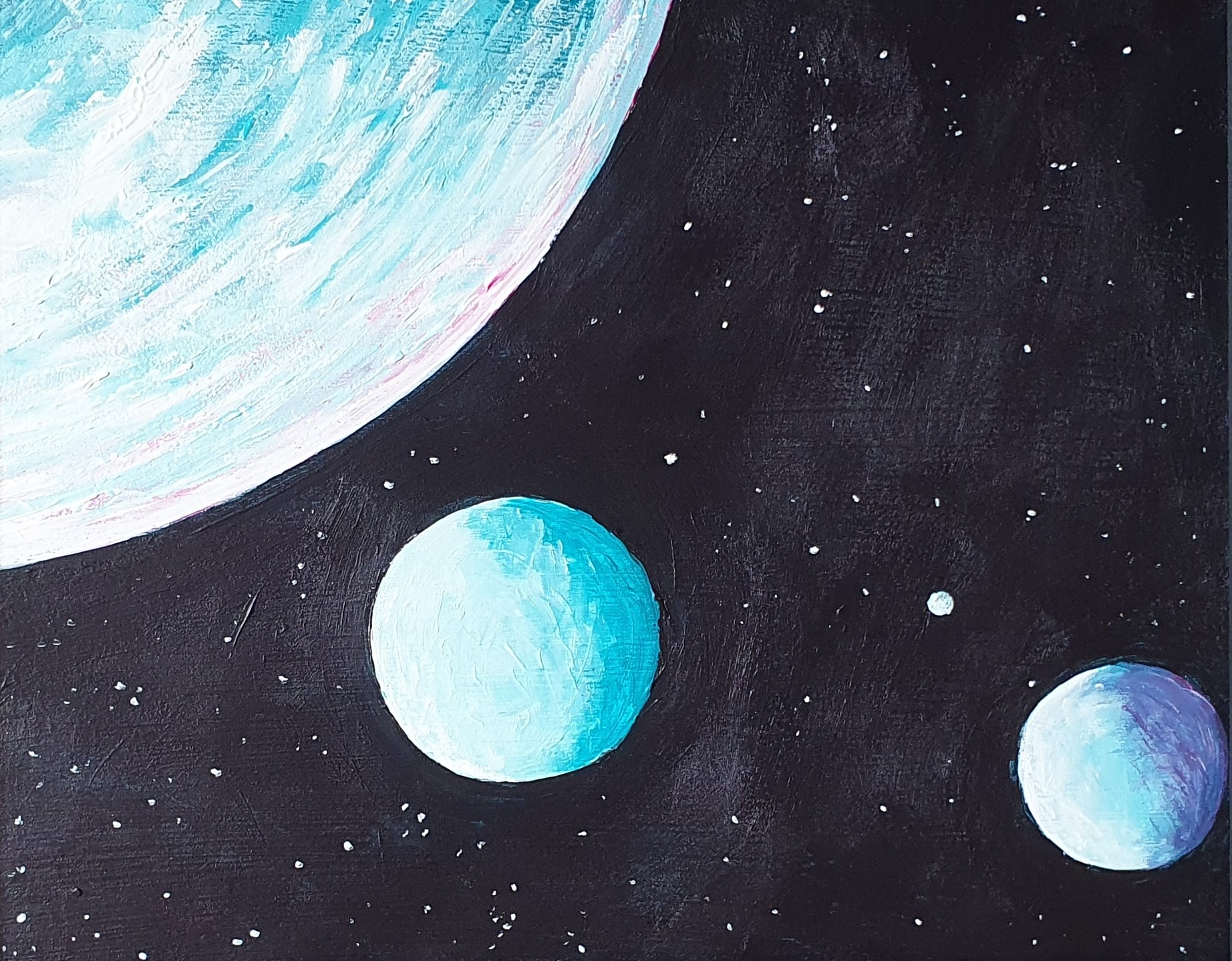
Hydrocarbons are ubiquitous in the solar system. They are non-fossiliferous and therefore not the result of billions of years of death and burial of living organisms as is alleged on Earth.
In any case, the fossiliferous origin theory for hydrocarbons on Earth is false. Those hydrocarbons are in fact primordial. Petroleum and natural gas are cooked up through chemical reactions with Calcium Carbonates, Iron Oxides and Water deep below the crust where the temperature and pressure are sufficiently high enough to achieve the reduction reaction necessary. See Abiogenic Deep Origin of Hydrocarbons: Not Fossils But Primordial.
Another problem with the fossiliferous origin theory is the existence of hydrocarbons found everywhere in the atmospheres of the outer planets, frozen in the surface and subsurface layers of planets, moons, comets, asteroids, meteoroids, and in interstellar dust.
“Of special interest is the presence on [Saturn’s moon] Hyperion of hydrocarbons — combinations of carbon and hydrogen atoms that are found in comets, meteorites, and the dust in our galaxy,” said Dale Cruikshank, a planetary scientist at NASA’s Ames Research Center.
Why special interest? Because where there are hydrocarbons there might be life. So they imagine. Hydrocarbons are ‘organic’ molecules and thus associated with life.
However if Carbon based molecules are primordial in the universe there is no need to associate them with life. The existence of Carbon does not guarantee a biological origin. For example, the mineral Graphite is pure Carbon but not derived from a past biological source.
Bacteria are often involved in the reactions that generate hydrocarbons so these molecules might be a tracer for extraterrestrial life. That is the unproven assumption, anyway.
Molecular hydrogen occurs in a plume on Saturn’s moon Enceladus. It can drive the reduction of CO2 to release energy. Methane has been observed in many places: from the dusty plains of Mars, to the great lakes of the Saturnian moon Titan, to the glacial wonderland that is Pluto. Organic molecules are common where volatile elements and reducing conditions prevail: these organic molecules can have diverse origins. Future space missions will attempt to illuminate the “organic solar system” and the role played by possible extraterrestrial life.
Glein, Christopher & Zolotov, Mikhail. (2020). Hydrogen, Hydrocarbons, and Habitability Across the Solar System. Elements. 16. 47-52. 10.2138/gselements.16.1.47.
Another of Saturn’s moons, Enceladus, has several unique features that are claimed make it a prime target in the search for extraterrestrial life.
Enceladus has a global subsurface ocean 6-10 kilometers deep located beneath an ice shell 30-40 kilometers thick. Cassini gravity measurements confirmed the existence of this vast ocean in 2014.
There is strong evidence that Enceladus’ seafloor features active hydrothermal vents, which could provide energy and nutrients to fuel microbial life.
Cassini detected organic compounds like methane, propane, acetylene and formaldehyde in the plumes erupting from Enceladus’ south pole. Organic compounds are chemical building blocks of life.
In 2022, scientists found evidence of phosphorus in Enceladus’ ocean, an essential ingredient for life on Earth. This was the first detection of phosphorus on an extraterrestrial ocean world.
Hydrocarbons were also detected in plumes that erupt from the moon’s south polar region. They blast water vapor, ice particles, salts, and organic molecules from Enceladus’ subsurface ocean out into space.
Basic hydrocarbons are ubiquitous in the atmospheres of Jupiter and Saturn. The parent molecule, methane (CH4), undergoes photochemical reactions which convert it to chain molecules such as acetylene (C2H2), ethylene (C2H4), and ethane (C2H6). The atmosphere of Saturn’s largest moon, Titan, contains higher mass hydrocarbon ions such as C3H3+, C3H5+, and C5H5+. Hydrocarbons containing as many as seven carbon atoms were observed in Titan’s atmosphere by the planetary probe Cassini, which also observed nitriles, nitrogen-containing hydrocarbons. Because of Titan’s extremely cold temperatures, these hydrocarbons condense and rain down upon the surface. What appear to be hydrocarbon lakes exist on Titan’s surface.
Saturn’s moon Titan is the only world in our solar system other than Earth that has stable liquid on its surface. The alleged ocean on Enceladus is subsurface. Jupiter’s moon Europa is also believed to have an ocean buried beneath a thick crust of ice estimated to be 15-25 kilometers deep.
The liquid in Titan’s lakes and seas is mostly methane and ethane.
The lakes and seas on Saturn’s largest moon Titan hold massive amounts of liquid hydrocarbons — 40 times more than are found in Earth’s proven oil reserves, new observations by NASA’s Cassini spacecraft suggest.
Titan, which is about 1.5 times bigger than Earth’s moon, harbors about 2,000 cubic miles (9,000 cubic kilometers) of liquid methane and ethane on its frigid surface, researchers announced last week. The hydrocarbons are almost all contained in an area near Titan’s north pole that’s just 660,000 square miles (1.62 million kilometers) in size, a region slightly larger than Alaska.
Space.com, December 2013
That was reported in 2013 but by 2019 three of the lakes on Titan seem to have dried up.
Three lakes on Saturn’s moon Titan have up and vanished.
Researchers previously had seen evidence that Titan’s lakes, filled with hydrocarbons like methane and ethane, shrink during the moon’s summer. But a new analysis of data from the defunct Cassini spacecraft offers the first glimpse of lakes completely disappearing off the face of the moon.
ScienceNews.org, April, 2019
If anything these claims show you the mindset of the scientists. They only can associate hydrocarbons with extraterrestrial life because they believe life evolved on planet Earth beginning with a warm pool on the side of a volcano some 4 billion or more years ago. If life spontaneously self organised in pond scum back then as is alleged, then why not elsewhere in the solar system?
The problem is an ignorance of what life actually is. It is not just a particular arrangement of organic compounds out of billions that could randomly have occurred, but a very specific order upon which information is coded such that the organism is self-replicating. That information did not create itself. It can only come from an Intelligent Mind.
Thus the existence of hydrocarbons does not mean life. It is the existence of the information encoded on those organic molecules such as in DNA that guarantees the potential for life. No complex coded information and there is no life!
An area covered in stacks of bricks, steel, glass and other building materials does not indicate a building once stood there. Those materials might have been prepared for an intelligent mind who is planning to build a building with those materials but using a specific set of plans. Those plans contain the information to build it. And they did not arise by chance, even over billions of years.
This is the problem with anti-theist mindset. As long as the Creator was not involved any hypothesis is acceptable. But the solar system is screaming that there are hydrocarbons everywhere and as such they are not an indication of life evolving out of pond scum. Just the opposite.
They are a testament to the Creator who created the solar system only several thousand years ago. He created it with plenty of hydrocarbons everywhere. Deep in the mantle of the planet Earth they are cooked up and supply a fuel source to the life on the planet, as part of His providential provision.
The existence of hydrocarbons in mind boggling quantities in the solar system tells us a lot.
Their existence does not guarantee the existence of extra-terrestrial life. If life spontaneously arose from non-life, without the hand of the Creator, all these moons and planets should be teeming with life. They should have at least some simple lifeforms or evidence of its past existence. But for all the searching, no life has ever been found. Life is unique to Earth.
The vast quantities of hydrocarbons on Earth is not the result therefore of eons of time and death and burial of living creatures. The eons of time are a fiction, as is the unscientific unbiblical belief that life spontaneously arose by chance, and that all life on Earth evolved from some single-celled universal common ancestor.
The whole Climate Cult scam is exposed. Hydrocarbons were provided by the Creator as a fuel source for mankind. Therefore there is no concern that burning them for heat and power will cause catastrophic boiling of the oceans as the UN alleges.
The Creator provided these fuel sources in a thermodynamic state suitable to extract energy. The idea that man knows a better way to produce so-called green clean energy is contrary to known physics. The Problem with All Green Energy is …. Basic Physics.
Subscribe
Free
To be notified by email put your email address in the box at the bottom of your screen. You’ll get an email each time we publish a new article.

Premium
Subscribe to our Newsletters as a Premium member ($5 USD/month or $30 USD/year) and get a free PDF of my book Apocalypse Now, which you can download from a Premium members only post here.
Paid Premium members will get exclusive access to certain content I publish, which I expect to be about 4 exclusive posts per month.





 Bible Science Forum