


AI stock market trading really took off in 2024. Now that we are headed into 2025 where do we expect the stock market to go? That is a good question.
The Dow Jones Industrial Average is the most well-known share index in the USA. The Dow Jones was developed by Charles Henry Dow and originally contained just 12 American companies. It was published for the first time in May 1896 and opened at a level of 40.94 points. Today, the Dow Jones Industrial Average consists of the 30 most important market-leading companies on the American stock exchange and reflects their growth. (See Markets Insider for the list.)
The following analysis of the index, the Dow Jones Industrial Average (DJIA), now indicates a coming crash of the stock market in 2025. In this analysis I looked at the historical times when the Dow rapidly declined and looked for a trend in the time interval between those periods when the DJIA rapidly declined by more than 10% in one month.
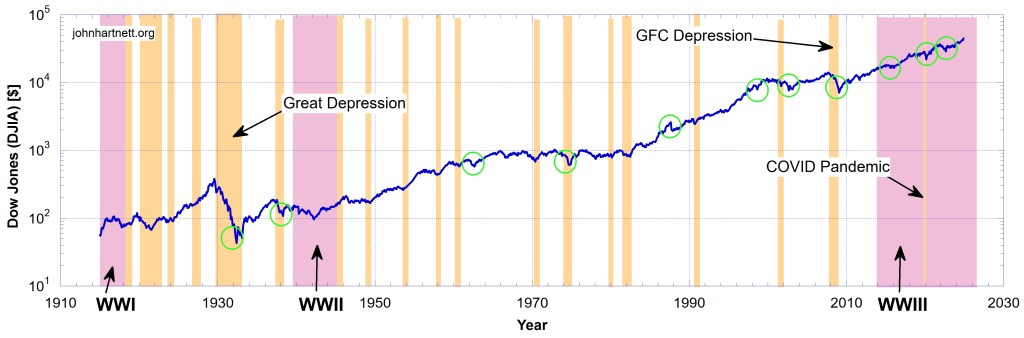
On Chart 1 I plot the Dow Jones from 1914 to December 24, 2024 on log-linear axes. The green circles indicate times of rapid decline in the index.
It is necessary to plot on a logarithmic vertical axis because of the constant devaluation of the dollar. In a previous post Global Monetary System Teetering on the Brink I looked at the Dow Jones index where I normalised it to 1914 dollars. This had the effect of stripping out dollar devaluation.
In Chart 2 I have not done this, but instead taken the rate of change (the derivative) of the Dow as a fraction of its value at any time, hence calculated (1/x)(dx/dt) where x = DJIA index. The result is a fractional rate of change per time step, which is one month in this case. This method has the effect of normalising the derivative so all data may be properly compared.
Chart 2 is shows the rate of change (the first derivative of blue curve in Chart 1) of the Dow Jones as a percentage change per month, because the data were sampled monthly.

The green circles are the same periods as found and indicated in Chart 1. Each indicates the rapid decline in the index at that historical date.
From those dates I assembled a list and calculated the time interval in years between when they occurred. In Chart 3 I have plotted these intervals except for the first one from August 1931 to February 1938. The period of the Great Depression up to World War II (1940) is a bit chaotic. So my Chart 3 starts in 1962 with first interval from 1938 of 24 years. Whether or not this should have started in 1940 makes very little difference to the analysis.

Chart 3 indicates the time interval from the previous rapid decline in the Dow Jones index and plotted in the blue squares as a function of when that interval finished. For example, the data point in 1973 is equal to about 11 years from the previous event in 1962.
In Chart 3 the smooth curve (1) is not a fit but a guide to the eye. It clearly indicates a progressively decreasing time interval between rapid declines in the Dow. The straight line curve (2) is a linear fit to the blue squares. The red circle is the point it would be if the next collapse in the Dow occurred on January 1, 2025.
Because the historical data (blue squares) trend line is non-linear it is hard to predict an exact date of the next crisis in the Dow. But from the red circle indicating where it would be if it occurred on January 1, 2025, it is very clear that we are already over due for the next rapid decline in the Dow Jones index.
I conclude, according to this analysis, the next financial crisis in the US stock market must occur soon in 2025. See related posts listed below, especially the first two.
Of course all this implicitly assumes that the same human behaviour is operating as have operated in past crises. Whether or not that is true we’ll soon see. Perhaps the use of AI in trading algorithms will change it. But I personally do not think so.
Related Reading
- US National Debt Predicts the Next Big Financial Crisis
- Next Global Financial Crisis in 2025?
- Global Monetary System Teetering on the Brink
- Nikkei 225 Compared to the Dow Jones
Subscribe
Free
To be notified by email put your email address in the box at the bottom of your screen. You’ll get an email each time we publish a new article.
Premium
Subscribe to our Newsletters as a Premium member ($5 USD/month or $30 USD/year) and get a free PDF of my book Apocalypse Now, which you can download from a Premium members only post here.
Paid Premium members will get exclusive access to certain content I publish, which I expect to be about 4 exclusive posts per month.






 Bible Science Forum