
Since 2015 black holes have become the next big thing in astronomy and astrophysics. It also has become apparent that nearly every galaxy has a supermassive black hole at its center. Now they are being invoked as a place to look for the elusive putative axion, whether ultralight or “fuzzy”, which is alleged to be the missing Dark Matter.
Black holes, as we all know, have an event horizon from where nothing escapes not even light, hence the word black in their name. But outside the event horizon of a rotating black hole — they all rotate — is the ergosphere. In the ergosphere particles including photons (and any bosons) get boosted into intense levels of energy. This is a process called superradiance.
The superradiance effect is created as the photons or other particles get closer to the black hole. It supercharges the ergosphere.
Some photons passing close to the black hole get trapped in the ergosphere, and as they get closer to the event horizon, they whip around the black hole faster and faster. With every loop, they gain more and more energy. Some of those photons fall to their doom, crossing the event horizon, never to be seen again. But some scatter off of other photons and escape, and are boosted to incredibly high energies in the process. Space.com
This is all theory! It has not been observed yet.
The superradiance process is unstable. Over incredibly long timescales, enough photons can get boosted to high enough energies that the entire surroundings of the black hole turn into a giant “bomb,” with the trapped photons blasting away in a single gigantic burst. But this process happens slowly enough that we haven’t seen it play out in the universe yet. Space.com (my emphasis added)
Yes, you guessed it. Here is a proposed mechanism, never been observed, that might be employed to search for Dark Matter, the fictional stuff that allegedly 85% of the matter of the universe is made from.
The form of Dark Matter they want to look for with black holes is dark photons.
One possibility is that dark matter is a new kind of ultralight particle that shares a lot of characteristics with bosons but does not interact with all the normal particles in the universe. These “dark photons” would be incredibly light yet absolutely flood the cosmos. But because they would not interact with normal matter, they would be exceedingly difficult to observe directly.
That is, unless they collect around black holes. Superradiance can operate on dark photons just as well as it does on normal photons. When dark photons collect around black holes, they can get trapped and boosted to high energies, where they might transform into other particles (or even just normal photons). Space.com (my emphasis added)
These alleged dark photons may be the ultralight axions or the “fuzzy” axions which have a mass/energy density so low they they would be 19 orders of magnitude lighter than neutrinos or 25 orders of magnitude lighter than electrons. They are alleged to have dimensions of the horizon — the Hubble length — in the early big bang universe.
And the only way this superradiance mechanism could work for these fictitious dark photons is if they are so incredibly light. If they were much heavier bosons they wouldn’t collect around the black holes and the superradiance wouldn’t work.
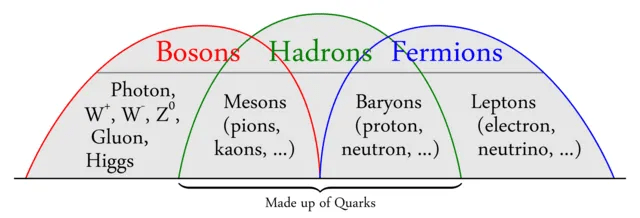
Also now if there was more than one species of dark matter, e.g. a dark boson (with integer spin, an ultralight axion or dark photon) and another fermion-like dark matter particle, then the dark matter fermion (with odd half-integer spin) would quench any superradiance effect on dark photons.
In a theoretical paper found on the arXiv,
The researchers found that the interactions between the different kinds of dark matter can mess up the superradiance process, thus preventing the dark photons from getting a boost and blasting off. Instead, as they whip around the black hole, they might keep hitting the other species of dark matter particle, sapping their energy in the process.
This means we can’t take the observed limits at face value. Just because astronomers haven’t seen superradiance doesn’t necessarily indicate that dark photons don’t exist. Instead, it might mean the physics of dark matter is much more complicated than we thought. Space.com (my emphasis added)
It sure is!
I describe all this because it is another case of clutching at non-existent straws to reason why the universe is as it is.
Big bang cosmology is in crisis. The theory requires all sorts of Dark Matter and Dark Energy to rescue it from the darkness of oblivion. No dark sector particles or dark photons have ever been detected, so explanations of why we don’t see them are offered.
Black hole superradiance has never been observed anyway even for normal visible photons let alone for dark sector photons. The absence of observed superradiance raises questions about the complexity of the physics of Dark Matter and the validity of existing cosmological theories.
Excuse the pun but they are digging their black hole deeper and deeper. It is time to look for a God edifying model that describes the created universe as we see it now.
Related Reading
- Dark Photons and the Illusion of Dark Matter
- Can Axions Cleanup the Problem of Fine-Tuning in the Universe?
- Should Biblical Creationists Believe in Dark Matter and Dark Energy?
Free Subscribers
Subscribe to our Newsletters as a Free Subscriber and be notified by email. Just put your email address in the box at the bottom of your screen.
You’ll get an email each time we publish a new article. It is quick and easy to do and totally free. You only need do it once.
Premium Subscribers
Subscribe to our Newsletters as a Premium Subscribers at $5 USD/month or $30 USD/year (you choose).
Paid Premium Subscribers will get exclusive access to certain content I publish. That will only cost you a cup of coffee per month.
Also you’ll get access to download, for free, a PDF of my book Apocalypse Now. You can download it from a Premium members only post here.
And now you’ll get exclusive access to the chapters (in their initial draft form) to my new book with working title “The Physics of Creation”; plus eventually a PDF of the final compiled book.
This is how you can support my work. I have been publishing this website for 10 years now and up to 2024 I never asked for any support.
Press the button “Premium” on the front page to find a list of Premium content. Over time that list will grow. Thanks so much to all supporters.
At a minimum, please join as a Free Subscriber. It’ll cost you nothing. It may also help me beat the shadow banning of some posts.





 Bible Science Forum