


Occasionally I go off the reservation and philosophize about something. This time I ruminate on the problems scientists face when trying to publish in first ranked journals their findings in peer-reviewed research papers.
The problem occurs when anyone presents an alternative to the ruling paradigm. It is not particular to those who hold a biblical worldview but for anyone it is nearly impossible to publish any thesis that goes against the big bang evolutionary narrative on the origin of the universe.
Censorship of ideas is extremely strong in academia. There is no such thing as freedom of speech and expression. The high priests control what information is allowed and their power over the gateways is absolute.
Sometimes you can publish alternative ideas in lower grade B or C journals where the impact is much less. But publishing any alternative physical theories in mainstream physics journals is nearly impossible. It is not entirely impossible but you must get the manuscript passed the Editor and often two or more anonymous reviewers.
Often the way researchers get around such limitations is by getting to know anyone important in their field and “plowing the ground” first so that when their paper comes up for review they already have some advocates. But when it is very alternative, for example, against the big bang paradigm, the high priests are extremely reluctant to let the paper go through to publication.
As an example I describe the story behind the work I did with Dr. Christopher Fulton and Dr. Halton Arp over about a 10 year period. This saga has several successes with publication but many are not so fortunate.

The underlying these behind this work is found here: Galaxy-Quasar Associations. The key point is that it brings into doubt the redshifts of galaxies and quasars being located at the distances determined by their redshifts. Undermine that and you undermine the entire big bang cosmological model.
My story starts at the 2nd Crisis in Cosmology conference (CCC-2) in Port Angeles, Washington state, USA in 2008.
I met Chris Fulton there and heard his presentation on his statistical analyses of the probability of high redshift quasars being physically associated with low redshift parent galaxies. I learned from him that he had been in a PhD program at an Australian university with Halton Arp and an Australian professor as his supervisors (thesis advisors) but that his Australian supervisor left the university and so the university shut down the program he was running and Chris was “left to fend for himself”.
At that time Chris also told me that he had for 2 years already been ‘fighting’ with the Editor and reviewers for his submitted paper to The Astrophysical Journal (ApJ), which is the leading journal in that field.
Chris had already done an enormous amount of new work stipulated by the reviewers and the ApJ Editor-in-Chief (EIC) to answer all their objections. The latter were really aimed at shutting Chris down, making him give up, but he wouldn’t.
I suggested to Chris that he enrol at my university, The University of Western Australia, to complete his PhD. I knew the executive quite well and arranged a short period enrolment so that he could submit his thesis. Universities make a lot of money from successful PhD completions so it was a win-win for all.
Chris came on campus in Western Australia for a period of 6 weeks and presented his work at a theoretical physics conference I had organised there.
In order to get Chris’ PhD thesis passed we had to choose 3 reviewers who were not antagonistic to the alternate views expressed therein, that is, against the big bang paradigm. Eventually the thesis was passed and Chris received his PhD.
During that time Chris continued to work with the ApJ Editor to get his paper through the review process. After 6 years it was accepted for publication. Note the dates ‘received 2006 May 13’ and ‘accepted 2012 May 30’ in the image below.
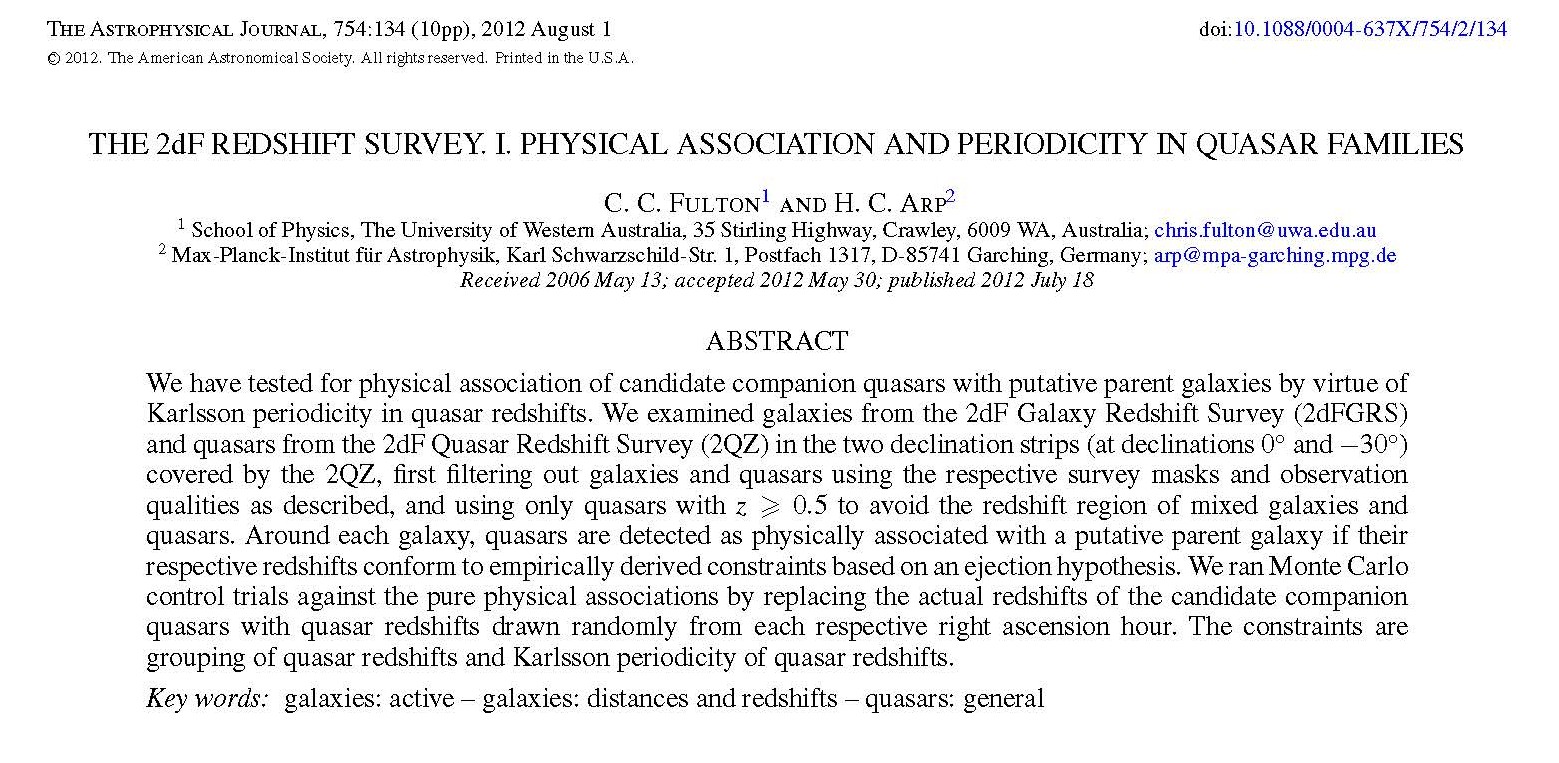
That is 6 years from submission to acceptance. It is a mammoth task. But in the end it was reluctant acceptance by the EIC of the journal.
In what follows more detail is given so that you might understand how the “gate keepers”, the high priests of the peer-review journal publications, operate. This is mostly true for all of the first ranked journals. And for many you cannot even get the Editor to pass the manuscript out for review.
Subsequent to the final success after 6 years with the ApJ 2012 paper the authors, now including myself along with Drs Fulton and Arp, submitted a follow-on paper again to ApJ for consideration. As with the 2012 paper the authors were in contact with the EIC during the entire submission, which in this case lasted four years until rejection.
Note that was four years wrestling with referees and the editors which ended in rejection of the follow-on paper.
The good news about that follow-on ApJ endeavour was that the authors were at least able to continuously engage with a referee by responding to reports and making changes for or rebutting each statement made in each report. When the first referee was unable to find a legitimate reason for rejection of the paper after several reports, the EIC agreed to search for a second referee.
The bad news was that the second referee, being resolutely determined to find for rejection and having difficulty doing so, hit upon a claim that the strength of the quasar family detection signal obtained by the authors was not due to the hypothesis being tested but rather to a bias in the simulated data used to perform the significance test.
Indeed, a small bias did exist, as is often the case depending on the nature of the data set as well as how a fit to the data is performed. However, for multiple reasons that bias could not have produced such a significant signal as the authors found even at a lower strength.
In spite of several of the authors’ demonstrations of the clear incorrectness of the referee’s assertion, each of which required a year or more of careful development, implementation, and execution, the referee stuck to the assertion and recommended rejection.
The authors then spent another year carefully removing the bias from the simulated data, performing the tests with and without the bias removed, and generating a plot of the signal that clearly shows identical results with and without the bias.
The authors then used this evidence to appeal the rejection. The EIC said that he read over the appeal carefully but found it “repetitious” (it is unknown what was meant by that) and did not send it to the second referee because it would not change the decision of that person.
Furthermore, the EIC was not willing to find a third referee. Shortly after that, the authors submitted the paper to the journal Ap&SS and it was published a year later in 2018. In total that was 5 years and 2 journals to get the second paper published. But eventually it was.

Dr Fulton, now with new co-authors, submitted a new paper that not only finds multiple periodicities in spectral line data of the astrophysical objects, quasars and galaxies, but also that those periodic behaviours are closely intertwined with multiple redshift periodic behaviours, notably including the ones for quasars studied in the 2012 and 2018 papers.
The submission story is rather lengthy and complicated, but for this third paper it started two and a half years ago with back-to-back rejections by the A&A journal, without it ever going to a referee, followed shortly thereafter with a rejection by the MNRAS journal, also never going to a referee.
The MNRAS situation was more promising because the second anonymous MNRAS editor suggested the investigation of two possible sources of systematic errors in the spectral line processing. If the systematics could be addressed, the paper could be resubmitted as a new paper.
The authors replied in the affirmative to carry out a systematics investigation followed by resubmission. The resubmission occurred in February 2025 and consisted of 161 megabytes of PDF files including the paper and numerous external files including those generated during the investigation.
The paper was immediately rejected by two editors, both of whom had little interest in the paper and apparently zero interest in the results of the investigation. There was one short comment paragraph that was at best disingenuous and at worst deeply flawed. This was pointed out in a response suggesting reconsideration.
The corresponding Assistant Editor was kind enough to use her personal email to forward the response in spite of an MNRAS policy of rejections being final. That appeal was also rejected. The authors are preparing for submission to another journal.
That is the end of my example story but it is not rare. This sort of gate-keeper control is ubiquitous and endemic.
It is about controlling the narrative which leads to controlling who does or does not get funding and who climbs the academic ladder of success.
For submissions to journals which oppose the ruling paradigm it is essential that any real challenge “does not get a foot in the door”. Such is the sorry state of academic science today.
Related Reading
- Galaxy-Quasar Associations
- The Distances to Quasars
- Halton Arp—Big-Bang-Defying Giant Passes Away
- Confirmed: Physical Association Between Parent Galaxies and Quasar Families
- Quantized Quasar Redshifts | New Method Confirms Periodicity
Free Subscribers
Subscribe to our Newsletters as a Free Subscriber and be notified by email. Just put your email address in the box at the bottom of your screen.
You’ll get an email each time we publish a new article. It is quick and easy to do and totally free. You only need do it once.
Premium Subscribers
Subscribe to our Newsletters as a Premium Subscribers at $5 USD/month or $30 USD/year (you choose). Cancel anytime.
Paid Premium Subscribers will get exclusive access to certain content I publish. That will only cost you a cup of coffee per month.
Also you’ll be able to download, for free, a PDF of my book Apocalypse Now and also a PDF of my book The Physics of Creation The Creator’s Ultimate Design for Earth.
You can download them from the link below.
This is how you can support my work. I have been publishing this website for 10 years now and up to 2024 I never asked for any support.
Press the button “Premium” on the front page to find a list of Premium content. Thanks so much to all supporters.
At a minimum, please join as a Free Subscriber. It’ll cost you nothing. It may also help me beat the shadow banning of some posts.





 Bible Science Forum
Leave a comment