
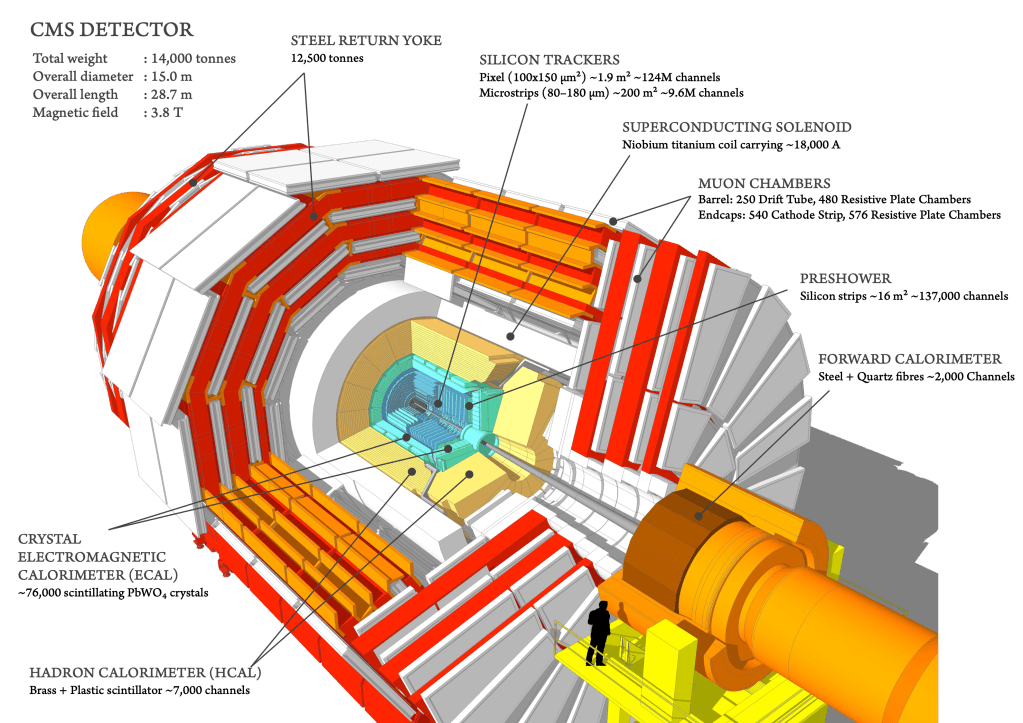
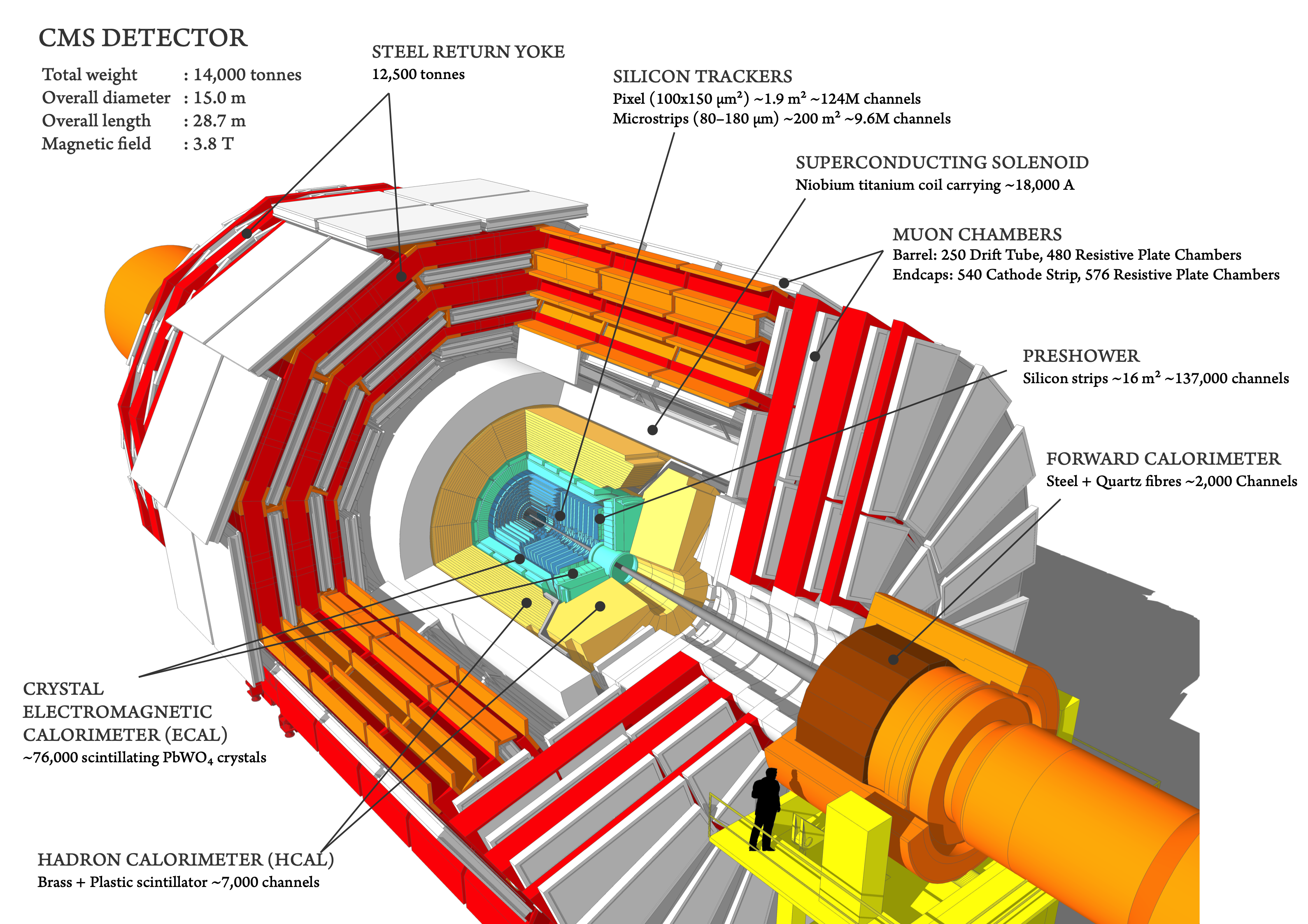
Enormous amounts of money are literally funneled into physics experiments searching for or testing new physics. One of those lines of experimental tests, for at least the last 30 years, at the CERN Large Hadron Collider (LHC) has been supersymmetry theory, which is also affectionately called SUSY.
Supersymmetry, a theory that posits every known elementary particle has a heavier “superpartner” particle, has been the superstar of theoretical physics for the past half century. Its proponents have seen it as the best hope for particle physics to solve long-standing mysteries such as dark matter.
ScientificAmerican.com, March 24, 2025, Supersymmetry Washes Out at the Large Hadron Collider
According to the theory, supersymmetric particles were assumed to exist even though they were not found in the most successful theory in physics the Standard Model of particle physics. An Extension had to be added with a zoo of unobserved putative dark sector particles. Some of those were considered as a potential solution to the dark matter crisis in cosmology.
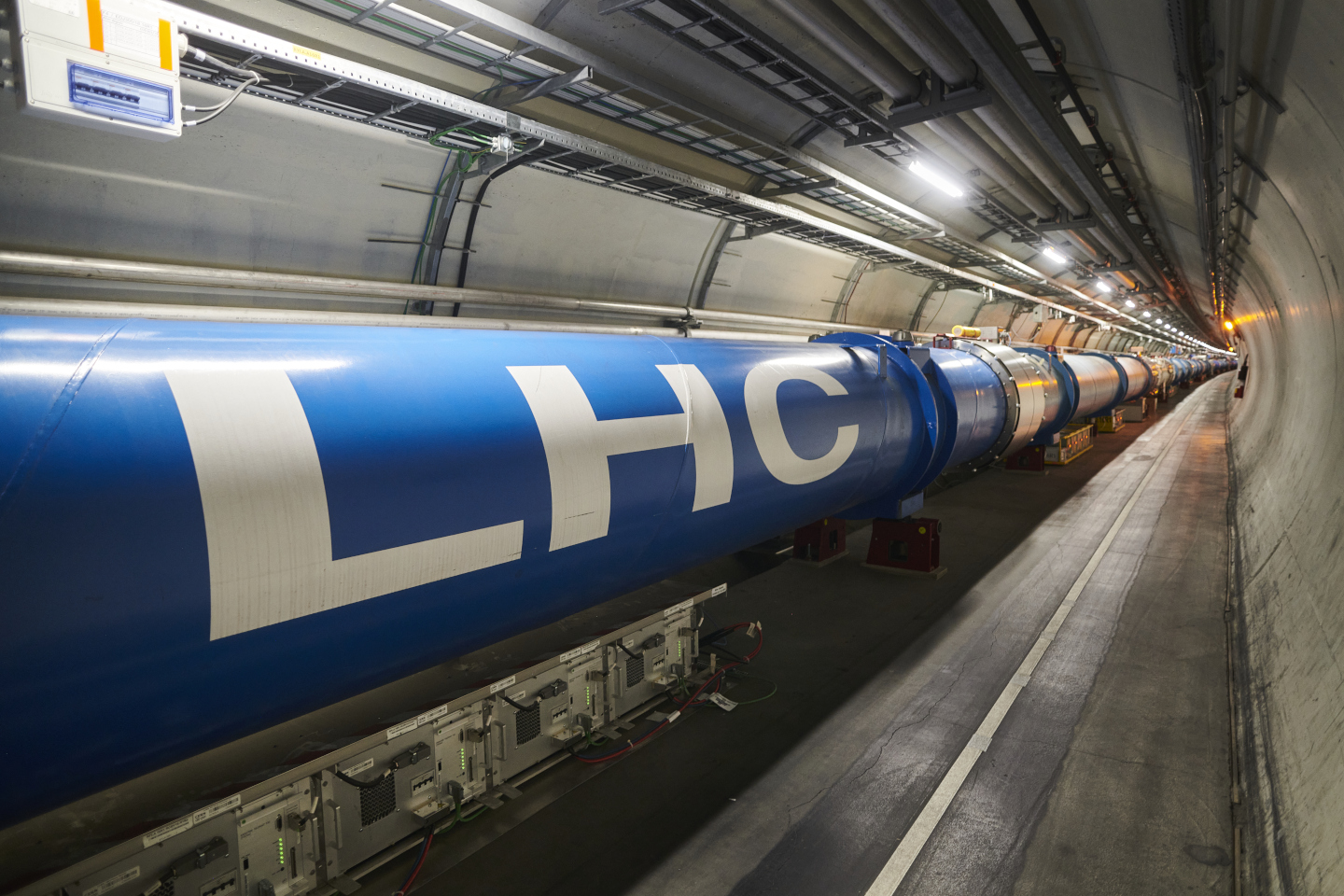
Previously I reported in SUSY is Not the Solution to the Dark Matter Crisis that after the equivalent of 10 years of run time on the LHC the lowest energy stable putative SUSY particle, the neutralino, was not detected at all even though a wide range of masses was searched with the LHC and the CMS and ATLAS detectors.
Nobel Laureate Gerard ‘t Hooft said that supersymmetric particles with sufficiently low masses would be discovered like “sitting ducks”. But they weren’t and the majority of its proponents finally admitted defeat. That should have been the end of that search for dark matter SUSY particles and the end of supersymmetry theory.
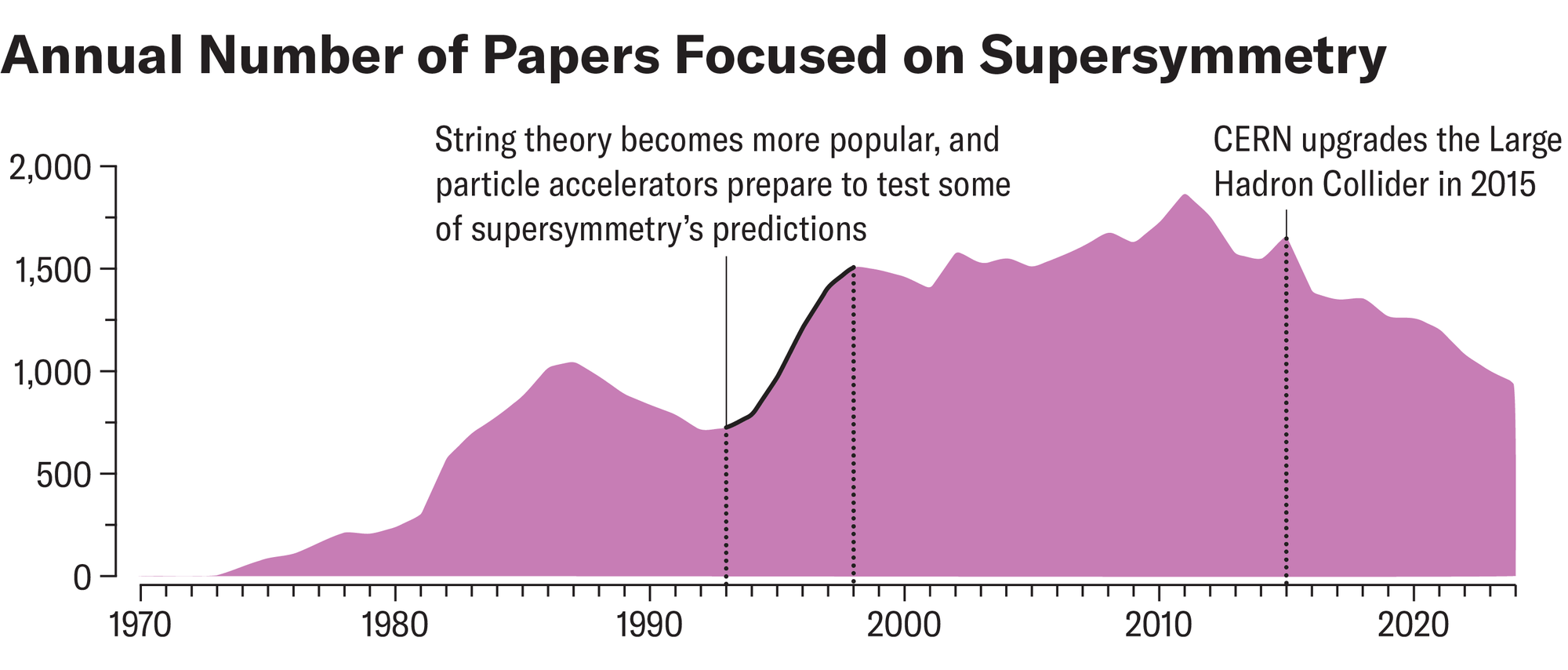
“Supersymmetry was a huge industry starting from the 1990s until around 2015. But the lack of a discovery of superpartners after the LHC upgrade to higher collision energy was a turning point for most of the community,” notes Adam Falkowski, a theoretical physicist at the Laboratory of the Physics of the Two Infinities Irène Joliot-Curie (IJCLab) in France.
ScientificAmerican.com, March 24, 2025, Supersymmetry Washes Out at the Large Hadron Collider
The LHC was upgraded June 3, 2015 with the beginning of the LHC ‘Run 2’ with an increased collision energy of 13 TeV.
In 2015 upgrades to the LHC nearly doubled the energy of its collisions to 13 tera electron volts, but the analyses kept coming up empty-handed—to the palpable consternation of proponents and opponents alike. Once-robust enthusiasm for SUSY began to wane.
The last LHC upgrade was completed by April 2022 with the beginning of LHC ‘Run 3’ with an increased collision energy of 13.6 TeV, only a 4.5% increase. That Run will end in July 2026. But to no satisfaction of the diehard devotees to SUSY and putative SUSY particles from the dark sector.
Despite that the SUSY field of physics has been an enormous money spinner but to what end? Like string theory (which it is a part of) SUSY has come up with absolutely nothing, certainly no dark matter particles ever detected.
See here for a graphic illustrating the efforts by using the number of research papers published annually as a measure.
The Scientific American article I am quoting from has in its URL “supersymmetrys-long-fall-from-grace”, which is quite different to its title “Supersymmetry Washes Out at the Large Hadron Collider“. It is a deliberate biblical reference, which perhaps the Editor changed.
One section of that article under the subheading of “An Almost Biblical Belief” is worth noting.
Theorists soon realized that the mathematical tools involved in “SUSY” (the theory’s commonly used nickname) could fix many vexing problems in physics. Posited superpartners were ready-made candidates for particles of dark matter, and SUSY offered possible routes for a theory of quantum gravity. Additionally, it served as crucial scaffold for string theory and was a key argument for building the LHC. As the number of peer-reviewed publications on SUSY soared, the theory became a cultural phenomenon, with savvy science communicators churning out books, articles and interviews touting its validation as an almost foregone conclusion.
“When I was a student,” Falkowski says, “the existence of SUSY was almost a fact for a bulk of researchers working on the topic. This certainly was reflected in hiring practices, and you had a large group of top researchers whose entire publication list was tied to supersymmetry.”
All the while, no experimental discoveries came along, and supersymmetric models grew notoriously unfalsifiable, mainly because of their arbitrary features. The models came with many variables with unknown values added by hand—and required fine-tuning to explain SUSY’s absence from the natural world. Calculations to predict the masses of superpartners were prone to upward revision after each null result across multiple generations of colliders.
“Physicists tend to be faddish, following trends,” says Nobel laureate Sheldon Glashow, a professor at Boston University and one of the architects of the Standard Model. “At times, belief in supersymmetry seemed almost biblical.”
Physicists are not impartial. They hold a worldview and that worldview dictates their reality. Models were constantly manipulated and unknowns were added by hand. The models grew to be more and more unfalsifiable but the bottom line in experimental physics is the null result. No detection over the widest range of predicted energies means the theory is falsified. But only when it is not. That means the diehards will never accept a null result.
This also means all hopes of dark sector particles at energies of the LHC have also died.
Dark matter itself is a fiction. There is no Extension of the highly successful Standard Model of particle physics. All experiments to date have found nothing. The following graphic illustrates this very well.

This is an exclusion space for null detection of putative dark matter particles, also called dark photons at energies less than 100 keV, which is much less than the 13.6 TeV of the LHC Run 3.
Yet at all these energy ranges no detection of any putative dark matter particle or dark photon has ever been achieved in any lab experiment.
The reason SUSY is a failed theory is because it is based on a false foundation: that is, that the Universe is the product only of natural law and materialism, and that it has evolved to its current state over the past 13.8 billion years.
But that is not the case, and though there may yet still be undiscovered particles, dark matter comprising 80% of all the matter in our Milky Way galaxy (yet is invisible) sounds more and more like story-telling than real physics.
Related Reading
Dark Matter Crisis for about 50 articles on the subject.
Free Subscribers
Subscribe to our Newsletters as a Free Subscriber and be notified by email. Just put your email address in the box at the bottom of your screen.
You’ll get an email each time we publish a new article. It is quick and easy to do and totally free. You only need do it once.
Premium Subscribers
Subscribe to our Newsletters as a Premium Subscribers at $5 USD/month or $30 USD/year (you choose).
Paid Premium Subscribers will get exclusive access to certain content I publish. That will only cost you a cup of coffee per month.
Also you’ll get access to download, for free, a PDF of my book Apocalypse Now. You can download it from a Premium members only post here.
And now you’ll get exclusive access to the chapters (in their initial draft form) to my new book with working title “The Physics of Creation”; plus eventually a PDF of the final compiled book.
This is how you can support my work. I have been publishing this website for 10 years now and up to 2024 I never asked for any support.
Press the button “Premium” on the front page to find a list of Premium content. Over time that list will grow. Thanks so much to all supporters.
At a minimum, please join as a Free Subscriber. It’ll cost you nothing. It may also help me beat the shadow banning of some posts.





 Bible Science Forum
One response to “Dark Matter Search | SUSY’s Long Fall From Grace”
I have a sneaking suspicion that the main product of the many colliders out there (in recent decades, at least) has been grant funding for a great many physics academics. Maybe I’m being cynical, but the FCC seems like a giant money-grab to me and not based on answering real, scientific questions. The fact that billions were sunk into the failed search for SUSY should make funding incredibly difficult to come by in the particle/heavy-ion world, but that oddly doesn’t seem to be the case.
LikeLike