
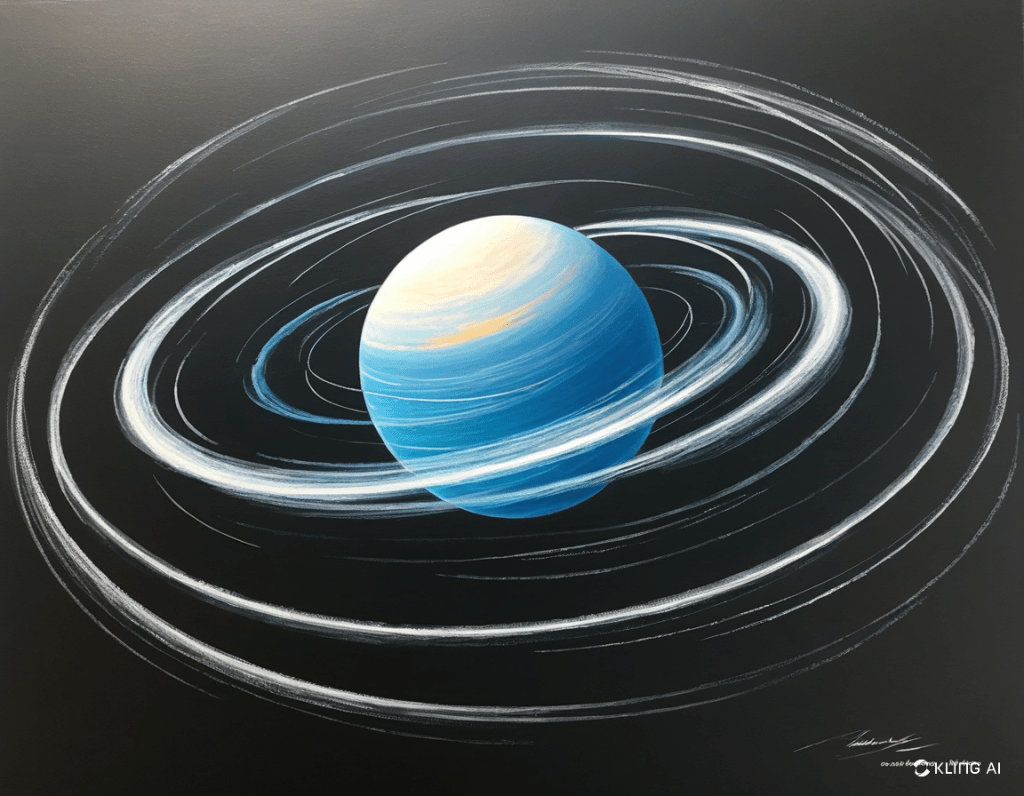
I recently reported that evidence exists for the Earth to have once had an equatorial ring. The physical evidence was the detection of 21 asteroid impact craters in a band within 30° of the equator. And that band only represents 30% of the exposed, potentially crater-preserving crust. So…. if, from creation, the planet Earth had a disk of icy cometary/asteroid material as rings like Saturn’s, what happened to it?
I have been thinking about this and how one might model it to try to understand what effect the loss of that disk would have had.
It is not so easy to develop a realistic model because of the unknowns. But there are a few reasonable assumptions we can make.
If matter from the disk impacted the Earth the angular momentum of that material would be added to Earth’s angular momentum increasing it’s rotational energy. That means it would tend to increase the rotation speed of the planet and decrease the 24-hour day.
Alternatively if matter from the disk was driven out into space through gravitational coupling and some orbital energy of the planet transferred to the receding disk, then the rotation speed of the planet would have decreased and the length of the day increased.
The scripture in Genesis 1 is very clear that God created everything in 6 x 24-hour days. That fact is summarised in the following.
11 For in six days the LORD made heaven and earth, the sea, and all that in them is, and rested the seventh day: why the LORD blessed the sabbath day, and hallowed it.
Exodus 20:11 AKJV
The days here are the normal days that the Hebrew people would have understood at the time of the exodus from Egypt. They are not some indeterminate length of time.
So if the length of the day has not changed in the past 8,000 years since the creation then the effects of an equatorial disk of matter, when it was lost, could only have caused a minor perturbation to the rotation speed of the planet.
Now consider that the Moon is currently receding (moving away) from the Earth at about 38 mm per year due to tidal effects.
It is a well-established observational fact that the Moon is moving away from the Earth at a current rate of about 38mm per year. This value is now known very accurately because of work done to monitor the Earth-Moon distance using a laser beam bounced back from reflectors left on the surface of the Moon by the Apollo astronauts, but the recession was noticed by early astronomers because of the effect the increasing distance has on the orbital speed of the Moon, resulting in it not being in the “correct” position in the sky.
Some angular momentum is transferred to the orbit of the Moon from the rotation of the Earth causing the Earth to rotate slower and slower.
Evolutionary long-age believers would say that the geological record is consistent with the day being much shorter than it is now, i.e. 21.9±0.4 hours 620 million years ago, and that there were 13.1±0.1 synodic months/year and 400±7 solar days/year. Wikipedia.
The idea is that as the Moon has receded it took rotational energy from the Earth and the period of rotation increased to the current value of 24 hours with respect to the Sun (a solar or synodic day).
Of course, this is just story-telling. No scientific method can make a measurement on past events.
But let’s do a back-of-the envelope guess-timate. Assume the Earth-Moon system has been there 10,000 years since creation and the Moon’s recession speed is 4 cm/year. That amounts to 400 m over an average Earth-Moon distance of 400,000,000 m. Therefore the fractional change is 1 part in a million. Assuming a direct proportionality that would translate into an increase in the length of the synodic day of 86,400 s ÷ 1,000,000 ≈ 0.1 s longer. Or no real appreciable change. But more careful calculations need to be made than that.
So here my argument is that the stability of the Earth-Moon system and the fixed value of the solar (synodic) day tells us that no major changes in any putative disk of material around the Earth could have ever occurred. Because if it did it would have perturbed the length of the 24-hour day. It could have existed, but its mass and rotational energy was very small compared to the Earth’s.
The evidence of 21 asteroid impacts is real enough but the added rotational energy from those impacts to the Earth must have been insignificant.
Also because the source material in the putative disk was axisymmetric as evidenced by the asteroid craters being axisymmetric in the equatorial plane of the Earth the disk would have had very little effect on the precession of the Earth’s rotation axis.
Related Reading
- Some Secular Astronomers Now Believe That Earth Once Had a Ring
- Book: “The Physics of Creation, The Creator’s Ultimate Design for Earth”
- Obliquity of Earth’s Axis | How Has It Changed?
- Can We Know the Year of Noah’s Flood?
- Evidence of Creation | Mechanism Causing Perturbation in Obliquity of Planet Earth
Free Subscribers
Subscribe to our Newsletters as a Free Subscriber and be notified by email. Just put your email address in the box at the bottom of your screen.
You’ll get an email each time we publish a new article. It is quick and easy to do and totally free. You only need do it once.
Premium Subscribers
Subscribe to our Newsletters as a Premium Subscribers at $5 USD/month or $30 USD/year (you choose).
Paid Premium Subscribers will get exclusive access to certain content I publish. That will only cost you a cup of coffee per month.
Also you’ll be able to download, for free, a PDF of my book Apocalypse Now and also a PDF of my book Physics of Creation The Creator’s Ultimate Design for Earth.
You can download them from the link below.
This is how you can support my work. I have been publishing this website for 10 years now and up to 2024 I never asked for any support.
Press the button “Premium” on the front page to find a list of Premium content. Thanks so much to all supporters.
At a minimum, please join as a Free Subscriber. It’ll cost you nothing. It may also help me beat the shadow banning of some posts.






 Bible Science Forum
Leave a comment