
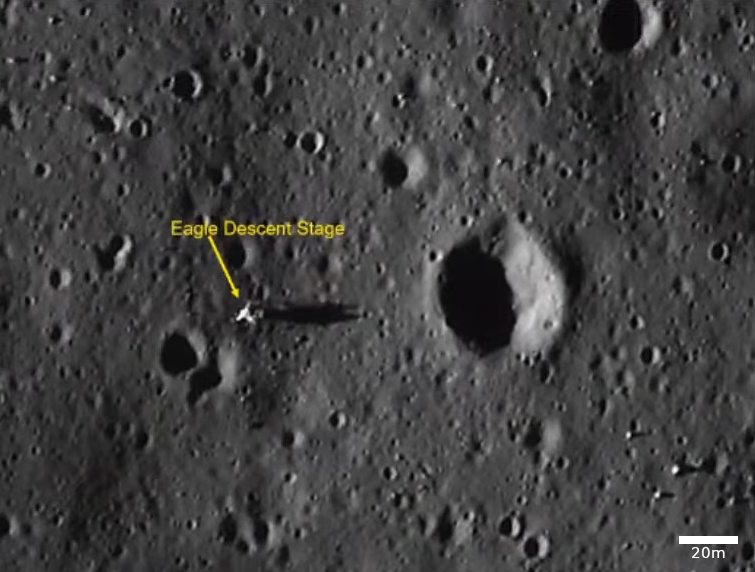
One of the major claims of the “Moon Landing Hoax” proponents is that there is no evidence that NASA ever landed any Apollo spacecraft with astronauts on the lunar surface. And they will not accept as contrary evidence to their claim any images supplied by NASA, because NASA is in on the hoax.
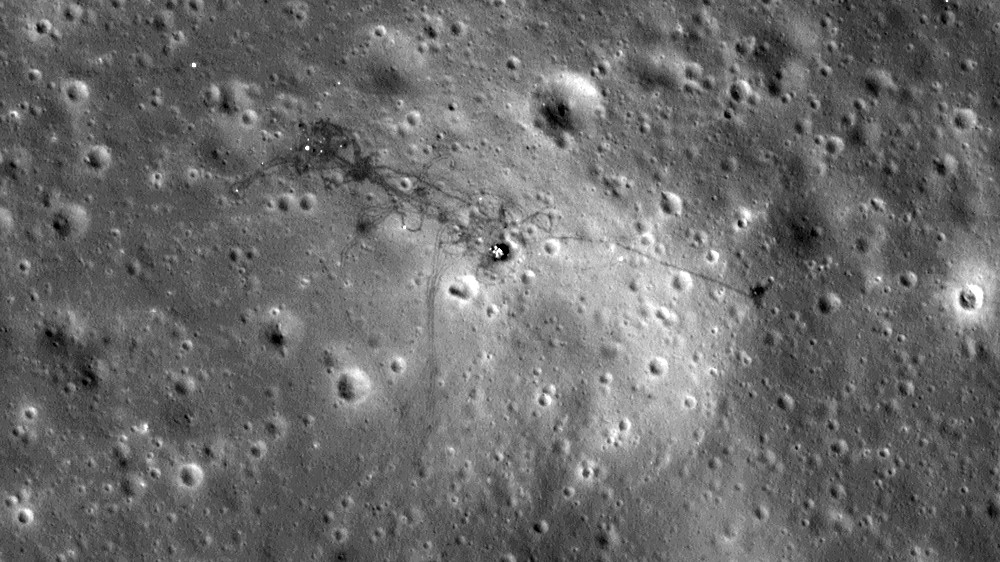
I few years ago I wrote a piece showing NASA images that show Apollo Moon Landing sites. See Apollo Moon Landing Hoax and the ‘Face on Mars’ Those images, like the Apollo 15 site shown below, were taken by NASA’s Lunar Reconnaissance Orbiter (LRO) in orbit of the Moon about 50 km above the surface. That is how close you need to position your telescope and camera to get clear images. Due to the physics limitations of Earth based telescopes and even of the Hubble Space Telescope (HST), which is in space but not in lunar orbit, resolution of clear images of objects less than 100 m on the lunar surface is not possible.
The image above of the Apollo 11 “Eagle” Lunar Module descent stage sitting on the Moon at Tranquility Base was supplied by the Indian Space Research Organisation (ISRO) Chandrayaan-2 lunar orbiter. That is not NASA, so can we accept this as evidence?
But the question here is, can we see the Apollo Moon landing sites from Earth? No, we can’t and that is because of the physics involved.
One big limiting factor is the Earth’s atmosphere with its constantly changing optical index causing diffraction of light and therefore blurring of images. Some very large telescopes implement adaptive optics. By use of a reference laser beam projected into the atmosphere and smart control of the surface of the objective mirror correction can be made in real time that greatly mitigate the effects of the atmosphere. But even so that is not enough.
NASA/GSFC/Arizona State University Source
The biggest issue is resolution. The resolution of a reflector telescope is fundamentally limited by the size of its objective mirror, specifically its diameter. This limitation arises due to the wave nature of light and diffraction, which causes light passing through a circular aperture (such as a mirror) to spread out and form a diffraction pattern. The smallest angular separation between two point sources that can be resolved is given by the Rayleigh criterion, θ ≈1.22 λ/D, where λ is the wavelength of light and D is the diameter of the mirror.
This means that larger mirrors provide better angular resolution, allowing finer details to be distinguished. For example, the Hubble Space Telescope (HST), with a 2.40-meter primary mirror, achieves a very small minimum resolvable angle, enabling it to resolve stars separated by about half a light year at the distance of the Andromeda galaxy.
While the mirror’s surface quality and smoothness can affect image quality by introducing wavefront errors or scattering, the fundamental limit is set by diffraction and the mirror’s diameter. Even a perfectly polished mirror is subject to this diffraction limit, which is why larger mirrors are essential for observing finer details in astronomical observations.
The following video gives a good explanation of this and other techniques astronomers use to improve their image resolution, like taking thousands of photos of the same site and stacking those images to produce a single better resolution image. But that too has its limitations.
The video shows the limits of telescope technology, and contextualizes the scale of features on the moon. It draws inspiration from “Powers of Ten,” zooming all the way from ground-level on earth to right above Tranquility Base.
From this we understand that there are physical limitations to Earth-based telescopes resolving small objects on the surface of the Moon. No Earth-based optical telescope has an objective mirror large enough to resolve an object the size of the Lunar Module descent stage on the lunar surface.
The only way to see the Apollo Lunar Module descent stages is from spacecraft in lunar orbit. Here I have shown two images taken that way, one from NASA (Apollo 15) and one from ISRO (Apollo 11). In addition the video shows images of the Apollo 11 site at Tranquility Base on the Moon.
I find that a lot of the Moon Landing hoax proponents irrationally reject the observational evidence because it comes from NASA. Now I don’t like the term “conspiracy theory”. Sometimes some so-called “conspiracy theories” turn out to be true, for example, that the COVID jabs are in fact engineered bioweapons to cause infertility and depopulation. But to say that humans did not land on the moon, or even that no humans have gone higher above the Earth’s surface than a few hundred kilometers is pure fiction.
Related Reading
- Apollo Moon Landing Hoax and the ‘Face on Mars’
- Apollo Missions and Equipment Left on the Moon
- Was the 1969 Moon Landing Faked?
- Starship Earth
- The First Moon Landing
Free Subscribers
Subscribe to our Newsletters as a Free Subscriber and be notified by email. Just put your email address in the box at the bottom of your screen.
You’ll get an email each time we publish a new article. It is quick and easy to do and totally free. You only need do it once.
Premium Subscribers
Subscribe to our Newsletters as a Premium Subscribers at $5 USD/month or $30 USD/year (you choose). Cancel anytime.
Paid Premium Subscribers will get exclusive access to certain content I publish. That will only cost you a cup of coffee per month.
Also you’ll be able to download, for free, a PDF of my book Apocalypse Now and also a PDF of my book The Physics of Creation The Creator’s Ultimate Design for Earth.
You can download them from the link below.
This is how you can support my work. I have been publishing this website for 10 years now and up to 2024 I never asked for any support.
Press the button “Premium” on the front page to find a list of Premium content. Thanks so much to all supporters.
At a minimum, please join as a Free Subscriber. It’ll cost you nothing. It may also help me beat the shadow banning of some posts.




 Bible Science Forum
Leave a comment