


When I was in my second year of an undergraduate degree in physics, I will never forget what my lecturer said to a small group of us budding physicists gathered to hear him introduce us to quantum theory. He said:
“If a tree falls down in a forest and no one was there to hear it, does it make a noise?”
This metaphorical statement is one that underpins the philosophy in quantum mechanics. It harkens back to the famous Young’s double slit experiment. See Fig. 1b.
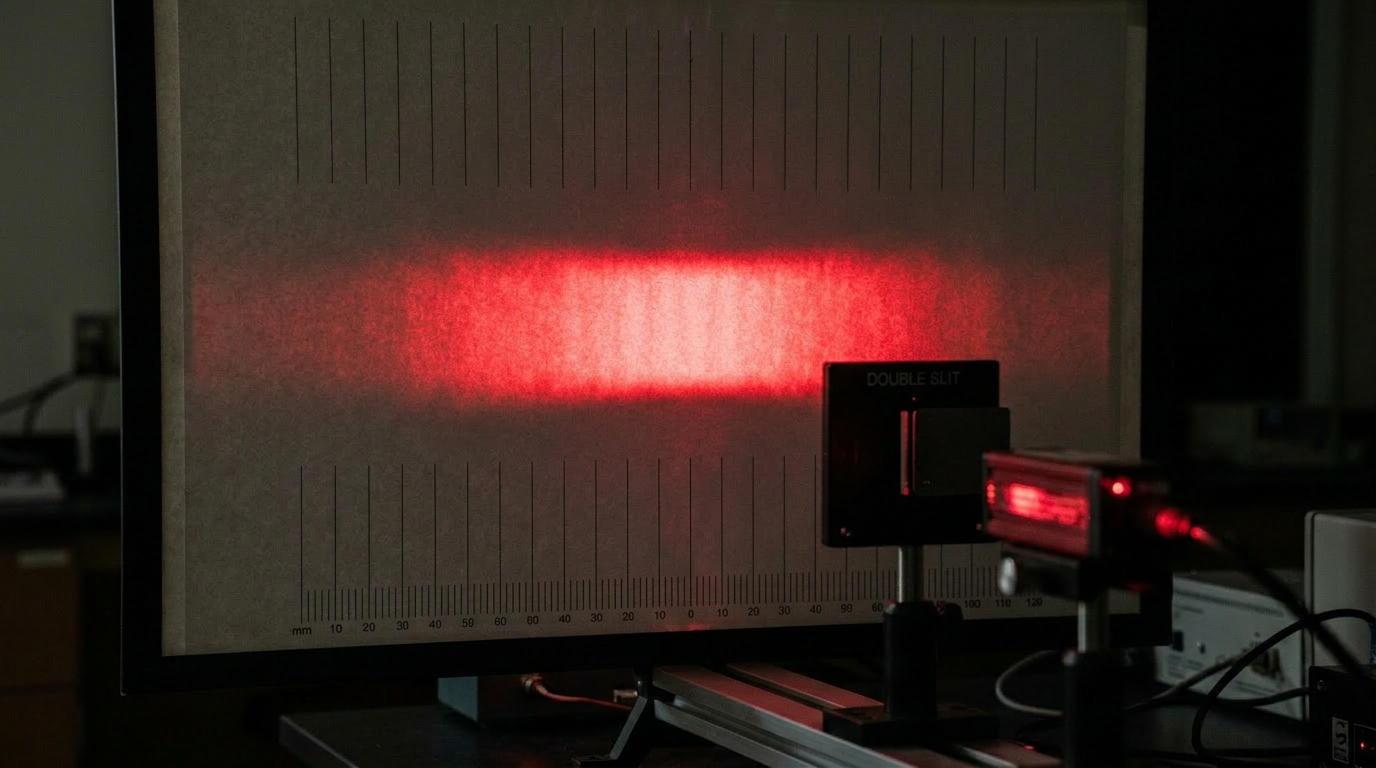
In a single slit experiment (Fig. 1a) the wave properties of laser photons interfere and create the above image. But add another slit (Fig. 1b) and you get a distinct interference pattern. Not smeared but discrete.
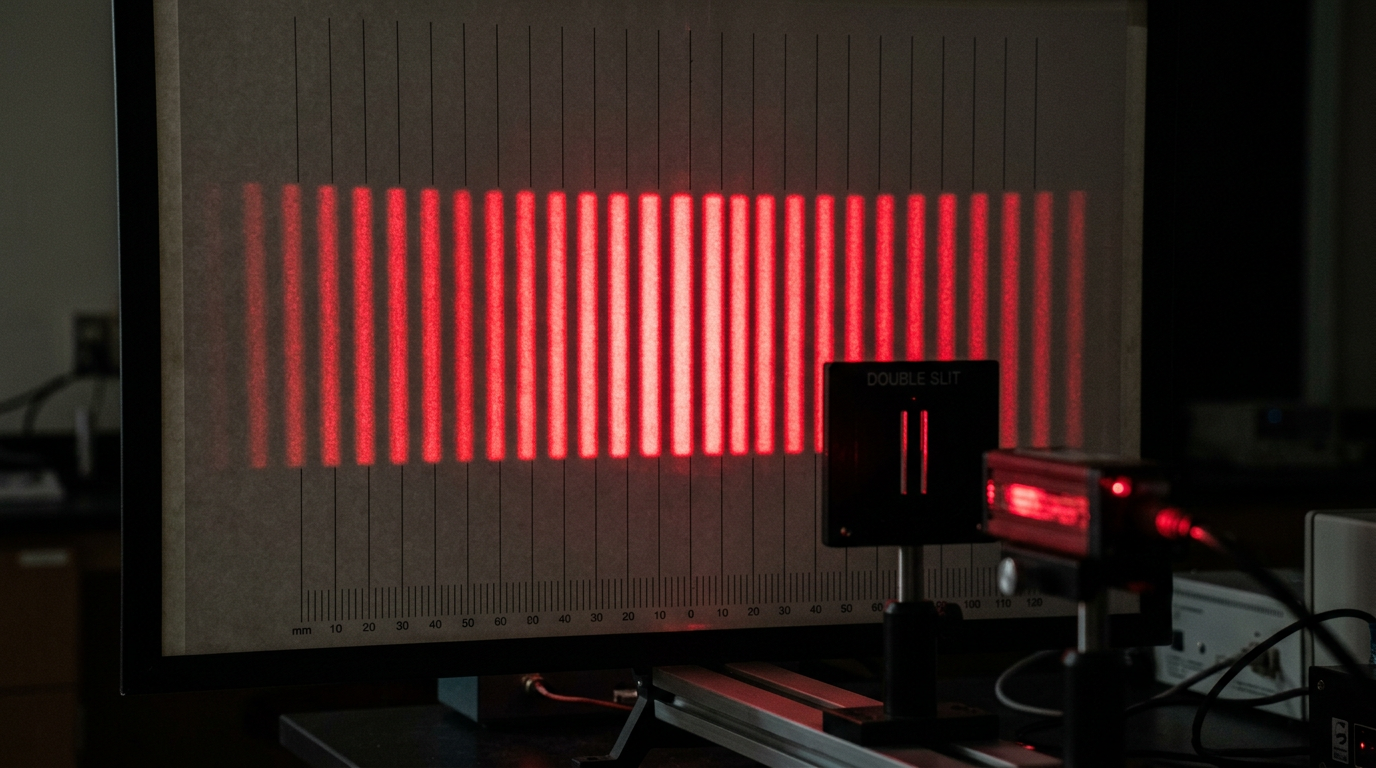
The laser light can be modelled as either a wave or a collection of particles. In fact all particles have a wavelength. We call that the de Broglie wavelength.
The de Broglie wavelength is the wavelength associated with a moving particle, defined by the formula λ=h/p, where h is the Planck constant and p is the particle’s momentum. This concept, proposed by Louis de Broglie in 1924, established the wave-particle duality, indicating that all matter exhibits wave-like properties.
For non-relativistic particles, the wavelength can be calculated using mass and velocity as λ=h/mv. The wavelength is inversely proportional to momentum, meaning higher momentum results in a shorter wavelength. This wave-like behavior was experimentally confirmed through electron diffraction experiments, such as those by Davisson and Germer in 1927, and is fundamental to quantum mechanics.
That means the de Broglie wavelength of macroscopic bodies, bigger than a grain of sand, are infinitesimally small. Planets, stars, galaxies, clusters of galaxies have zero wavelength and therefore you should realise that quantum theory can never apply to these bodies.
In Fig. 2a I show an electron gun emitting a beam of electrons incident on a double slit. Each electron causes fluorescence in the screen as it hits it. Over time a diffraction pattern builds up on the screen.
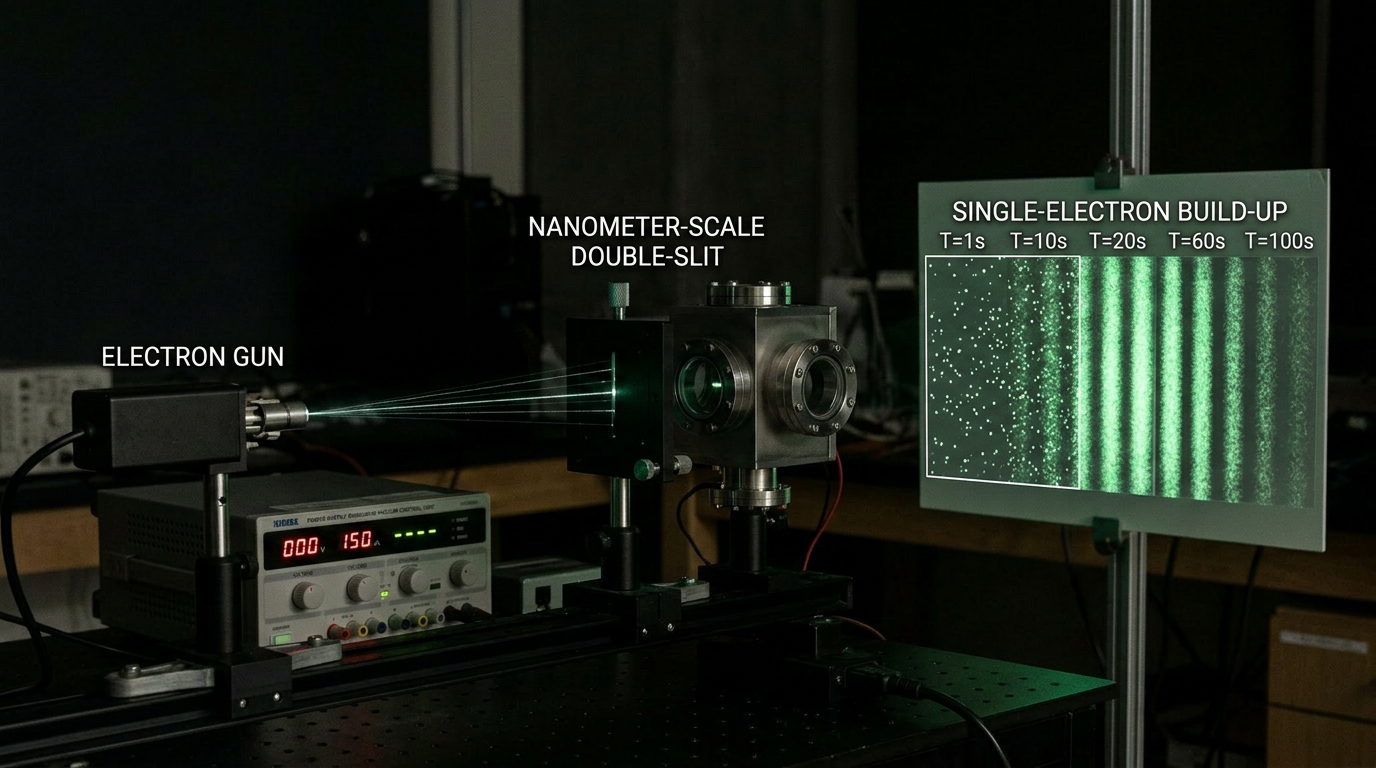
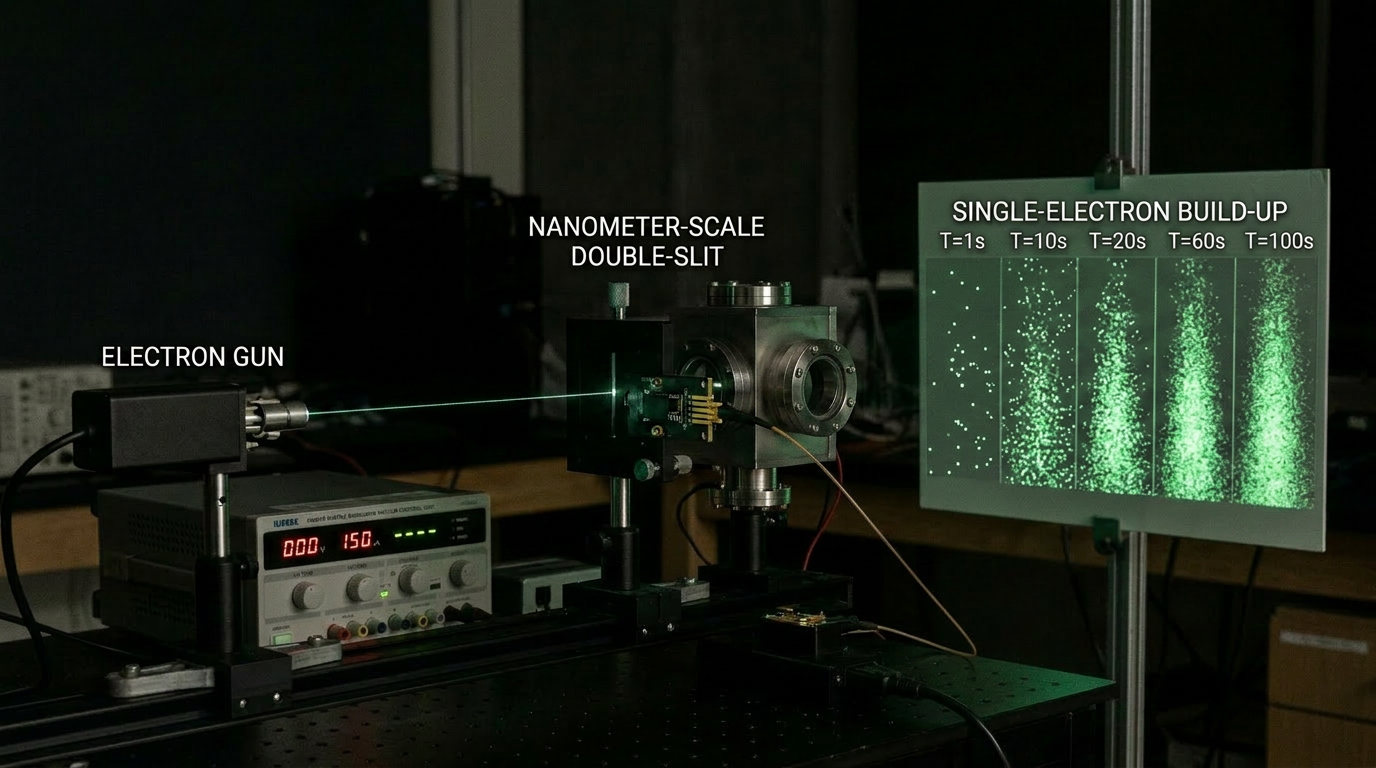
In these experiments we may not care which slit of the two that the photon or the electron pass through. In all such cases, an interreference pattern develops. Standard wave theory would model this effect on the wave nature of subatomic particles passing through the two slits. These particles have a finite wavelength which can overlap its neighbours wavelength causing a classical interference effect.
But you could also add a detector to your set-up to see which slit each electron passes through. And as soon as you do that you lose the interference pattern.
Photons are particles of light and have tiny momentum, therefore long wavelengths, so we’d expect strong interference patterns. Electrons are more massive than photons and have shorter wavelengths, but as you can see they still interfere in a Young’s double slit experiment.
But you can also do this experiment with particles much larger than electrons. Molecules have been used for example.

Now this is where things get interesting. We could set up our experiment in Fig. 2a so that the electrons are very slowly released from the emitter such that only after the time has elapsed for one electron to travel from the emitter to the screen is the next electron emitted.
That means the argument cannot be made that the wave properties of the electrons cause then to interfere with each other and produce the interreference pattern on the screen.
This is where the tree-falling-down-in-the-forest really comes in. If there is no observer we cannot say anything about whether or not the tree makes a noise. Similarly if we have no detector at either slit we cannot say anything about which slit any electron passes through. All we can say is that each electron has a certain probability of passing through a given slit. And quantum theory is born.
We use a mathematical device called a wave function that describes the evolution of the electron (or any particle) when we are not “observing” it. See Fig. 2a above. But the very act of making an observation (with a detector) changes the outcome of what we see. We say the act of observing collapses the wave function and we get the resulting outcome for an ensemble of particles over time. See Fig. 2b above. But their wave functions were not freely interfering with each other. The use of a detector interfered with that.
So the electrons do not need to be all in the same space nor temporally associated. All that matters is that we don’t “look”. The wave function is this “animal” that is only able to describe the probability of a certain outcome of a set of experiments, for example, electrons in the above case. For any individual particle there is no exact deterministic outcome, only a probability of a certain outcome. This is the standard Copenhagen interpretation, which treats particles as existing in a superposition of quantum states until measured. But until they are measured their future evolution is non-deterministic. Their precise positions and trajectories (or momenta) are unknown. Think Heisenberg uncertainty principle.
That was what my professor taught us back in that second year quantum physics class. Without an observer in the forest the trees may fall or rise, make noise or not when falling. Only when observed do we see them fall and make a noise.
Alternately, the de Broglie–Bohm theory or pilot wave theory, is a deterministic interpretation of quantum mechanics that posits particles have definite positions and trajectories at all times, guided by a physical “pilot wave” (the wave function).
That theory asserts that the wave function evolves according to the Schrödinger equation and physically guides the particle’s motion through a “quantum potential.” This approach eliminates the need for wave function collapse and provides a realist, deterministic view of quantum phenomena.
It has the following key characteristics:
- Determinism: The theory is fully deterministic; if the initial positions and wave function are known, the future trajectory of every particle can be calculated precisely.
- Hidden Variables: The exact position of the particle is considered a “hidden variable” that determines the outcome of measurements, even though we cannot know it with perfect precision without disturbing the system.
- Non-Locality: The theory is inherently non-local, meaning particles can be instantaneously influenced by the wave function across vast distances, although this does not allow for faster-than-light communication.
- Historical Context: Originally proposed by Louis de Broglie in 1927, the theory was largely abandoned until David Bohm independently rediscovered and expanded it in 1952. It was later championed by physicist John Bell, who showed it could satisfy the constraints of quantum mechanics despite initial objections.
The pilot wave theory is in some ways more satisfying because it is deterministic even though we we may not know precisely all the needed parameters to make a calculation. At least we are not forced into believing the many-worlds interpretation with multiple universes splitting off for every possibility of an outcome of an experiment.
The many-worlds interpretation is pretty much the multiverse or parallel universes of Michio Kaku and others. No Creator is needed. He is replaced by an infinite ensemble of universes. See On the Origin of Universes by Means of Natural Selection and The Big Picture: On the Origins of Life, Meaning and the Universe Itself? Part 9
Non-locality is a concept that is often talked about as if one could prepare an quantum entangled pair of particles and send one of the pair across the universe but use the local one of the pair to communicate instantaneously, that is, much faster than the canonical speed of light. No such possibility exists.
As strange and as spooky as quantum physics may sound it is now a well established physical theory that very successfully describes the outcomes of experiments in particle physics. No tinkering with it will ever discover a way to describe the present universe and it laws without the Creator. And the pilot wave interpretation is, in principle, a deterministic understanding of those laws when applied at the subatomic level. I suggest that only the Creator knows every particle, its position, energy and trajectory exactly. But to us some details remain hidden.
Conversely abandoning quantum physics because it appears to be non-deterministic is also crazy. Advances in physics (not cosmology) come from experimental laboratory tests. Those tests all point to a rational understandable universe, where energy is conserved and stable particles do not spontaneously come into existence from nothing (not even from energy), as some atheistic cosmologists believe.
Related Reading
- The Singularity—a ‘Dark’ Beginning
- Stephen Hawking and Imaginary Time
- Inflation—All in the ‘Dark’
- An Eternal Quantum Potential or an Eternal Creator God
- Quantum Theory to Eliminate the Beginning of the Universe
- An Eternal Big Bang Universe
From now on most new posts will be Subscriber only. Most of those will be Free Subscriber posts. Please subscribe.
Free Subscribers
Subscribe to our Newsletters as a Free Subscriber and be notified by email. Just put your email address in the box at the bottom of your screen.
You’ll get an email each time we publish a new article. It is quick and easy to do and totally free. You only need do it once.
Premium Subscribers
Subscribe to our Newsletters as a Premium Subscribers at $5 USD/month or $30 USD/year (you choose). Cancel anytime.
Paid Premium Subscribers will get exclusive access to certain content I publish. That will only cost you a cup of coffee per month.
Also you’ll be able to download, for free, a PDF of my book Apocalypse Now and also a PDF of my book The Physics of Creation The Creator’s Ultimate Design for Earth.
You can download them from the link below.
This is how you can support my work. I have been publishing this website for 10 years now and up to 2024 I never asked for any support.
Press the button “Premium” on the front page to find a list of Premium content. Thanks so much to all supporters.
At a minimum, please join as a Free Subscriber. It’ll cost you nothing. It may also help me beat the shadow banning of some posts.






Leave a comment