

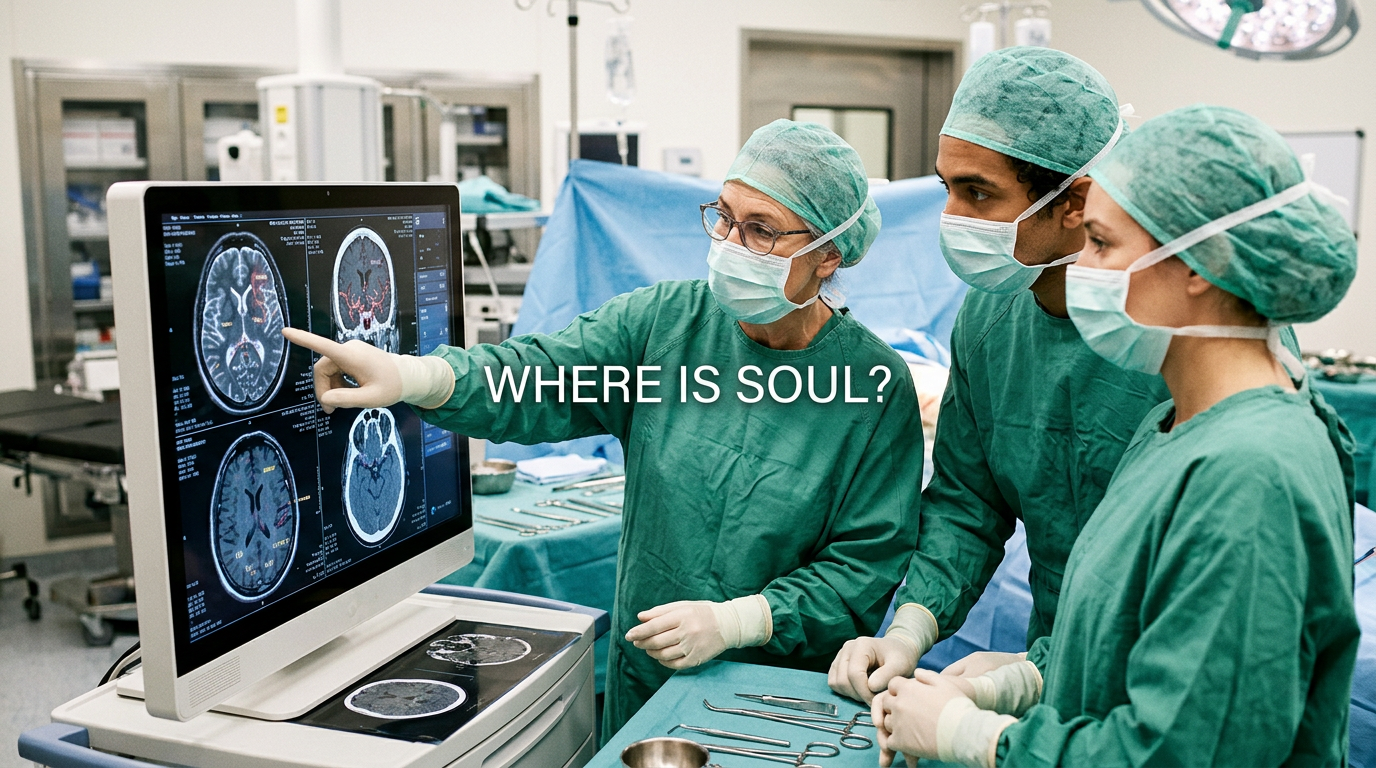
A leading neurosurgeon breaks down one of humanity’s biggest questions: Does the soul exist separate from the brain? Using real brain-surgery cases, split-brain research, free-will experiments, and near-death studies, he examines whether modern neuroscience points to a mind beyond matter, and whether the soul might actually be immortal.
Dr Michael Egnor stated in this presentation: There is no organ of intellect and will. Our brains can do computations but free will and the ability to conceptualise abstract thoughts does not come from the brain. In his presentation he shows you how this is the case. He addresses these big three questions:
Where is our soul? What is the soul? and is the soul immortal? Watch his illustrated video presentation or read the Transcript below.
Transcript
What is the soul and is the soul immortal? I very strongly believe that this is a question for neuroscience. That is it’s obviously there are theological answers to [music] this and there are philosophical answers to this but neuroscience also addresses these issues.
There are three questions that I want to ask today about the human soul. First of all, does the soul exist as something separate from the brain? The current materialist way of looking at things is that all of our mind is just from the brain. And if it does so, then what is the soul? And is the soul immortal? I very strongly believe that this is a question for neuroscience.
That is it’s obviously there are theological answers to this and there are philosophical answers to this. But neuroscience also addresses these issues. And it does so I think in a fascinating way.
The first question, does the soul exist as something separate from the brain?And I’d like to start with my own story.
I started out as a materialist and an atheist as a young man. And in medical school, I I fell in love with neuroanatomy and neurophysiology because I thought that learning about the brain, learning all the detailed beautiful neuro anatomy would really help me understand who I was and understand what it was to be a human being.
I trained in neurosurgery at the University of Miami and have been at Stonybrook on faculty there since 1991. And I’ve done about 7,000 brain operations. And I’ve learned a fair amount in not only academically but just in personal experience as to how the brain works and how the mind relates to the brain.
I saw a number of things over my career that made me question the traditional materialist way of understanding how the brain works.
The patients I’m going to show you here are real people. I’ve changed their names, but they’re very real people. The picture on, I guess, it would be which side on your left is an MRI of the brain of a young lady. And the black there is spinal fluid. The brain is the gray stuff there.
She’s missing about two thirds of her brain. That’s the way she was born. The image alongside of it is a normal brain for comparison. When she was a young baby, we scanned her and found this and we were rather pessimistic with her family about her chances of having a normal life. She grew up a completely normal person. She was on the honor roll in high school. If you met her today, you’d say she’s a bright young lady. She’s perfectly fine. Missing two thirds of her brain.
This is a little boy named Joshua. He was born missing also about two thirds of his brain. And he … that again that black space there is just water. He was evaluated by the ethics committee at my hospital and they recommended that he not be fed when he was born because he was in such terrible shape that that it’d be better if he passed away.
We rescinded that order and fed him and he’s now graduating from high school. Perfectly normal young man. Plays sports. He’s a great kid.
Maggie is a young lady who was in a gifted program when she was young. She’s a brilliant young woman. Missing most of her cerebellum and part of the central regions of her brain. She has had to have some surgery to take care of fluid pressure there, but she’s done very well. She has a master’s degree in in English literature and she’s a published musician.
Nicholas is a little boy who’s quite handicapped. He has cerebral palsy and he’s missing both hemispheres of his brain.
The only part of his brain he has is his brain stem. He is handicapped. He can’t speak. He can’t walk. But he’s fully conscious. He’s kind of funny. He laughs. He cries. He’s emotionally a normal person even though he is handicapped, even though he’s missing his entire brain hemispheres.
So it raises the question, it sounds like a really strange question, but as you see, it’s so strange.
Is the brain the organ of the mind? You know the heart’s the organ of circulation. The kidneys are the organ of making urine.
But is the brain completely the organ of the mind? Clearly in some ways it it is but in other ways it may not be.
This question was first addressed by Wilder Penfield who’s a neurosurgeon worked in Montreal in the mid- 20th century probably the greatest scientist in the neurosurgical profession. And he was the pioneer in epilepsy surgery and he would do awake brain surgery meaning that patients during the brain surgery would be fully awake with local anesthesia so they felt no pain and he would stimulate their brain to map the surface of their brain to remove foci of epilepsy.
And he’s devoted his career to studying epilepsy and he asked a fascinating question. He said, “Why are there no intellectual seizures?” When people have seizures, if they remain conscious during the seizures, they do one of four things.
They’ll have uncontrollable movements. Their arm will shake. They can have sensations like tingling on their skin. They can have emotions, powerful fear or laughter or joy. And they can have memories. You can have a seizure where you get this recurrent memory.
But nobody ever has a calculus seizure. Nobody ever has a mathematic seizure where you can’t stop doing long division.
And Penfield said that’s really odd. If you can evoke all these other things, why can’t you evoke abstract thought, reasoning, theology, philosophy, thinking about God? It doesn’t happen from seizures. And he said the most reasonable explanation is that that aspect of the mind isn’t from the brain.
He tested this further by intraoperatively with awake patients stimulating the surface of their brain to map the brain just like he would map a city and to find out where where different things were located on the brain again so he could protect them in removing epileptic foci.
But he couldn’t find any kind of abstract thought centers in the brain. There’s a movement center, there’s a sensation center, there’s a visual center, there’s a hearing center, there are emotional centers, there are memory centers, but there’s no center for thinking abstractly. There’s no center for reason. And he said that’s odd. That’s the same thing that he found with looking at the kinds of seizures that happen.
Some of the most interesting work along this line has been done by Roger Sperry and his colleagues. Sperry won the Nobel Prize for this work. Back in the mid-20th century, an operation was developed for people who would have a seizure in one hemisphere of the brain that would spread to the other hemisphere and these were catastrophic seizures that were very difficult to control.
So what Sperry so and an operation that was developed not by Sperry but by others was to cut the brain in half essentially so that if a seizure started in one half of the brain it couldn’t spread to the other half and that made the seizures much easier to control and and much milder and it was called a corpus callosotomy and we still do that surgery today.
So the hemispheres of the brain are functionally disconnected and Sperry who was a neuroscientist realized that you could study what each hemisphere does because they’re disconnected. So he did a lot of wonderful work and the left hemisphere controls speech, the right hemisphere controls spatial orientation and he got the Nobel Prize for that.
But one thing that he noticed and I’ve noticed too is that people who have had their brains cut in half are pretty normal people. As you meet these people, the brains are cut in half and they’re walking and talking. They feel normal. They have less seizures than they used to have.
It would be the same thing as if someone just took a chainsaw and cut the laptop in half and it still worked just fine.
Like there’s something odd about this.
The follow-up research on that is something that still gives me chills.
And I learned about this decades ago and I think it’s among the most fascinating results in cognitive neuroscience.
Justine Surgent was a researcher in McGill in Montreal worked like about 20 years after Sperry and she studied people with split brain surgery and what she did was she found a way to present pictures of things like pictures of arrows to each hemisphere separately at the same time. So she put arrows up that the right hemisphere would see one arrow, the left hemisphere would see the other arrow, but no part of the brain saw both arrows. One half saw one arrow, the other half saw the other arrow.
And she asked the people, are the arrows pointing in the same direction or not? And they always got it right.
But how did how could they compare arrows when no part of the brain saw both arrows?
So she concluded that there was something in the mind that wasn’t in the brain.
Yair Pinto has furthered that research in which he tells stories to split brain patients where the first half of the story is presented to one hemisphere, the second half of the story is presented to the other hemisphere. But you don’t understand the story unless you see both.
A good example would be if the left hemisphere gets a can see a baseball and the right hemisphere can see a broken window. So Pinto would ask the patient what happened and the patient’s always answered the baseball broke the window. But no part of the brain saw both the baseball and the window.
So there’s something in the mind that’s not in the brain.
Wilder Penfield also studied free will and he did a very very interesting study during these awake brain operations. He would stimulate the surface of a patient’s brain and if you stimulate the right place you can make them do things like make them raise raise their arm.
He would ask them during the surgery to occasionally raise their arm themselves without him stimulating them. And you can’t feel your brain. Your brain has no sensory things and the patients are under surgical drapes, can’t see what he’s doing. And he would ask them, “When your arm goes up, I want you to tell me whether you did it or whether I did it.” And they always got it right. Hundreds of thousands of trials of this in 1,100 patients. No one ever missed it. No one ever got it wrong.
And he concluded then that he couldn’t find any place in the brain that simulated free will.
That free will wasn’t in the brain. That you could always tell this is my will. This is not someone doing it to me.
So free will is not a brain function.
Benjamin Liebbit did probably the most famous research on free will. And what Liebbit found and it would take awhile to go in details about how he did his experiments. They were quite ingenious. But he would record electrical signals from the scalp and these are people who haven’t had any surgery. They’re just normal volunteers.
And what he found was that when you decide to do something simple, there tends to be a spike in brain activity that happens about a half second before you decide. Like if you’re going to turn on a light switch, about a half second before you turn on the light switch, your brain spikes. And that’s before you’re aware that you’re going to turn it on.
So what and that seems at first glance that everything is driven by your brain. Your brain makes you do it and you don’t really have any free will. It’s all just chemicals driving you to do things.
But he was a very clever researcher and what he did is he asked people to veto your decision. That is that when you’re about to flip the switch, say no, I’m not going to do it. I’ve changed my mind. And the veto didn’t have a spike in the brain.
So he said it’s not so much that that he showed there was free will but they showed there was free won’t.
That is that your brain and he commented he was a religious man and he said this is the traditional religious way of understanding human motivation that we’re hit with temptations from our brain but we have the free choice to do it or not because the free choice to do it or not did not have any new brain activity at all. It was independent of the brain.
So, the brain keeps hitting you with these things. Have that extra piece of cake. But you can say yes, yes or no, and you can’t blame your brain.
Adrienne Owen is a researcher. I think he’s currently in Indiana. He was at Cambridge in England. Did a fascinating study in patients in persistent vegetative state. Persistent vegetative state is the deepest level of coma. It’s just a step above brain death and it happens when people have had very severe brain injuries from lack of oxygen or from motor vehicle accidents.
And it’s called vegetative because it’s been assumed that these people are basically vegetables, meaning that they have no mind. They’re just a body and there’s no mind left.
Some of you may recall the Terry Shiavo stuff that went on about 20 years ago. She was in persistent vegetative state.
What Owen did is he put patients in MRI machines and did functional MRI that shows brain activity and he would ask them to think about things with a headset. He’d say, “Think about walking across the room or think about your family or thinking about or think about playing tennis.” And they would show patterns of brain activation in their very damaged brain.
And he then did that with normal volunteers and found the patterns were identical. Implying that they were understanding what he was talking about. And then what he did, he was very clever. He asked the same questions, but he mixed up the words so they didn’t make any sense.
Instead of “think about walking across the room”, he say “room across walking about think”. Doesn’t make any sense. And the brain was silent.
So these people were understanding the questions he was asking even though their brains were practically destroyed.
And he actually found, he and others other people have have replicated his work that about 40% of people in persistent vegetative state show clear evidence of being able to communicate. There are people who can do mathematics in persistent vegetative state. You ask them what’s 9 plus 6. You count when you hit 15 the brain lights up.
There are people who can tell their family histories. You know, Is your brother’s name George? Brain will light up. So you can communicate with people in the deepest level of coma in many cases.
Near-death experiences are sort of the paradigmatic example of a separation between the soul or the mind and the brain. And while some near-death experiences may be not genuine, they may be hallucinations or whatever, there’s no doubt that there is a real core of real experiences.
There are probably about 20% of near-death experiences are veridical, meaning they could be checked. The person knows things that occurred when they were dead, things that went on inside the room, etc.
Probably the most famous near-death experience was Pam Reynolds who was an aneurysm patient operated on in 1999. And in order to safely operate on the aneurysm, her surgeon had to stop her heart after cooling her body down to about 50° Fahrenheit. And that gave him about 30 minutes to fix the aneurysm.
He drained all the blood out of her brain, fixed the aneurysm, and then rewarmed her and started her heart again. And she survived and did very well actually.
She said that in the recovery room, she said, “You know, I watched the operation.”
He said, “What?” You know, you were brain dead. You couldn’t possibly watch the operation.
So, she said that as soon as her brain went dead, she popped out of her body, floated up to the ceiling, watched the surgery.
She said that her vision was amazingly accurate. And it was a beautiful scene.
And then she told him what he talked about during the surgery. She told him what the instruments looked like and what music was playing in the room during the surgery.
And things like this have happened a number of times. So in my view there’s no question that some near-death experiences are very real.
The other thing that for me is very convincing is that people have surveyed the literature and there are thousands of examples of this in the literature where people go down a tunnel and they see loved ones and relatives at the other end of the tunnel. Nobody in the medical literature who’s had a near-death experience has ever seen a living person at the other end of the tunnel.
It’s not like you kind of want your mother and your mother’s still alive and you see her at the other end of the tunnel. Only dead people are at the other end of the tunnel, including people that you didn’t know were dead.
There are a number of examples of people who were in car accidents where someone in the car died and they didn’t know the person died because they were critically injured also and they saw that person on the other side of the tunnel, but not people in the car who didn’t die.
Everybody asks about Phineas Gage. Phineas Gage was a gentleman who in a work accident in the 19th century had an iron spike that was driven through his brain and his personality changed. He was a religious upstanding man before this and after this he wasn’t too bad a guy but he kind of lived the high life a little bit. And people say well that doesn’t that prove that the brain completely controls the mind and it doesn’t.
Gage’s emotional state changed but there’s no evidence that there was any change in his mathematics or reason or things like that. So obviously if you have brain injury you can have changes in the way you behave but that doesn’t mean that every aspect of the mind comes from the brain.
A question that is being asked particularly nowadays with AI is, is the mind a kind of computation and no it’s not. It’s not a kind of computation for a very simple reason.
Everything in your mind is pointed at something. It has a meaning to it. Right? When you think, you always think about something. You can think about Dallas, you can think about a laptop, think about your family.
But nothing in computation has any aboutness to it. That is a word processor. A word processing program doesn’t care about your opinion in the essay you’re writing. You you can write a pro essay and a con essay. It doesn’t matter. Computation has no aboutness. A camera doesn’t care whether you’re taking a picture of a sunset or a picture of a snow scene.
Couldn’t care less. So computation has no meaning in it. The only meaning is what we ascribe to it. So, not only is the mind not a kind of computation, it’s the opposite of computation.
Now, you can study the brain as if it were a computer, but that’s just an artificial framework you’re imposing on the brain, but the mind is not a kind of computation.
It’s the opposite.
Then you can ask the question, did the mind evolve?
I don’t really think that anything evolved, but I certainly don’t think that that the mind evolved. And the reason is very simple. If natural selection is a real force that can actually create biological novelty, which I don’t believe for the most part that it can. It can only work on physical things. And at least part of the mind, as we’ve seen repeatedly, is not physical.
So, you can’t evolve something that isn’t inherent to matter.
So, is the brain the organ of the mind? Seem like a crazy question, but it’s not crazy at all because our capacity for reason, our capacity for free will can’t be evoked from the brain. But we certainly have this capacity.
So I think the most reasonable scientific conclusion is that the brain is the organ of movement, perception, memory, and emotion. Those definitely come from from the brain. There’s no question about that. But there is no organ of intellect and will.
Now, the brain in some sense is necessary for normal functioning of the intellect and will. That is, you’re not going to be able to think too clearly about calculus if you’ve just been hit over the head with a baseball bat. And your will can be affected by alcohol, which affects the brain. But that doesn’t mean that your intellect and your will come from the brain because there’s a ton of scientific evidence that they don’t come from the brain.
So the first question we ask is does the soul exist? And the answer is yes. The soul exists. The soul is what animates a human being. Our soul is everything that makes us alive. So part of the soul is brain activity. Moving, sensing, emoting and remembering. But part of the soul is this abstract capacity that we have.
So what really then is the soul? It’s like a hybrid.
Well, the soul can do a variety of things. It it knows, it loves, you know, we know things, we love things, and it animates us. It makes us living human beings. It has no parts as Sperry and surgeons in Pinto found.
If you cut the brain in half, you don’t cut the soul in half. It has no location. Meaning near-death experiences don’t happen in a place, at least in this world, that we can put our finger on. You know, you can’t find the tunnel anywhere that people go down. Soul is not in time. Near-death experiences are timeless in a sense.
And the soul abides meaning it exists even after death and it can even exist with severe brain injury.
So the soul is a spirit and our spirit is our soul. We are the only living creatures whose souls are spirits. Animals have souls. Even plants have souls. But their souls are entirely material. Their souls — like an animal soul — lets the animal remember and move and perceive and do things like that. Very very very important stuff. But animals don’t do calculus. Animals don’t think about God.
Animals don’t even have free will. They can have appetites but they don’t think morally about things. So we are the only living creature that has a spiritual soul. And again, while one can make a very strong theological argument about the truth of this and even a philosophical argument, you can make an equally strong neuroscientific argument.
And since truth is unitary, the arguments, if they’re true, all have to line up. And in fact, they do line up.
We are a paradigm of all creation. Meaning, we’re a mixture of spirit and matter.
We have one foot in matter, our our body, our movement, sensation, memory, and emotion, and one foot in spirit, intellect, and free will. And that’s been referred to by theologians as the great chain of being.
We are made in God’s image in this sense that God is infinite spirit, his knowledge, love, and power. And the human soul knows, loves, and acts. And we are created in his image. The spiritual aspect of our soul is God’s image.
Is the soul immortal?
One could at least think that, okay, well, all right, so we have souls, so it’s a spirit. But when our body dies, the spirit blinks out, goes away.
The question then is, can a spirit die? What does it mean for a spirit to die? Which we can get at by asking, what does it mean to die?
What does death really mean? So, if you think of a chair, a tree, and a dog. Say, how do those things die? Well, a chair, at least metaphorically, could be said to die. And what happens if a chair dies, is that it’s reduced to wood chips, just a pile of dust. You say, well, there’s no longer any chair. It’s just a pile of dust. The matter in the chair never goes away, but it’s just dust now instead of a chair. The tree is the same thing. When the tree dies, it rots and just goes back into soil. The dog is the same thing.
So life is an integration of matter to make a living thing. And death is a disintegration of matter. When we die, our bodies don’t go away. They disintegrate.
But every atom inside our body will end up somewhere else.
So the physical body can disintegrate. But can a soul, a spirit, a spiritual soul disintegrate?
And to get a feeling for the answer to that question, think about the number eight (8). There are two ways that the number eight can be represented. One is written down on a piece of paper and the other is conceptually thinking about the number eight. Well, certainly the number eight written on a piece of paper can disintegrate if you put the paper in fire and burn it. It just becomes a pile of ash. So, in that sense, the number eight can die, can disintegrate if it’s material.
But the number eight conceptually, one might say the spiritual number eight can’t die. You’re you’re not going to hear from a mathematics department at the local university that the number eight passed away yesterday.
And so now we have to count from 6 7 9 9 10. Right? So numbers don’t die.
Abstract things don’t die. And spirits don’t die.
Matter disintegrates. Spirits can’t disintegrate. And note that this immortality is natural.
Of course it comes from God. But we are naturally immortal.
That is, it’s in our nature that our spirit cannot disintegrate and cannot die. Your spiritual soul has no off switch. Your body has an off switch but not your soul. And the soul is immortal.
One question that has utterly fascinated me for many years and I thought about it philosophically, theologically etc. Has bothered me a little bit. When people have near-death experiences, they report beautiful scenes. They say the colors are just breathtaking and that their vision is like nothing they’ve ever experienced on Earth.
And you know, and I’m a scientist of sorts. I say, “Well, how can you see without eyes?” You know, we’re talking about a spiritual soul. Spiritual souls are neat things, but they don’t have eyes.
You know, in the resurrection they’ll have eyes, but you’re in that intermediate state [in a near death experience]. So, how do you see anything?
And Thomas Aquinas addressed this question almost a thousand years ago and he gave kind of an analogy. He said, “Imagine that life on earth is like being inside a church with stained glass windows at night. And the church is lit from indoors with candles. So, it’s kind of dim in there. You can see things. You can see, you know, the windows at night, but it’s dark outside. And you just see this dim inside of the church. And imagine you’re getting towards daylight, but it’s still dark. And then the candles go out. And that’s when you die. But as the sun rises, suddenly you see incredibly beautiful things. You see by God’s light from outside.”
So the light that people are seeing, I think, in near-death experiences is divine light. And that’s how we see. It’s a different kind of light.
So thank you. And we can discuss these issues in much more detail and other issues in the immortal mind.
(end of presentation)
I found this very interesting and it resonates with what I have experienced in my own life. The incident he mentions of the near death experience of the woman who had a brain aneurysm was very familiar to me. She said she left her body and watched the whole operation from above, looking down on the surgeons.
In 1974 when a small group of fellow believers laid hands on me and prayed for me to receive the gift of the Holy Spirit I experienced leaving my body and looking down from above at them with their hands laid on me as they prayed for me. I felt my body being filled with warm fluid (oil of the Spirit) from head to toe. I soon returned to my body and told them what I saw. It was a very euphoric experience.
Another point that comes to mind is that the brain may be the computational center but it is not the source of the soul or mind, the intellect. The scientific evidence indicates that the soul and intellect, the spiritual being that we are, made in the image of God, is not the product of the material world. The Bible in numerous places tells us that the soul resides in the heart, and when we die it continues on.
Eventually we must all stand before our Maker after our body has died but our spirit lives on.
For we must all appear before the judgment seat of Christ, that each one may receive his due for the things done in the body, whether good or bad.
2 Corinthians 5:10 ESV
Recommended Reading
- The Human Heart is More than Just a Meat Pump
- The Weapons of Our Warfare Are Not Earthly But Spiritual for the Demolition of Satan’s Strongholds
- Liberty and Freedom in Christ
- We Fight Against the Rulers of Darkness
- The Salvific Power of Christ
Free Subscribers
Subscribe to our Newsletters as a Free Subscriber and be notified by email. Just put your email address in the box at the bottom of your screen.
You’ll get an email each time we publish a new
Premium Subscribers
Subscribe to our Newsletters as a Premium Subscribers at $5 USD/month or $30 USD/year (you choose). Cancel anytime.
Paid Premium Subscribers will get exclusive access to certain content I publish. That will only cost you a cup of coffee per month.
Also you’ll be able to download, for free, a PDF of my book Apocalypse Now and also a PDF of my book The Physics of Creation The Creator’s Ultimate Design for Earth.
You can download them from the link below.
This is how you can support my work. I have been publishing this website for 10 years now and up to 2024 I never asked for any support.
Press the button “Premium” on the front page to find a list of Premium content. Thanks so much to all supporters.
At a minimum, please join as a Free Subscriber. It’ll cost you nothing. It may also help me beat the shadow banning of some posts.








Leave a Reply