
I am now 74 years old and like a large percentage at my age have an enlarged prostate (BPH). When talking with other older men prostate cancer comes up quite a bit. At my doctor’s office for years I have had the routine screening via blood tests for PSA (prostate-specific antigen), a protein that is supposed to give you an early indication of prostate cancer.
My results have always been low (<2), but I also recently found out that that those tests are notoriously unreliable to detect cancer especially the more aggressive kind. However PSA can be used to monitor someone who has been otherwise diagnosed with prostate cancer.
The main limitations of using PSA for prostate cancer screening are:
PSA is prostate-specific but not cancer-specific. Benign conditions — benign prostatic hyperplasia (BPH), prostatitis, infection, inflammation, and even age — all elevate PSA. Roughly 72%–80% of men with an elevated PSA do not have prostate cancer, leading to unnecessary biopsies and anxiety.
About 15% of men with a “normal” PSA actually have prostate cancer. No PSA value can rule out cancer, so a normal result provides false reassurance.
PSA cannot distinguish between aggressive, life-threatening cancers and slow-growing, indolent tumours that would never cause symptoms or death in a patient’s lifetime. This leads to diagnosis and treatment of cancers that pose no real threat, exposing men to the side effects of surgery, radiation, or hormonal therapy (e.g., incontinence, erectile dysfunction) without any health benefit.
I personally have several friends and relatives who have told me they have prostate cancer, diagnosed by biopsy. Unfortunately several of those have also had the deadly COVID vaccine shots, which have been linked to turbo cancer.
This led me to dig into this subject a little more. But nothing I write here is medical advice. I offer it only for informational purposes.

Up to 90% of men over the age of 80 have benign prostatic hyperplasia (BPH). The prevalence of BPH increases significantly with age, with approximately 50% of men between ages 51 and 60 affected. For those over 60, estimates vary by study but generally indicate that 70% of men in their 60s, rising to 70–80% for those in their 70s, and reaching nearly 90% for men aged 80 and older.
Cancer is found incidentally in 10%–20% of surgically removed BPH specimens. Additionally, more than 20% of men with prostate cancer also have BPH, indicating that while the conditions frequently coexist, BPH itself is not considered a risk factor or precursor for developing prostate cancer.
The mainstream clinical consensus is that BPH does not increase the risk of developing prostate cancer. They are distinct conditions that can coexist due to shared risk factors (age, genetics, hormones), but one does not cause or predispose to the other.
The strongest evidence comes from the Prostate Cancer Prevention Trial, a large prospective study that found no significant association between symptomatic BPH and prostate cancer risk, and is described as “the strongest evidence to date” supporting this conclusion.
There is some nuance in the research:
- A 2016 meta-analysis reported a statistical association (RR ≈ 2.93), but with very high heterogeneity between studies, and the authors themselves noted that detection bias (men with BPH get more prostate exams, so incidental cancers are found more often) likely explains much of the signal.
- A 2025 Mendelian randomization study suggested a possible genetic-level link, but this is early and not yet reflected in clinical guidelines.
- A 2023 Beaumont Health MRI study actually found that BPH was associated with a reduced risk of prostate cancer.
In short: BPH is not a precursor or risk factor for prostate cancer. If you have BPH, your prostate cancer risk is no higher than that of a man without BPH of the same age and family history.
Then I found this message (below) on Dr. Mike Yeadon’s Telegram channel.
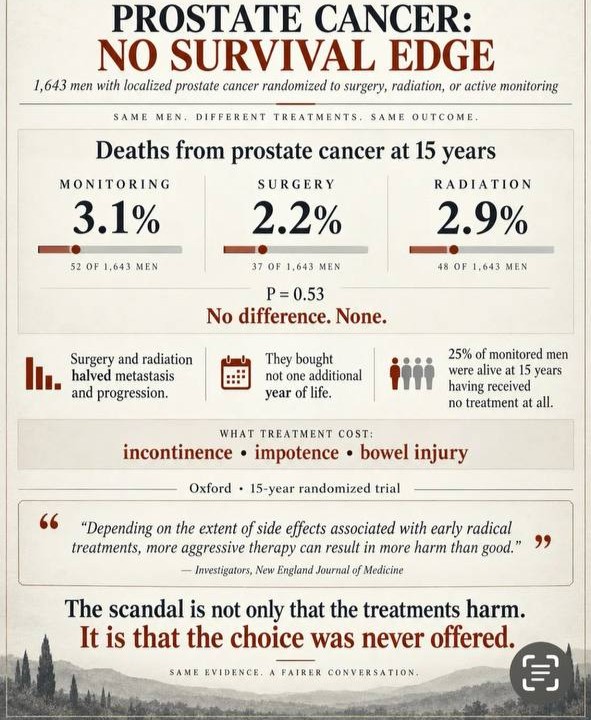
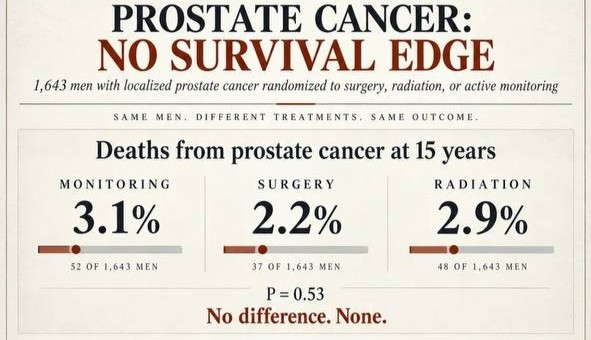
This from as study published in the New England Journal of Medicine. Based on a 15-year randomised trial of 1,643 men with localised prostate cancer it was found that no treatment option of surgery or radiation brought the patient any more time than those who were just actively monitored.
Dr. Mike Yeadon wrote on Telegram in this regard:
In case it passed you by, it’s really important to keep away from urologists unless you have really serious problems voiding your bladder. Even then, tread very carefully. They’re not to be trusted, any more than any other medical doctor.
Oh, and please don’t ever consent to “routine screening for prostate cancer”.
This brief statistic shows why not.The aggressive “treatments” used don’t extend your life, but they are likely to damage you, not unusually in serious, permanent ways.
But hey, at least the surgeon makes money.
Best wishes
Mike
Research on Cancer Risk after COVID Vaccination
Data from 8,407,849 individuals between 2021 and 2023 were obtained from the South Korean National Health Insurance database. Using that data research, published September 2025, in the journal Biomarker Research found a significant cancer risk increase of 27% overall from mRNA and non-mRNA vaccines.
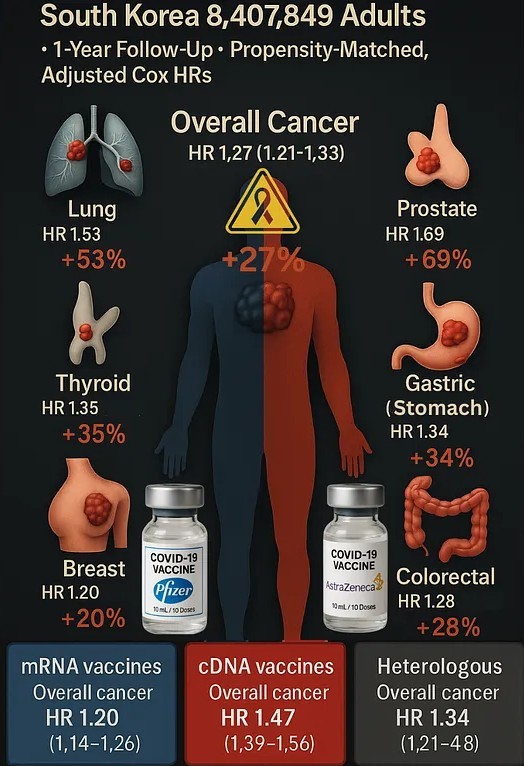
Specifically the research findings showed, at the 95% confidence interval, cancer risk increases of 35.1% for thyroid, 33.5% for gastric, 28.3% for colorectal, 53.3% for lung, 19.7% for breast and 68.7% for prostate cancers at 1 year post-vaccination.
In terms of vaccine type,
- cDNA vaccines (non-mRNA, genetic vaccines that use plasmid DNA encoding specific antigen sequences) were associated with the increased risks of thyroid, gastric, colorectal, lung, and prostate cancers;
- mRNA vaccines (a type of vaccine that uses synthetic messenger RNA to instruct cells to produce a specific protein) were linked to the increased risks of thyroid, colorectal, lung, and breast cancers;
- and heterologous vaccination (administering different types of vaccines to the same person) was related to the increased risks of thyroid and breast cancers.
For COVID-19 Pfizer-BioNTech (Comirnaty) and Moderna (Spikevax) produced the only mRNA vaccines currently authorized. They showed a 20% higher overall risk of cancer.
Whereas AstraZeneca (Covishield) and Johnson & Johnson (Janssen) produced non-mRNA vaccines, which rely on DNA within an adenoviral-vector rather than messenger RNA.
The ZyCoV-D vaccine developed by Indian pharmaceutical company Zydus Cadila is a cDNA vaccine, a notable example of a plasmid DNA vaccine that has received regulatory approval, utilizing intradermal delivery.
Non-mRNA type vaccines were found to be associated with a 47% higher overall risk of cancer.
Patients who received a mixture of mRNA and cDNA doses also faced an increased risk, with a 34% higher incidence of cancer overall.
Epidemiologist Dr. Nicolas Hulscher wrote in a post on Substack:
“Critically, the signal was observed across all vaccine types — both mRNA and viral-vector (cDNA) shots — and in every demographic group analyzed. In plain terms: both major COVID-19 vaccine platforms appear to be carcinogenic …. In other words, no vaccine technology was free of cancer risk in this dataset.
Dr. Angus Dalgleish, a medical oncologist, told The Defender the study builds on other recent findings but “is the first to show that cDNA [non-mRNA] and mRNA vaccines are associated with cancer risk, suggesting that the spike protein is directly carcinogenic.”
In that 2025 Korean study COVID-19 vaccination was linked to significant increases in multiple major cancers, with the signal consistent across all vaccine platforms, in both sexes, and age groups.
The highest cancer risk increase from COVID-19 vaccines was for prostate cancer (~69%). Non-mRNA (cDNA) vaccines using viral vector or plasmid DNA and the use of heterologous vaccination (mixing different types) were the highest for cancer risk.
Even though the Pfizer mRNA vaccine is not the same as the cDNA vaccines plasmid DNA was found in a deadly heart turbo-cancer tumor in a patient who was vaccinated 170 days after a Pfizer mRNA shot.
Related Reading
- Significant Increases in Cancer Mortality After COVID mRNA Vaccination, Japanese Researchers Find
- Watch: Spike Protein Leads to ‘Five Mechanisms of Damage’ in Human Body
- Pfizer Synthetic Vaccine Spike-Encoding Plasmid DNA Found Inside Deadly TURBO CANCER of the Heart
- Was the COVID-19 Vaccine the Cause of Dolly Parton’s Death from Turbo Cancer?
- Dr. Mike Yeadon | All Vaccines are Worthless Poisons
- Dr. Mike Yeadon: EVERYTHING Was Propaganda. There Was No New Illness Called Covid19. There Is No SARS-CoV-2 “Virus”
- Dr Mike Yeadon Discusses The Abuse of Emergency Use Authorizations for the Vaccines
- Vaccines: A Dangerous Tool for Population Control
- There Never Was a Pandemic! We Were All Scammed!
Free Subscribers
Subscribe to our Newsletters as a Free Subscriber and be notified by email. Just put your email address in the box at the bottom of your screen.
You’ll get an email each time we publish a new article. It is quick and easy to do and totally free. You only need do it once.
Premium Subscribers
Subscribe to our Newsletters as a Premium Subscribers at $5 USD/month or $30 USD/year (you choose). Cancel anytime.
Paid Premium Subscribers will get exclusive access to certain content I publish. That will only cost you a cup of coffee per month.
Also you’ll be able to download, for free, a PDF of my book Apocalypse Now and also a PDF of my book The Physics of Creation The Creator’s Ultimate Design for Earth.
You can download them from the link below.
This is how you can support my work. I have been publishing this website for 10 years now and up to 2024 I never asked for any support.
Press the button “Premium” on the front page to find a list of Premium content. Thanks so much to all supporters.
At a minimum, please join as a Free Subscriber. It’ll cost you nothing. It may also help me beat the shadow banning of some posts.







Leave a Reply