by Prof. Augusto Zimmermann and Emeritus Prof. Gabriël A. Moens AM

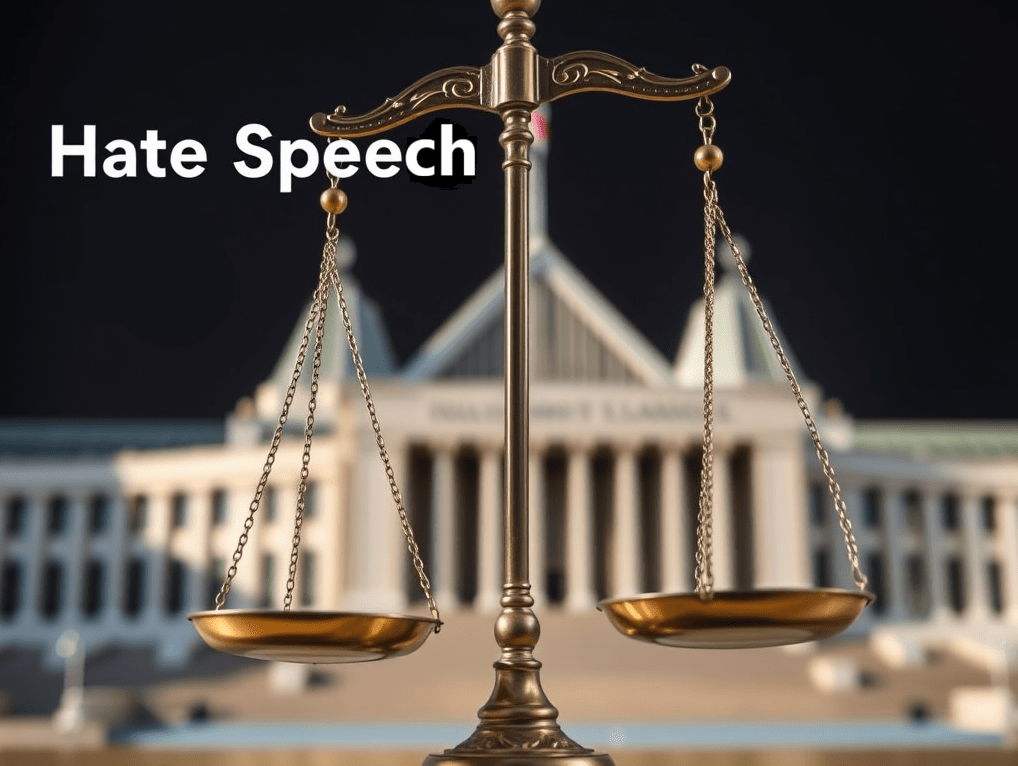
The adoption of legislation that adversely affects, even prevents, free speech has been of increasing concern in Australia. Next week, the Australian parliament is being recalled for the purpose of passing laws against “antisemitism, hate and extremism”. The proposed legislation in question is the Combating Antisemitism, Hate and Extremism Bill 2026, which seeks to criminalise antisemitism, hate speech and extremism.

The term “extremism” is itself an artifice because even the initiation of a serious conversation about the country of origin of new arrivals could trigger the application of the law. People will face five years in jail if their speech can cause someone “to be intimidated”. The proposed legislation says it is “immaterial whether … the conduct actually results in any person feeling intimidated”.

The proposed hate speech laws are so vague that a wide variety of legitimate political communication could be banned. They could easily be used to silence genuine commentary of government policy.

Immigration is a good example. To deal with immigration in a responsible manner, it is worth remembering the words of the late Sir Harry Gibbs, formerly Chief Justice of the High Court of Australia:

While it would be grossly offensive to modern standards for a state to discriminate against any of its own citizens on the grounds of race, a state is entitled to prevent the immigration of persons whose culture is such that they are unlikely readily to integrate into society, or at least to ensure that persons of that kind do not enter the country in such numbers that they will be likely to form a distinct and alien section of society, with the resulting problems that we have seen in the United Kingdom.[1]

Likewise, according to Senator Matt Canavan:

The current government is facing significant criticism of its immigration policies that have allowed 1.3 million migrants in Australia in just three years. I have argued that we should not take so many people in from countries that have different cultures and customs than us so quickly. We must make sure people that do move here adopt our values and lifestyles. Taking in so many people so quickly overwhelms our ability to assimilate people while maintaining a harmonious country.[2]

As Senator Canavan himself points out, these valid arguments against mass immigration “could easily fall foul of the above definitions because what makes some ‘intimidated’ is left vague and undefined”.[3]

In what is perhaps most intriguing, this Omnibus Bill – it also deals with gun control and a governmental gun buyback scheme – which the government is seeking to approve in a special parliamentary session does not mention Islamic terrorism.[4] Indeed, the Australian government has not even mentioned radical Islam as the main purpose of these laws, despite the fact that an Islamic terror attack is the cause of the slaughter of many innocent people, not only at Bondi Beach on 14 December 2025, but other previous terrorist attacks on Australian and foreign soils. As noted by The Spectator Australia,

If this government was serious about addressing the source of violence and terror, the wording of the bill and the way in which it has been publicly described, would have no trouble restricting itself to the ideological culprit of the Bondi incident.[5]

In allowing the focus to be on antisemitism instead of Islamic terror, this government has betrayed the people of Australia and make a mockery of the deaths at Bondi Beach.[6]

In this sense, the proposed legislation may not be used to truly combat Islamic terrorism, or the promoters of Islamist hatred, despite overwhelming evidence of their existence. As also stated by The Spectator Australia,

This is bizarre, given Islamic terror is the sole cause of the Bondi Beach terror attack and essentially the only ideology responsible for terror attacks on Australian soil in the last 20 years.[7]

Naturally, many statements by the more extreme Muslim religious spokesmen in Australia should be treated appropriately with contempt or revulsion. But if people were to react in this way, they risk breaking the law. For example, it will become illegal to express repugnance for a Muslim terrorist who, based on his “religious belief”, murders large numbers of innocent civilians.

An additional worry is that these laws, once enacted, will have retroactive effects, meaning that past speech and behaviour could now be considered hate crimes and subject to the laws’ punitive provisions. The Bill is patently clear that, for the purposes of enforcing these laws, “conduct constituting a hate crime may have occurred before commencement”.

(2) In Subsection (1):

(a) a reference to conduct constituting a hate crime includes a reference to conduct constituting a hate crime that occurred before subsection (1) commences. 

Professor Lon L Fuller, an influential jurisprudential thinker of the past century, argued that retrospective laws are usually associated with totalitarian regimes, such as Nazi Germany. He reminded us that “it is normal for a law to operate prospectively” and “retroactivity presents a real problem for the internal morality of law”. He relevantly stated that,

A general increase in the resort to statutes curative of past legal irregularities represents a deterioration in the form of legal morality without which law itself cannot exist. The threat of such statutes hangs over the whole legal system and robs every law on the books of some of its significance.[8]

Hence, laws should be clear, precise, and forward-looking. Because retroactive laws operate in terrorem, a legal system truly based on the Rule of Law prohibits ex post facto legislation, unless such retroactivity can be applied for the benefit of the person affected by it. Otherwise, if laws are retrospective, we might never know whether what we did in the past could eventually be criminalised.

In general, such attempt to further outlaw ‘hate-speech’ by the Australian government is too broad and will have a chilling effect on public debate.[9] Media companies and citizens have only a narrow set of defences to avoid being charged, under the draft legislation.[10]

Curiously, but not surprisingly, Islamic hate preachers may be able to avail themselves of an exemption that protects them, even from the most dreadful hateful speech that might incite violence. Indeed, if the offensive speech is part of a religious text, or references such text, that speech will be legally protected. This provision can be found in Defence, Religious Teaching, or Discussion:

(4) Subsection (1) does not apply to conduct that consists of directly quoting from, or otherwise referencing, a religious text for the purpose of religious teaching or discussion.

Hence, the proposed laws, in providing an exemption for speech that relies on religious texts, are effectively giving advice to radical Islamist preachers on how to continue their inflammatory sermons with impunity. And yet, Australians know  that tolerance of incendiary Islamic sermons constitutes a societal malady and threat that needs to be removed because it presents a serious risk, not only to Australia’s Jewish population, but to everyone.[11] However, “the very individuals considered to be the most dangerous in our community and who are known to be responsible for radicalising others to violence could find their speech protected”.[12]

Are our politicians afraid of arresting Islamic terrorists? Are they terrified of ending up like Salman Rushdie or Charlie Hebdo?[13]

Be that as it may, if the Bill becomes law, many Australians will be reluctant to make critical comments or warn against radical Islamic activity in Australia or abroad, however well-based these comments or warnings would be. In a world where Muslim terrorists are active, and where threats are made by them, the ability of Australians to defend themselves and their interests would be seriously undermined. Australians will be too afraid to speak out against religious extremists or a government, the policies of which have led us directly to where we are today. Consequently, we can even predict that more people will be killed, and more Islamic terrorists will act with impunity.

From there, of course, it is also a small step to falsely criminalise anyone who opposes mass immigration. And we can also expect the government to seek full censorship of social media platforms.[14]

From this perspective, a particularly troubling element of the proposed legislation is that it could seriously jeopardise Australia’s security. Indeed, one of the principal consequences of this sort of legislation is precisely the weakening of Australia’s security. The totalitarian effect of this Bill undermines fundamental human rights, and, more specifically, our implied (constitutional) freedom of political communication.

Our concern that the proposed law will fatally affect people’s right to free speech is also a theme in Professor Fuller’s book The Morality of Law.[15] In his book, he deals with the minimum conditions which every mature legal system must satisfy to achieve its purpose. These conditions, which are inherent in the concept of ‘law’ include, as mentioned before, the requirement that rules must be prospective, must not be constantly changing and their implementation by officials must not be perverted, but also that a person’s dignity and human rights are not violated.

The satisfaction of these requirements will usually promote respect for the Rule of Law. Therefore, these conditions possess moral value which is worthy of preservation. In such circumstances, the High Court that surely will be involved in a consideration of the proposed law in the future, would be well served if it were to remind itself of the prophetic words of Sir Edward Coke (1552-1634) who, in the celebrated Bonham’s Case of 1608 stated that “when an act of Parliament is against common right and reason or repugnant or impossible to be performed” should “adjudge such act to be void.”[16]

We already have a considerable number of laws broadly covering the areas of hate-speech and incitement of violence. The Australian government is not acting in Australia’s best interest in supporting this anti-free speech legislation. On the contrary, legislation of this kind is wrong in principle and dangerous generally, particularly when religious extremists have murdered victims in Sydney and their hostile activity is taking place across Australia. We need to heed the words of Judge Learned Hand who, in a speech in New York’s Central Park, in 1944, told his audience in his The Spirit of Liberty speech that “Liberty lies in the hearts of men and women; when it dies there, no constitution, no law, no court can even do much to help it. While it lies there it needs no constitution, no law, no court to save it.”

Augusto Zimmermann is foundation dean and professor of law at Alphacrucis University College. He served as associate dean at Murdoch University. He is also a former commissioner with the Law Reform Commission of Western Australia.

Gabriël A. Moens AM is an emeritus professor of law at the University of Queensland and served as pro vice-chancellor and dean at Murdoch University

Moens & Zimmermann are the authors of The Battle for the Soul of Western Civilisation (Connor Court Publishing, 2026).


References

  1. [1] Rt Hon Sir Harry Gibbs, GCMG, AC, KBE, ‘Australia Day Message, 26 January 2002’, Upholding the Australian Constitution, Volume 17, Proceedings of the Seventeenth Conference of The Samuel Griffith Society, 8-10 April 2005 (The Samuel Griffith Society, 2005), 369.
  2. [2] At https://x.com/mattjcan/status/2011047022963642447
  3. [3] Ref. 2.
  4. [4] Flat White, ‘Albanese’s Trojan Horse Omnibus Bill’, The Spectator Australia, 12 January 2026, at https://www.spectator.com.au/2026/01/albaneses-trojan-horse-omnibus-bill/
  5. [5] Ref. 4.
  6. [6] Flat White, ‘The Neo-Nazis Are Gone. The Islamic Terrorists Remain Safe,’ The Spectator Australia, 13 January 2026, at https://www.spectator.com.au/2026/01/the-neo-nazis-are-gone-the-islamic-terrorists-remain-safe/.
  7. [7] Ref. 4.
  8. [8] Lon L Fuller, ‘Positivism and Fidelity to Law: A Reply to Professor Hart’, 71(4) Harvard Law Review, February 1958, 630-671, at 650-651.
  9. [9] Paul Sakkal and Mike Foley, ‘Free Speech Fears Fire Up Coalition Resistance to Hate Speech Bill,’ The Sydney Morning Herald, 14 January 2025, at https://www.smh.com.au/politics/federal/free-speech-fears-fire-up-coalition-resistance-to-hate-speech-bill-20260114-p5nu0e.html.
  10. [10] Ref. 9.
  11. [11] Ref. 6.
  12. [12] Ref. 6.
  13. [13] Ref. 6.
  14. [14] Ref. 6.
  15. [15]  Lon L. Fuller, The Morality of Law, Yale University Press, New Havenm, 1965.
  16. [16] (1610) 8 Co Rep 114.

Related Reading

Australia | The Day Free Speech Dies


The Good News – the Gospel


From now on most new posts will be Subscriber only. Most of those will be Free Subscriber posts.

Free Subscribers

Subscribe to our Newsletters as a Free Subscriber and be notified by email. Just put your email address in the box at the bottom of your screen.

You’ll get an email each time we publish a new article. It is quick and easy to do and totally free. You only need do it once.


Premium Subscribers

Subscribe to our Newsletters as a Premium Subscribers at $5 USD/month or $30 USD/year (you choose). Cancel anytime.

Paid Premium Subscribers will get exclusive access to certain content I publish. That will only cost you a cup of coffee per month.

Also you’ll be able to download, for free, a PDF of my book Apocalypse Now and also a PDF of my book The Physics of Creation The Creator’s Ultimate Design for Earth.

You can download them from the link below.

This is how you can support my work. I have been publishing this website for 10 years now and up to 2024 I never asked for any support.

Press the button “Premium” on the front page to find a list of Premium content. Thanks so much to all supporters.


At a minimum, please join as a Free Subscriber. It’ll cost you nothing. It may also help me beat the shadow banning of some posts.


Comments Welcome Below

Leave a comment

Trending