
Modern geocentrists are those who believe that the planet Earth is absolutely stationary or immobile in space at the intrinsic center of the universe. They also believe that the entire universe moves around the Earth, including the Sun and the planets of the Solar System. Their belief is not a relative transformation between a Sun-centred celestial frame and an Earth-centred frame, but an absolute reference frame centred on an immobile Earth.
Historically this notion was once believed, surprisingly not because of the authority of scripture, as you might have expected, but because of the precision of the scientific observations at the time.
Heliocentrism was the competing theory at the time of Galileo who supported the Copernican model of all the planets, including the Earth, orbiting the Sun.
Eventually the notion of absolute geocentrism was rejected after improvements in precision of the experiments. Among those experiments were tests of the existence of the luminiferous aether.
The ether1 wind is a hypothetical concept describing the apparent motion of the luminiferous aether relative to the Earth as it travels through space. In the 19th century, scientists theorized that light waves required a stationary medium to propagate, meaning Earth’s movement would create a detectable “wind” analogous to air resistance.
The existence of ether wind was famously tested by the Michelson–Morley experiment in 1887, which used an interferometer to measure differences in the speed of light in perpendicular (orthogonal) directions. The experiment yielded a null result, failing to detect the expected shift in interference patterns and proving that no such aether wind exists.
This definitive failure disproved the stationary aether model and served as a foundational catalyst for Albert Einstein’s theory of special relativity, which established that the speed of light is constant in all directions (isotropic)2 and does not require a medium.
Why the Aether Was Believed
By the early 19th century, the wave theory of light had gained strong support from interference and diffraction experiments. But waves, as understood at the time, required a material medium — just as sound needs air and water waves need water. Since light clearly travels through the vacuum of space, physicists posited an invisible, all-pervading medium: the luminiferous aether. It was conceived as extraordinarily rigid (to support transverse waves at light speed) yet perfectly frictionless (so planets could orbit without drag).
The Two Competing Drag Hypotheses
The key question was whether Earth’s motion through space would create a detectable “wind” of aether, or whether the aether would be carried along with Earth. Two models dominated:
- Fresnel’s partial drag (1818): The aether is mostly stationary, but transparent matter (glass, water) partially drags it along. The dragging fraction depends on the refractive index — the Fresnel coefficient. This model explained stellar aberration and was confirmed by Hippolyte Fizeau’s 1851 water-tube experiment, which measured light speed in flowing water and matched Fresnel’s prediction.
- Stokes’ complete drag (1845): The aether is a viscous fluid that is fully entrained by matter at the surface, transitioning to rest at higher altitudes. This neatly explained why no aether wind was observed in everyday optics, but required the implausible assumption that the dragged aether had no rotation — something Hendrik Lorentz showed to be mathematically inconsistent in 1886.
The Michelson–Morley Experiment in Detail
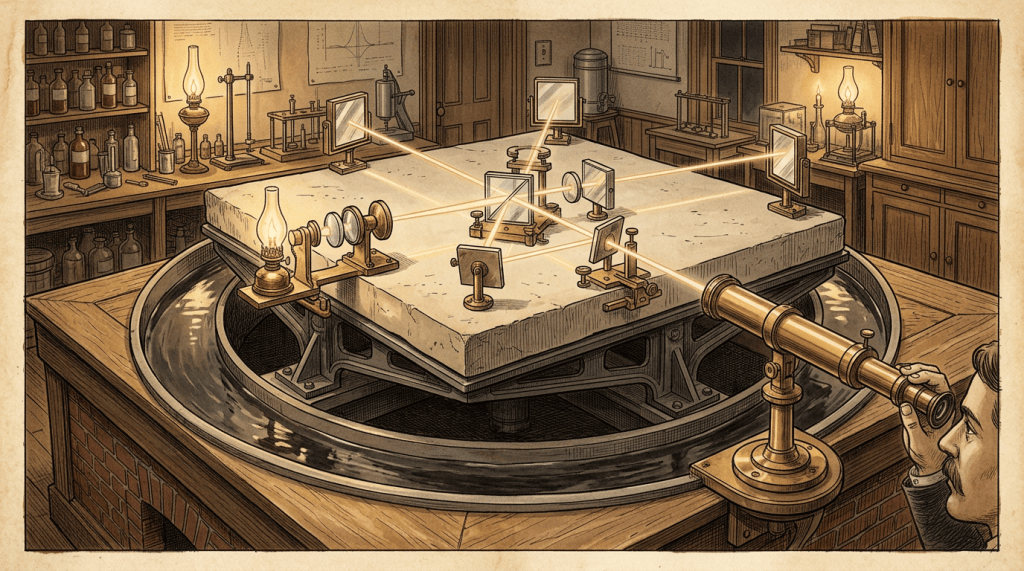
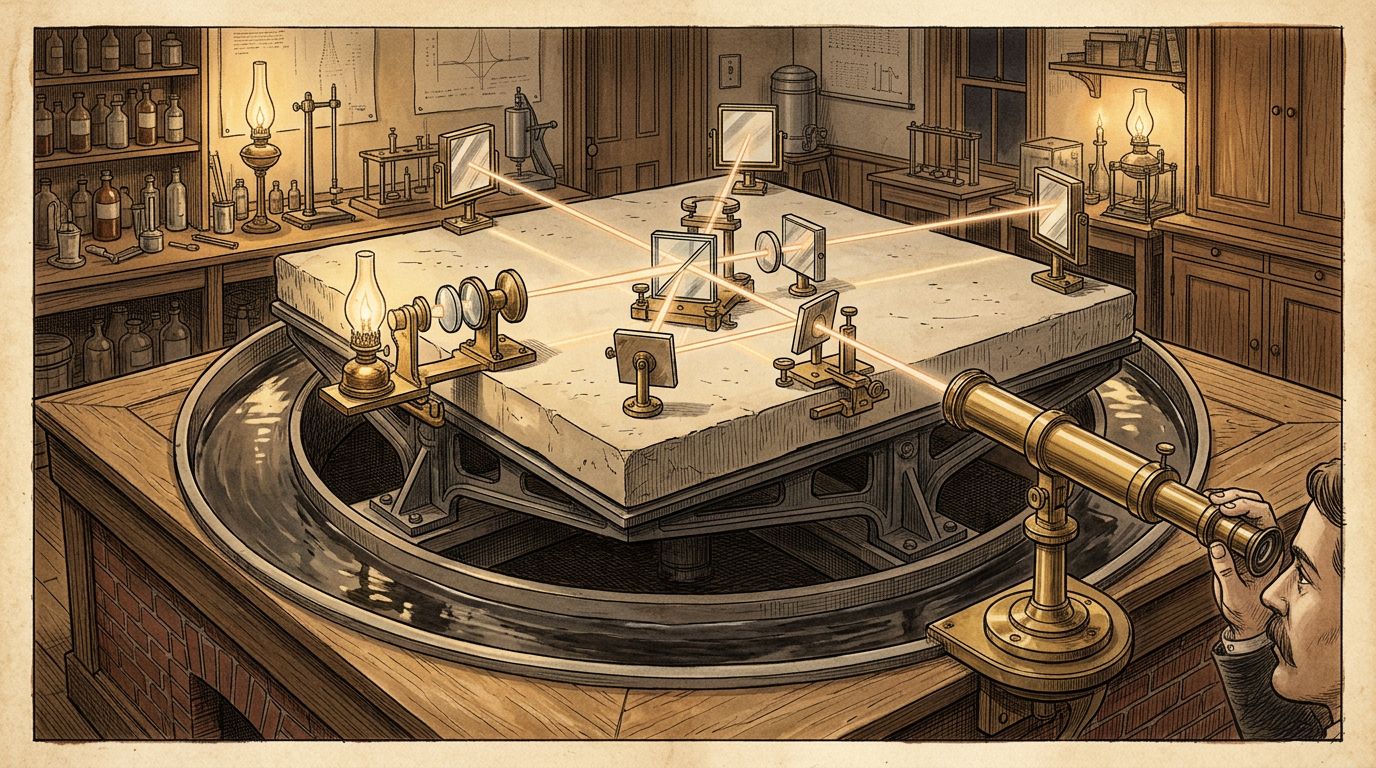
The experimental setup at Case Western Reserve University in Cleveland was deceptively simple in concept but extraordinary in precision:
- A light source (sodium lamp, 589 nm) sent a beam into a half-silvered mirror (beam splitter), dividing it into two perpendicular beams.
- Each beam traveled down an arm ~11 m effective length (light bounced back and forth between mirrors), reflected off a mirror at the end, and returned to recombine at the beam splitter.
- The recombined beams produced an interference pattern of bright and dark fringes visible through an eyepiece.
- The entire apparatus floated on a mercury trough atop a sandstone base to isolate it from vibration, and the base could be rotated by 90° to swap which arm was aligned with the presumed aether wind.
The logic: If Earth moves through a stationary aether at ~30 km/s (orbital velocity), then one arm should have light travelling “with the wind” and the other perpendicular arm should be “across it.” The time difference would shift the interference fringes. Rotating the apparatus by 90° should shift them again. The expected fringe shift was about 0.4 fringes.
The result: The measured shift was less than 0.02 fringes (probably ≤ 0.01) — less than one-fortieth of the expected value. The aether wind, for all practical purposes, was zero.
Why This Was So Troubling
The null result created a paradox that persisted for nearly two decades:
- The 1886 Michelson–Morley experiment confirmed Fresnel’s drag coefficient, supporting a stationary aether.3
- The 1887 interferometer experiment ruled out a stationary aether, seemingly supporting Stokes’ dragged aether.
- But Stokes’ model was mathematically incoherent (Lorentz, 1886).
Physicists initially dismissed the result as experimental error. Heinrich Hertz and others built on Stokes’ drag model. Hendrik Lorentz developed increasingly elaborate “aether-at-rest” theories with length contraction as an ad hoc fix. Lorentz contraction was a mechanical change in length in the direction of the motion but not in the perpendicular direction.
The Resolution: Special Relativity
In 1905, Albert Einstein sidestepped the entire problem. His special theory of relativity postulated that the speed of light is the same for all inertial observers, requiring no medium at all. The aether wind was not “too small to detect” — it was a category error. There was no aether to create a wind. The Michelson–Morley null result was not a failure of the aether theory but a direct consequence of the correct one.
Legacy and Modern Confirmations
| Experiment | Year | Arm Length | Expected Fringe Shift | Measured | Null? |
| Michelson (Potsdam) | 1881 | 1.2 m | 0.04 | ≤ 0.02 | ≈ yes |
| Michelson & Morley (Cleveland) | 1887 | 11 m | 0.4 | < 0.02 | ≈ yes |
| Morley & Miller (Cleveland) | 1902–04 | 32 m | 1.13 | ≤ 0.015 | yes |
| Joos (Jena) | 1930 | 21 m | 0.75 | ≤ 0.002 | yes |
| Modern resonator experiments | 2009 | — | — | 10-17 level | yes |
| Cryogenic sapphire resonators (Nagel et al.)4 | 2015 | — | — | 9.2±10.7 × 10⁻¹⁹ | yes |
Modern ring-laser and optical resonator experiments have confirmed the absence of any aether wind to a precision of 10⁻17, however I was involved in the design and implementation of a cryogenically cooled sapphire microwave resonator Michelson–Morley experiment (2015)4 which yielded a null result at 9.2±10.7 × 10⁻¹⁹(at the 95% confidence interval). That represents an order of magnitude improvement over previous Michelson–Morley experiments, making the null result one of the most robust in all of physics.
As mentioned above there are those who proposed Galileo was wrong and that the Earth is absolutely immobile. They claim that null results in Michelson–Morley experiments are because the putative ether wind around the planet is stationary because the Earth is stationary in space.
One example of claims like this can be found in the substack post “Heliocentricity and Scientism (part 2). Post-1905 experiments which found no movement of the Earth”.
In that piece the author stated:
Although these experiments found the same close to ‘null’ results, not a single one of the experimenters or the interpreters, could bring themselves to consider a perfectly viable model which explains the phenomena and measurements, namely that the Earth was immobile. This was forbidden.
But the design of the Michelson–Morley experiment compares the two-way speed of light in orthogonal directions. The null result is a direct measure of its isotropy in orthogonal directions. The speed is the same canonical value, c.
At the precision of our experiment — an eye watering precision of 10-18 — no putative ether wind was detected because the most parsimonious explanation (Occam’s razor) is that the speed of light is not affected by any ether wind. It is not additive, which is Einstein’s relativity postulate.
Thus the Earth is not immobile at the absolute center of the universe.
For one the planet rotates on its axis giving us the 24-hour day-night cycle.
In our experiment we rotated the apparatus with a 100 second period (0.01 Hz) and saw no signal nor at the second turntable harmonic (0.02 Hz). We also looked at the time period of the approximately 24-hour sidereal5 Earth rotation and its annual orbit around the Sun and found no signals there either. All null results.
In the trade this is called Lorentz symmetry for the photon, which all these experiments have found to be invariant under rotation, irrespective of direction. It is also invariant for inertial (non-accelerating) frames of reference. Transforming from one frame to another moving with a different velocity has no effect on the speed of light.
As a conclusion we can say that the “ether wind” stands as one of the great examples in science of a carefully designed experiment whose failure to find what it sought was the most important discovery of all.
An important side note here, is that Einstein assumed the two-way speed of light, c, to be isotropic for all inertial observers, to solve his relativity equations. That is a perfectly valid choice of convention. It means that the Michelson–Morley experiment could only potentially detect a relative change in c (the two-way speed) between the two orthogonal directions. That is what is needed to detect the putative “ether wind”, which these tests show was a failure.
Endnotes:
- Aether (or æther) is an obsolete spelling of the noun with various definitions relating to air, chemical compounds, and nonexistent clear elements filling outer space. The word is usually spelled ether in all main varieties of modern English. Aether still appears as a poetic affectation, especially in reference to the word’s ancient Greek and Latin senses, but ether is preferred by a large margin in most types of writing.
- Technically the speed of light here is the two-way or round-trip value for the speed of light, c. All experiments to date have measured only a two-way speed, c. Measurement of the one-way speed of light is a physical impossibility and must be chosen by convention. See The Conventionality Thesis on the Synchronisation of Clocks Separated by Distance
- In 1886, before their famous 1887 aether drift experiment, Michelson and Morley successfully confirmed Fresnel’s drag coefficient by measuring the speed of light as it passed through moving water and air. This experiment demonstrated that moving matter had little to no effect on the speed of light traveling through it, which contradicted the hypothesis of complete aether dragging and supported the concept of a stationary aether. These findings initially encouraged the scientists to believe they could detect the Earth’s motion through the stationary aether in their subsequent 1887 trials.
- Moritz Nagel, Stephen R. Parker, Evgeny V. Kovalchuck, Paul L. Stanwix, John G. Hartnett, Eugene N. Ivanov, Achim Peters, and Michael E. Tobar, Direct Terrestrial Test of Lorentz Symmetry in Electrodynamics to 10^-18, Nature Communications, 6, Article number: 8174, 1 September 2015.
https://www.nature.com/articles/ncomms9174 (You can download the paper for free.) - Sidereal rotation of the planet is with respect to the stars. A sidereal day is based on Earth’s rotation relative to distant stars, rather than the Sun. A sidereal day is approximately 23 hours, 56 minutes, and 4.1 seconds long, making it about 4 minutes shorter than a standard solar day, which is 24 hours long.
Related Reading
- The Cosmological Principle and Geocentrism
- Review of “The Principle”
- The Fingers of God Effect: Not Evidence For a Geocentric Universe
- Book Review: “Setting Aside All Authority” by Christopher M. Graney
- What Do We Really Know About the Cosmos?
- The Conventionality Thesis on the Synchronisation of Clocks Separated by Distance
- How Fast Does Information Travel to Earth from the Outer Most Reaches of the Cosmos?
- Einstein’s Physics Says There is No Biblical Creationist Starlight Travel-Time Problem
Recommended Reading
- Book: Apocalypse Now: On the Revelation of Jesus Christ
- Book: Merchants of Death: Global Oligarchs and Their War On Humanity
- Book: The Physics of Creation, The Creator’s Ultimate Design for Earth
Free Subscribers
Subscribe to our Newsletters as a Free Subscriber and be notified by email. Just put your email address in the box at the bottom of your screen.
You’ll get an email each time we publish a new article. It is quick and easy to do and totally free. You only need do it once.
Premium Subscribers
Subscribe to our Newsletters as a Premium Subscribers at $5 USD/month or $30 USD/year (you choose). Cancel anytime.
Paid Premium Subscribers will get exclusive access to certain content I publish. That will only cost you a cup of coffee per month.
Also you’ll be able to download, for free, a PDF of my book Apocalypse Now and also a PDF of my book The Physics of Creation The Creator’s Ultimate Design for Earth.
You can download them from the link below.
This is how you can support my work. I have been publishing this website for 12 years now and up to 2026 I never asked for any support.
Press the button “Premium” on the front page to find a list of Premium content. Thanks so much to all supporters.
At a minimum, please join as a Free Subscriber. It’ll cost you nothing. It may also help me beat the shadow banning of some posts.






Leave a Reply