


There have been observations by the astronomers using the celebrated James Webb Space Telescope (JWST) of galaxies with redshifts as high as 14, or 16, which means that they are being observed at a distance of more than 13.5 billion light-years and when the universe was only about 250 million years old if the standard big bang model is correct.
I recently reported that a new problem had developed. A newly observed object, CEERS-U-100588, provisionally named “Capotauro”, exhibited a photometric redshift of z = 32, far greater that any previously measured. That object highlighted the problem of correctly identifying these very high redshift Little Red Dot (LRD) objects. Its spectrum looks very much like a brown dwarf star in our galaxy and therefore could not be at the edge of the visible universe.
If it has a redshift of 32 and the standard cosmological model is correct it would mean Capotauro is observed at a time only 90 million years after the big bang. The inference is that the light that forms these images of these LRD galaxies, which we observe now in our solar system, took more than 13.5 billion years to reach us. But is that correct? And how does that fit with the biblical creation timescale much less than 10,000 years?
It really depends on your worldview. Yes, and your worldview influences what clock synchrony convention you stipulate. Let me explain.
More than 120 years ago Einstein introduced us to the concept of relativity. What that means is that all measurements of length (space) and time are subject to relative motion between the source and the observer. Different observers may conclude different outcomes for the same observation. What one observer measures will be different from another who is not co-moving with the other.
Einstein developed his theory of relativity based on the principle that only the spacetime interval between two inertial observers is invariant. It is a value that all observers could calculate and get the same result. But time alone is not invariant.
Clocks separated by a distance, one local and one distant, cannot be assumed to be synchronised. In fact, no synchronisation technique is possible using only the one-way transmission of a light signal. Only by choice of a synchrony convention can we make any useful calculation regarding distance and time. The chosen convention relates directly to the assumed one-way speed of light.
Einstein’s physics calls this the relativity of simultaneity. In that we have a free choice when choosing a clock timing convention. A choice of a convention is necessary to calculate the outcome of timing experiments like the light travel time from sources in the cosmos to Earth.
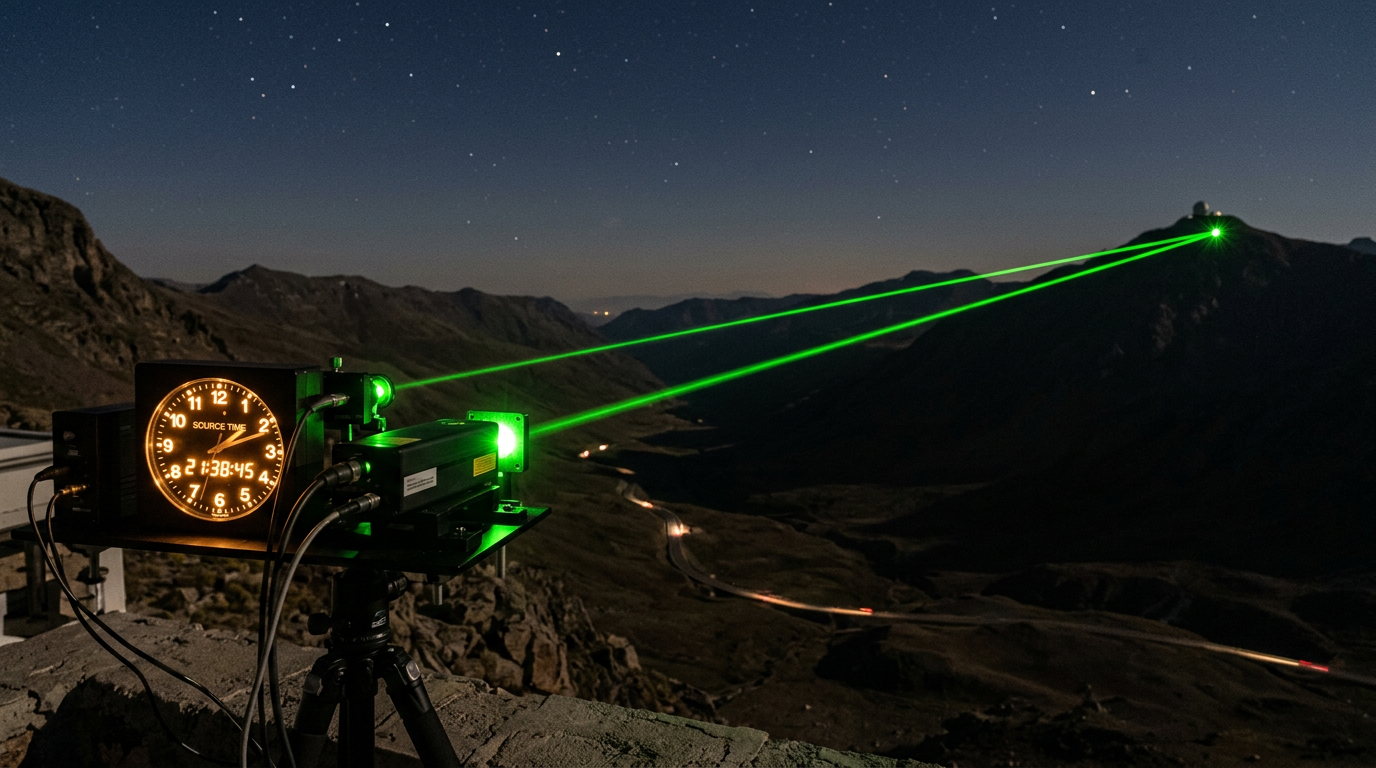
Let me give you a simple example. Let us assume a distant clock floating in space shows 12 noon and that information is sent by radio signal to us on Earth at an infinite speed. With no time lag the time we’d observe is 12 noon on the distant clock and that would agree with our local Earth clock. We’d then say the clocks are synchronised. Both clocks record the same time.
But how would you know how long it took that clock timing information to travel from the space clock to the Earth clock?
If you send a signal from Earth to the space clock and back again could you know the roundtrip travel time. That would let you synchronise the two clocks. But to do so only from the light signal coming one way from the space clock would be impossible. You would not know what time the signal left the source as measured on your local clock. Only if you assume the two clocks are synchronised could you calculate the travel time. But an assumption is made, that is, a convention is required to be stipulated.
This let’s you see that to choose a one-way speed of light value a convention on synchronisation of clocks separated by a distance is required.
If we do not assume any particular clock timing convention, and there are an infinite number, but leave it as a free parameter (ε), from relativity we can write down the one-way speed of light from a source as either v = c/2(ε-1) or v = c/2ε (two solutions), where v the light speed in the positive direction, and ε is the Reichenbach parameter that can take any value between 0 ≤ ε ≤ 1. The parameter c is the measured two-way or round-trip speed of light in vacuum.
Check the time for a light signal to travel distance d one-way to a reflecting mirror and back again. Only the round trip time can be measured on a local clock.
The one-way travel time of a light pulse to a mirror at a distance d away t1 = d/v = d 2ε/c and the time to travel back again one-way t2 = d/v = – d 2(ε-1)/c . The minus sign indicates the return journey.
Now add t1+ t2 = 2d/c ε – 2d/c ε + 2d/c = 2d/c and you get the total time which is the measured round-trip time. It is as we expect, twice the total distance d divided by the average speed of light c. By flipping this equation scientists have experimentally measured the average round-trip speed and always get c.
The clock synchronisation parameter ε disappears from the equation above. It cancels out. That means that no clock timing convention is needed, obviously because the same clock is used at the source and the receiver at the same location.
To examine what we get for a few special conventions let’s choose a some specific values for ε.
If ε = 1, then v = – ∞, meaning the incoming light speed is infinite towards you and v = ½c, meaning the outgoing light speed is half c away from you. This convention we call the Anisotropic Synchrony Convention (ASC).
But Einstein chose the convention with ε = ½ and for that reason it is called the Einstein Synchrony Convention (ESC).
If ε = ½, then v = – c, meaning the incoming light speed is c towards you and v = c, meaning the outgoing light speed is c away from you.
Thus under the ESC the one-way speed of light in any direction is equal to c, by convention. That is it assumes that the speed of light is isotropic.
However with all these conventions, for any allowable value of ε, the round trip speed of light is always c, which is the only measured value.
So now to answer the headline question. How fast does information travel from the outer most reaches of the cosmos?
It always travels at the speed of light. But what’s the incoming one-way speed of light?
You can’t just say the canonical value c = 299,792.458 km/s. That is the two-way or round-trip measured speed.
I could say that the one-way speed of light coming into Earth is -c/2(ε-1). But only by choosing a timing convention ε does it take a value. If I then choose ε = 1 the speed of light is infinite. And using the other solution c/2ε it evaluates to c/2 for the outgoing speed. Therefore the roundtrip average speed is c and invariant to all observers.
Therefore we can say that we see the most distant galaxies in the universe in real time. We can also say that the information about them and their spectra used to calculate their redshifts travelled to Earth instantaneously. There was no time delay.
The pattern of spectral lines formed in a galaxy’s light emissions just as the light left the galaxy is exactly the same as that we observe now.
There is no need to imagine that the wavelengths of those emissions were stretched out as the light travelled through space from the distant cosmos under the assumption of a finite speed of light c. That is the usual assumption for cosmological expansion of space, and they call that cosmological redshift.
Besides if the universe is static, which I believe it is, there can be no such stretching of space.
But if the universe was actually expanding, and if that mechanism really caused a redshift, the spectra in the galaxy light would change as a function of time. That is, from one year to the next the spectral lines should be slightly shifted. Such astronomical surveys are actually performed. However the sought after effects are tiny.
But none of this proves or disproves a convention. Both ESC and ASC are conventions. And both are used in interpreting the observed data.
Observed spectral features are formed by the oscillating atomic species in the gases in a source galaxy. And under the ASC model that light with its spectral features was carried to Earth instantly. So whatever the cause of the redshift, whether it be something intrinsic, or Doppler motion, or gravitational or other, that information was sent at infinite speed to the Earth observer.
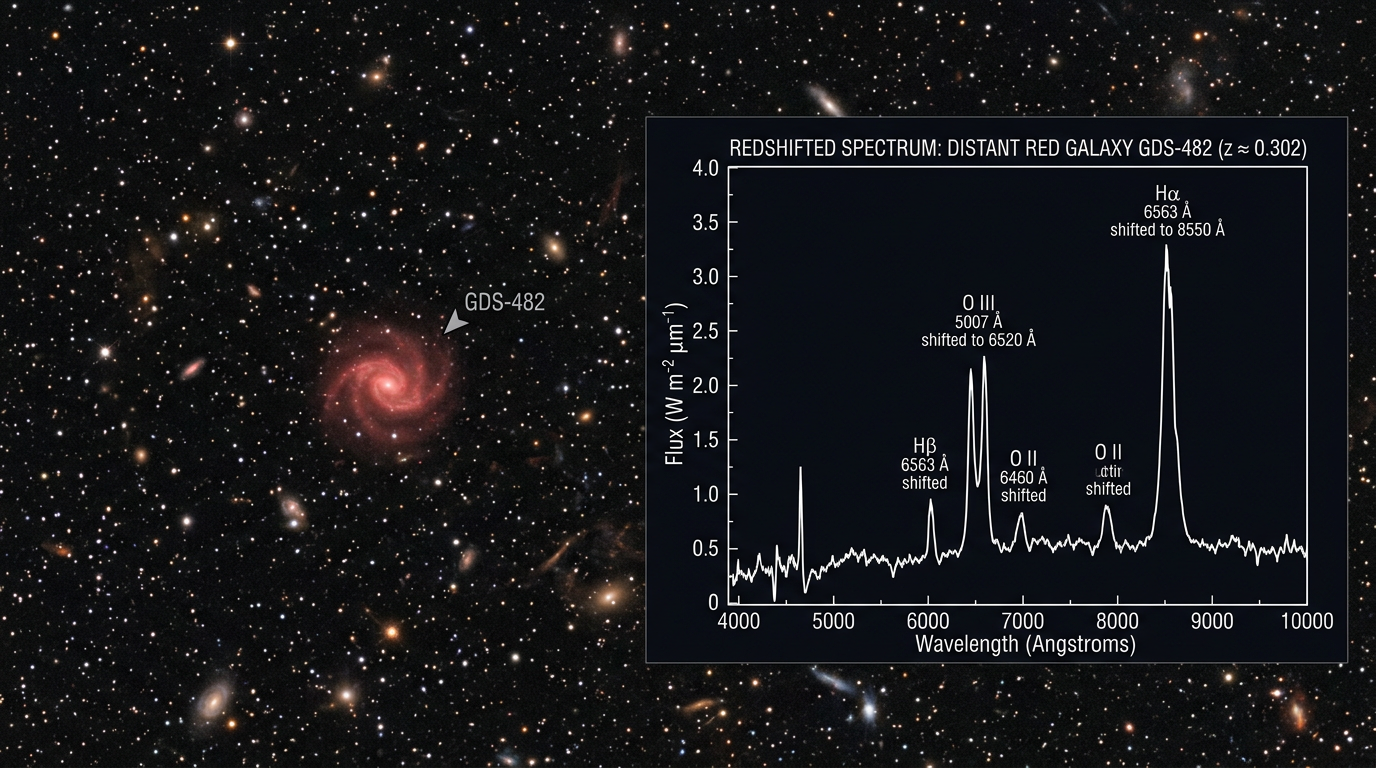
See above spectrum. This was observed at the Earth-based telescope, not out in the cosmos at the source.
Only by comparison with a lab reference can any shift in any line be determined. Note the Oxygen (OII, OIII) and Hydrogen (Hα, Hβ) lines in the above graphic. These emission lines were the result of excitation of those gases in some stars in the galaxy.
As I explained here the lines are due to the frequency of excitation and not their wavelength. To convert frequency to wavelength the canonical speed of light c is assumed. That means a timing convention was implicitly assumed.
But no physics is changed by assuming another timing convention. Therefore perhaps it is easier to use the equations that assume Einstein’s Synchrony Convention (ESC) in such cases as this. Isotropy in the speed of light does simplify the equations needed.
But in terms of transmission of information from the cosmos, eg. that spectrum, the Anisotropic Synchrony Convention (ASC) can explain an age for the universe consistent with the biblical timescale of less than 10,000 years.
Certainly the ASC model would predict fully formed mature galaxies as far as we can see them. God created a mature fully formed and functioning universe right from the fourth day of creation week. The JWST seems to be revealing such a universe.
Related Reading
- Are We Really Observing the Universe in Real Time?
- Can We See Into the Past?
- Do Distant Light Emissions Prove a Finite One-Way Speed of Light?
- Do Million-Light-Year-Long Galactic Jets Disprove the Bible on the Age of the Universe?
- James Webb Space Telescope | Extremely High Redshift Failure
- The James Webb Space Telescope Demolishes the Big Bang Hypothesis
- James Webb Space Telescope | Little Red Dot Galaxies are a Big Big Bang Problem
- Little Red Dots | Primordial Black Holes or Big Bang Failures?
- The Anisotropic Synchrony Convention Model as a Solution to the Creationist Starlight-Travel-Time Problem — Part I
- The Anisotropic Synchrony Convention Model as a Solution to the Creationist Starlight-Travel-Time Problem — Part II
- The Conventionality Thesis on the Synchronisation of Clocks Separated by Distance
- Questions on the Conventionality Thesis and the One-Way Speed of Light
- The Effects of the Curse Visible in the Cosmos Present Another Biblical Creationist Starlight Travel-Time Problem
Free Subscribers
Subscribe to our Newsletters as a Free Subscriber and be notified by email. Just put your email address in the box at the bottom of your screen.
You’ll get an email each time we publish a new article. It is quick and easy to do and totally free. You only need do it once.
Premium Subscribers
Subscribe to our Newsletters as a Premium Subscribers at $5 USD/month or $30 USD/year (you choose). Cancel anytime.
Paid Premium Subscribers will get exclusive access to certain content I publish. That will only cost you a cup of coffee per month.
Also you’ll be able to download, for free, a PDF of my book Apocalypse Now and also a PDF of my book The Physics of Creation The Creator’s Ultimate Design for Earth.
You can download them from the link below.
This is how you can support my work. I have been publishing this website for 10 years now and up to 2024 I never asked for any support.
Press the button “Premium” on the front page to find a list of Premium content. Thanks so much to all supporters.
At a minimum, please join as a Free Subscriber. It’ll cost you nothing. It may also help me beat the shadow banning of some posts.








Leave a Reply