

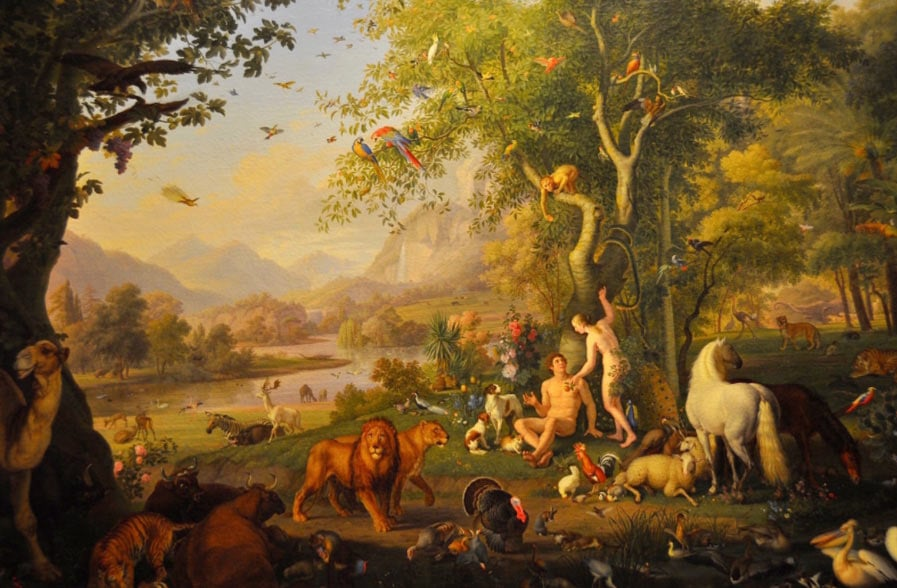
At the end of the creation of the heavens and the earth God rested from all His work (Genesis 2:1-3). The chapter division for Genesis chapters 1 and 2 should really be after the end of Genesis 2:3. That is, Genesis chapter 1 continues until the end of Genesis 2:3.
1 Thus the heavens and the earth were finished, and all the host of them. 2 And on the seventh day God ended His work which He had made; and He rested on the seventh day from all His work which He had made. 3 And God blessed the seventh day, and sanctified it: because that in it He had rested from all His work which God created [Hebrew: bara (create)] and made.
Genesis 2:1-3
Resting from His work means He no longer continued creating ex nihilo. It does not mean God went to sleep and did nothing in superintending the universe. The universe needs sustaining, against the natural laws of decay which God also made. But clearly there was a lot of work to do because…
17 … Jesus answered them, My Father works till now, and I work.
John 5:17
God does not sleep and He works to bring souls into the kingdom of God.
29 Jesus answered and said to them, This is the work of God, that you believe on Him whom He has sent.
John 6:29
3 Jesus answered, Neither has this man sinned, nor his parents: but that the works of God should be made manifest in him.
John 9:3
Really the first verse in the account of creation from man’s perspective is Genesis 2:4.
4 These are the generations [Hebrew: toledoth] of the heavens and of the earth [universe] when they were created, in the day that the LORD God made the earth and the heavens,
Genesis 2:4
The Hebrew word תּוֹלְדָה is transliterated as ‘toledoth’. It is variously translated as ‘generations’, ‘account’ and variants of those. This is the recording of the account of the universe from its creation in the same manner that toledoth is used in Genesis 5:1 (‘the book of the generations of Adam’) and Genesis 6:9 (‘These [are] the generations of Noah’). The phrase ‘the heavens and the earth’ is translated from a Hebrew merism and means ‘the universe’.
The account presented in Genesis 2:4-25 is about the creation of the first man and the first woman and their place in the creation. Genesis 2:4 is continued in the next verse.
5 And every plant of the field before it was in the earth, and every herb of the field before it grew: for the LORD God had not caused it to rain on the earth, and there was not a man to till the ground. 6 But there went up a mist from the earth, and watered the whole face of the ground.
Genesis 2:5-6
But this is not a chronological sequence of events. That was set already in chapter 1 through chapter 2 verse 3. God’s view of time is holistic, He sees it all like it has already happened. We have been conditioned to a sequential view of time, which is the Greek influence on our thinking. The account chapter 2 is not intended to be sequential in time.
Chapter 2 is an account of what happened in the Garden in Eden. The main message in verse 2:5 is that God created the plants as adults and not as seeds. That message is followed through with the creation of Adam as an adult not as an embryo. It follows that the same is true for all living things. The chicken definitely came before the egg.
7 And the LORD God formed [Hebrew: yatsar ] man of the dust of the ground, and breathed into his nostrils the breath of life; and man became a living soul.
Genesis 2:7
The Hebrew word translated ‘formed’ is ‘yatsar’ which means to mould into a form, like a potter moulding the clay. The Creator took the existing elements of the red earth and made Adam, a man. the Hebrew word for man is אָדָם ‘Adam’, which literally means ruddy (reddish colour). God breathed life into the body He made and Adam became a living soul.
8 And the LORD God planted a garden eastward in Eden; and there He put the man whom He had formed.
Genesis 2:8
It is a misconception that Eden is synonymous with the Garden. No, Eden had a much greater extent and in one region, towards the eastern side, God planted a special garden. It was special because of the special tree that God placed in it, the tree of life. That tree is symbolic of Christ, the tree or the vine (John 15:5) which we are to be part of. But Jesus Christ is the tree of life from which all life is sustained. I am talking about spiritual life, regeneration in Christ, not the walking dead, who until they are regenerated in Christ are spiritually dead.
9 And out of the ground made the LORD God to grow every tree that is pleasant to the sight, and good for food; the tree of life also in the middle of the garden, and the tree of knowledge of good and evil.
Genesis 2:9-10
Initially Adam and Eve were created as vegans, not even vegetarians. God provided the food for them, which was a lot of fruit it would seem (Genesis 1:29).
There was also that other tree, the tree of knowledge of both good and evil. It certainly was not an apple, as the Apple Corporation promotes, with the bite taken out of it. Their message is take a bite of the forbidden fruit and get all that knowledge.
10 And a river went out of Eden to water the garden; and from there it was parted, and became into four heads. 11 The name of the first is Pison: that is it which compasses the whole land of Havilah, where there is gold; 12 And the gold of that land is good: there is bdellium and the onyx stone. 13 And the name of the second river is Gihon: the same is it that compasses the whole land of Ethiopia. 14 And the name of the third river is Hiddekel: that is it which goes toward the east of Assyria. And the fourth river is Euphrates.
Genesis 2:10-14
There was a river which flowed out of Eden which split into 4 other rivers. The names of the rivers are listed. They flow into regions with familiar names Ethiopia and Assyria, but they could not be related to those places we now know. At the flood the earth surface was inundated and reworked leaving nothing of the past record. The fourth river was even called Euphrates, which also could not be the modern day Euphrates river for the same reason.
The river’s purpose was to water the Garden where Adam and Eve lived.
15 And the LORD God took the man, and put him into the garden of Eden to dress it and to keep it.
Genesis 2:15
God provisioned for their life, an ideal environment but that was not enough.
16 And the LORD God commanded the man, saying, Of every tree of the garden you may freely eat: 17 But of the tree of the knowledge of good and evil, you shall not eat of it: for in the day that you eat thereof you shall surely die.
Genesis 2:16-17
They were not to eat of the tree of knowledge for when (not if) they did they would start to physically die. They were tempted by Satan, represented in the Garden as a serpent, a mesmerising serpent. Mesmerise is like fascinate and hypnotise. Satan bewitched Eve but Adam followed the woman and ate the forbidden fruit (Genesis 3:6). The rest of that story I described in The Salvific Power of Christ.
Here I want to focus on what else was in Eden. We are told that in the land of Havilah there was gold and it was good (v. 11-12). Adam was commanded to work the land, to keep the garden to produce their food (v. 15). He obviously didn’t have any rats eating his fruit or vegetables, not like we are experiencing here where I live. Adam was required to do work, not just hang around doing nothing playing games.
For his work God provided smoothing more — gold. The gold was not evil, as their was nothing evil in the Garden. When God said it was ‘good’ it means it is a good thing. I can imagine as Adam worked the Garden he also found the gold. In the same manner if you work the spiritual garden of God, you will find gold.
So God provided in a very real physical sense a reward for labour. That means even before the Curse, when God made it much more difficult to grow food (Genesis 3:17) Adam needed to work the Garden to maintain it.
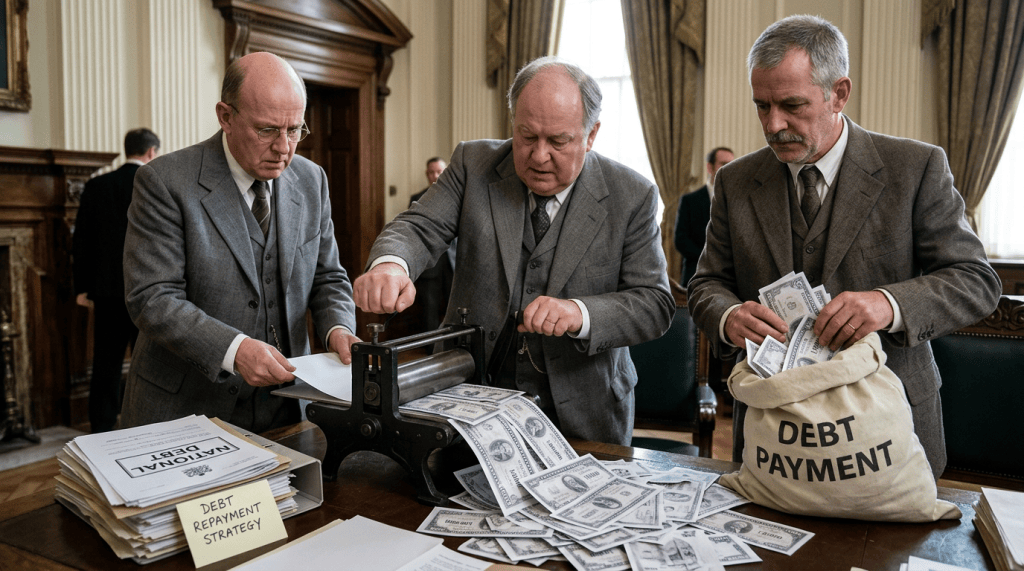
It is the same today, by our labour we are rewarded with gold. Gold is real money. Fiat currency is not money and will soon deflate to zero as the price inflation rapidly grows due to massive government credit creation out of nothing, ex nihilo.
Man cannot create ex nihilo, even though he appears to be doing that now with all the ‘money printing’. Wealth cannot come from making up numbers on a spreadsheet or churning out more banknotes.
God said that the gold of that land is good. By inference fiat currency is bad. Wealth only comes from the creative process of actually doing work through our labour. Yet the most important labour we can do is for the salvation of souls. That is God’s work that He does through us.
Labour not for the food which perishes, but for that food which endures to everlasting life, which the Son of man shall give to you: for Him has God the Father sealed.
John 6:27
Recommended Reading
- Book: Apocalypse Now: On the Revelation of Jesus Christ
- Book: Merchants of Death: Global Oligarchs and Their War On Humanity
Follow me
- Telegram.org: @GideonHartnett
- Facebook: Gideon Hartnett
- X (Twitter): @gideon195203

To be notified by email put your email address in the box at the bottom of your screen. You’ll get an email each time we publish a new article.

Click this image to make a secure Donation (Stripe) !





5 responses to “In The Garden In Eden”
John,
Genesis 2:8
And the LORD God planted a garden eastward in Eden; and there he put the man whom he had formed.
The garden was planted eastward IN Eden, but from where was it eastward?
LikeLiked by 1 person
That is what I wrote: “in one region, towards the eastern side, God planted a special garden.” The eastern side of Eden. That means in Eden. Are you suggesting there were no compass headings? The Earth’s magnetic field was created with the core of the planet. That has been circulating and the field strength has been freely decaying since.
LikeLike
No, I am not suggesting there were no compass headings. As a surveyor, I start from a point and head in the specific direction. When I see eastward, I wondered what the reference point or datum is, otherwise it seems irrelevant. No word in Scripture is irrelevant, so what then is the significance of the word eastward?
The Hebrew word can mean before that time, so could this be referencing time rather than azimuth?
The reason for my inquiry is that I believe in a literal 6 day creation, which raises questions such as the creation of both Adam and Eve on the same day. Adam would have been busy naming animals on that same sixth day, if we are to accept the traditional view of Adam and Eve within the context of the accepted literal six days of creation. I am sure he was in absolute awe when he opened his eyes on the day he was formed.
There are other questions that I have had to seek answers to, including where Cain’s wife came from. While it might seem logical to assume it was his sister, which a tradition view demands, there seems no conclusive Biblical witness to that, in my view, so might a more plausible explanation lie within those first 2 chapters of the Bible?
LikeLike
“….the natural laws of decay which God also made”.
But did He? Isn’t decay the consequence of sin entering into the world?
LikeLike
No it is not. Think about that, The natural law of decay is the 2nd Law of Thermodynamics. That must have been operating right from the beginning because natural processes, like digestion, rely on it. Fire is another. Oxidation, respiration and much more. It means energetic processes run downhill. Those are not the result of the Curse. But I can imagine that God withdrew some of His sustaining power which meant the temporal forward direction of the decay processes is accentuated. See the following post for some related explanation.
LikeLike