
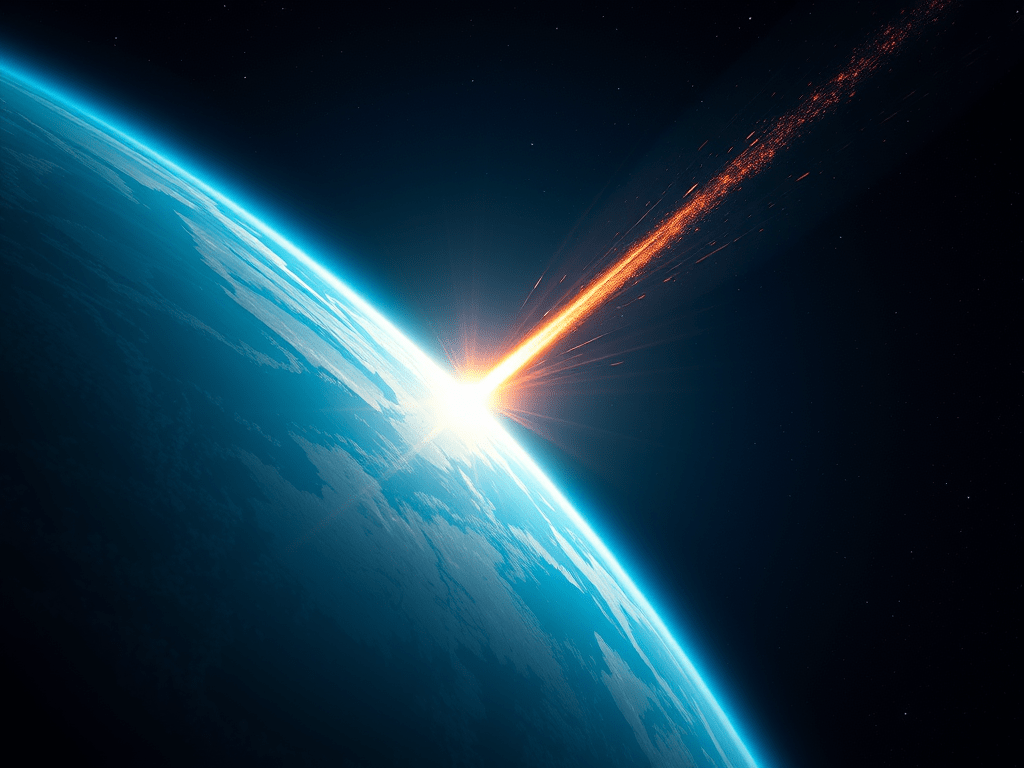
Even though the thickness of the Earth’s atmosphere is only about 2% of the radius of the planet it has an important design feature, to shield against damaging impacts by meteors and asteroids from space. Though a few large ones have gotten through, especially during the Genesis Flood, today most meteors burn up in the atmosphere.
The thick atmosphere creates drag, a strong resistance to colliding natural and manmade meteors falling towards the surface. The resistance causes heating of the meteor or asteroid because gravitational potential energy is lost as it falls. Some potential energy is converted to kinetic energy of the falling object but it soon reaches terminal velocity. The remaining energy must go somewhere.
The 1st Law of Thermodynamics tell us energy is conserved. The 2nd Law tells us that entropy is increased during this energy transfer. That means the space object matter is randomized as potential energy is converted to thermal energy, which in turn heats and vaporises the meteor, causing it to trail white hot particles behind it.
The Moon’s surface is covered in impact craters, but it has no atmosphere so no shield against them. Mars also has many impact craters but has an atmosphere. It is however very low density and so the planet continues to suffer meteor impacts. Recent measurements show that more marsquakes are from impacts than from the internal dynamics of the planet’s mantle and core.1
The Vredefort impact structure is the largest verified impact structure on Earth, formed from impact by an asteroid allegedly 2 billion years ago, as claimed by old-earth geologists. See Fig. 1 showing a satellite image of South Africa’s Vredefort Crater. The structure is so large it needs to be viewed from space.
Now heavily eroded the crater has been estimated to be 170–300 kilometres (110–190 mi) across when it was first formed. The remaining structure, comprising the deformed underlying bedrock, was named after the town of Vredefort, near to its location in the Free State province of South Africa. See Fig. 2. The central uplift of the structure is known as the Vredefort Dome.

The asteroid that hit Vredefort is believed to be one of the largest ever to strike Earth since the alleged Hadean Eon some 4 billion years ago. The asteroid has been estimated to have been between 20 and 25 kilometres (12 and 16 mi) in diameter and to have impacted the Earth with at vertical velocity of 15–25 km/s (9–15 mi/s).
Assuming a terminal speed of 20 km/s, that is an impact at the hypersonic speed of Mach 60, or 60 times the speed of sound for an asteroid 20 km diameter and the density of basalt, the kinetic energy at point of impact would be 2.5 x 10¹⁸ megajoules. That is equivalent to the energy from 6,000 nuclear explosions, each with a yield of 10 megatons of TNT. As a reference the atomic bombs dropped on Nagasaki and Hiroshima only had about a 10 kiloton yield. That means the asteroid impact was equivalent to 6 million Hiroshima atomic bombs.

From a biblical creationist worldview these impact craters are explained through the lens of the Genesis Flood which occurred 4,500 years ago and not 4.5 billion years ago. The fact that a few of the biggest ones are not so distinguishable and heavily eroded could indicate the impacts were towards the end of the Flood year. Most of the sedimentary layers had been laid down by that time.
The Chicxulub crater is another large impact crater buried underneath the Yucatán Peninsula in Mexico. It is alleged to have formed over 65 million years ago when an asteroid, about 10 km (6 mi) in diameter, struck Earth. It is alleged to have wiped out the dinosaurs and most other life on Earth, according to the evolutionary fairy tale.
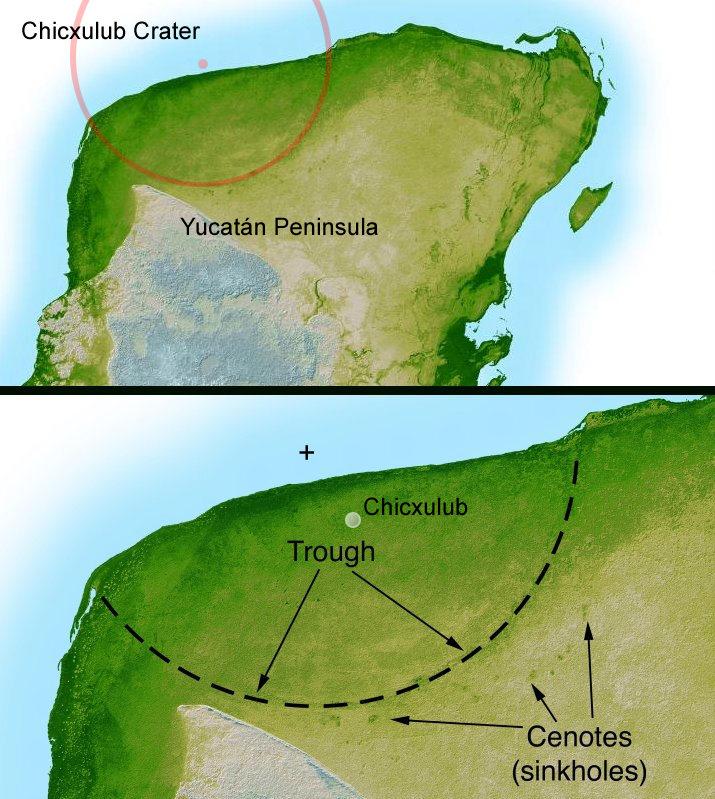
The Chicxulub crater is estimated to be 200 km (120 mi) in diameter and 1 km (0.62 mi) in depth. It is believed to be the second largest impact structure on Earth. Its crater ring is intact and can be seen from space. Fig. 3. But it is heavily eroded, indicating that the impact occurred late in the Flood.
The fact that the Vredefort structure is classed as the second oldest by old-earth evolutionary timescales could imply any asteroids prior to that one impacted during the Flood and thus their structures were erased by the floodwaters. That makes much more sense.
In these craters we see evidence of the Flood. It was only during the cataclysm of Noah’s flood that large asteroids impacted the Earth. The only humans and animals who survived that were safely in the Ark watched over by the Creator. For all the rest these asteroid impacts were used by God as judgment on the wicked, and that was 99.9% of all humans.
The fact is that most smaller meteors burn up in the atmosphere. That should be easily seen as a design feature. The atmosphere is a shield to burn up space debris falling out of orbit or coming from beyond Earth’s space environment. But will it be enough against future asteroids God might send in the final judgment and the last mass extinction event?
Reference
- Michelle Starr, Mars Is Rocked by Epic Quakes, And They Don’t All Come From Within, ScienceAlert, 13 February 2025.
- NASA Earth Observatory image created by Lauren Dauphin, using Operational Land Imager (OLI) on Landsat 8; data provided courtesy of the U.S. Geological Survey team. – Image and description, Public Domain, https://commons.wikimedia.org/w/index.php?curid=129698660
- NASA/JPL-Caltech, modified b – Modified NASA image, with scale and labels to increase clarity by David Fuchs. Original: http://photojournal.jpl.nasa.gov/catalog/PIA03379
Related Reading
- Why Elites Build Bunkers | Preparing for Earth’s Next Extinction Event
- Hell on Earth?
- Debunking LUCA: Science or Speculation?
Free Subscribers
Subscribe to our Newsletters as a Free Subscriber and be notified by email. Just put your email address in the box at the bottom of your screen.
You’ll get an email each time we publish a new article. It is quick and easy to do and totally free. You only need do it once.
Premium Subscribers
Subscribe to our Newsletters as a Premium Subscribers at $5 USD/month or $30 USD/year (you choose).
Paid Premium Subscribers will get exclusive access to certain content I publish, which I expect to be about 4 exclusive posts per month. That will only cost you a cup of coffee per month.
Also you’ll get access to download, for free, a PDF of my book Apocalypse Now. You can download it from a Premium members only post here.
And now you’ll get exclusive access to the chapters (in their initial draft form) to my new book with working title “The Physics of Creation”; plus eventually a PDF of the final compiled book.
This is how you can support my work. I have been publishing this website for 10 years now and up to 2024 I never asked for any support.
Press the button “Premium” on the front page to find a list of Premium content. Over time that list will grow. Thanks so much to all supporters.
At a minimum, please join as a Free Subscriber. It’ll cost you nothing. It may also help me beat the shadow banning of some posts.


 Bible Science Forum