
Are biblical creationists being misled to reject the existence of the unknown entities of Dark Matter and Dark Energy in astrophysics and cosmology? Personally I have been calling them fudge factors for the past 15 years.
I have even heard professors of physics in lectures in secular universities, not in creationist circles, say the silent thing out loud. Dark matter is a placeholder for unknown physics.
And Dark Matter is invoked on every scale, to produce the desired outcome, from star formation, galaxy formation and dynamics, cluster formation and dynamics, to the whole universe. Along with Dark Energy they are essentially the astronomers’ gods of the gaps.
In a recent paper Faulkner (2023)1 published in the Proceedings of the International Conference on Creationism the author argues in favour of the existence of Dark Matter and Dark Energy. Here I address his contention.
For too long, recent creationists have dismissed the existence of dark matter and dark energy as rescuing devices for the big bang model. A proper survey of the history of both dark matter and dark energy reveals that this assessment of dark matter and dark energy is false.
He argues that a rejection of the big bang model does not lead to a rejection of Dark Matter and cites three independent lines of evidence for Dark Matter:
- Dispersion velocities of galaxy clusters
- Rotation curves of spiral galaxies
- Gravitational lensing of distant galaxies and quasars by closer
galaxy clusters
I discuss these below.
But before doing that and for full disclosure I should state my worldview here. I do not accept any “god of the gaps”. That is I do not accept as observational evidence any line of evidence that has used a cosmology to produce it and needed Dark Matter and/or Dark Energy.
The standard big bang ΛCDM model does exactly that and requires those unknown entities when testing the distance modulus determined from type Ia high redshift supernova (high-z SN Ia) luminosity measurements against redshift (z). These are the measurements for which the Noble Prize in astronomy was awarded in 2011.
Adam Riess, Saul Perlmutter and Brian Schmidt, were awarded the Nobel Prize in Physics for their discovery of the accelerating expansion of the universe, which was first reported in 1998.
Using what has become standard big bang ΛCDM model Riess and his team found that distant supernovae were dimmer than expected, indicating that the universe’s expansion was accelerating rather than decelerating, contrary to previous theories. Dimmer than expected means to fit the theory to the observational data Dark Energy, represented by Λ, had to be included. Cold Dark Matter (CDM) also was necessary to get a fit to the data.
The alleged acceleration of the expansion of the universe is predicated on
- the universe is expanding,
- a standard absolute brightness reference from the high-z SNe Ia were correctly selected without bias,
- the Friedmann-Lemaitre description with Dark Matter (DM) and Dark Energy (DE) is the correct theoretical description.
I argue that all three of these premises are invalid. DE or a cosmological constant Λ was inserted into the Friedmann equation to achieve the needed fit. However because cosmology is underdetermined there are other possible theoretical descriptions that fit the same data.
One such example of that is the work I did myself on the Carmeli cosmology that showed excellent fit to the same high-z SNe data without any DM.2 And very importantly the Carmeli cosmology had no DE in it.
Another example is a new cosmology3 where the author stated:
“There are several papers that question the existence of dark matter, but mine is the first one, to my knowledge, that eliminates its cosmological existence while being consistent with key cosmological observations that we have had time to confirm.”
ScienceDaily.com
For more on that see New Research Suggests That Our Universe Has No Dark Matter.
Both of these cosmologies are expanding universe cosmologies. And there are others. This alone illustrates the underdetermined nature of cosmology. See Cosmology’s Fatal Weakness—Underdetermination.
However if the universe is static and not expanding then it’s back to the drawing board. I believe the evidence on that is equivocal. See Is the Universe Really Expanding — the Evidence Revisited.
One line of evidence is the circular method of selection of the high-z SN candidates to add to the type Ia class used as a standard candle. The supernova light curves are manipulated to get a supposed unbiased sample.
One researcher wrote:4
Since current investigators assume that the type 1a supernovae have essentially a fixed absolute BB [the standard ΛCDM cosmology] magnitude (with possible corrections for the stretch factor), one of the criteria they used is to reject any candidate whose predicted absolute peak magnitude is outside a rather narrow range. The essential point is that the absolute magnitudes are calculated using BB and hence the selection of candidates is dependent on the BB luminosity-distance modulus.
Basically he is claiming it is selection bias. This is circular reasoning; select only the candidates that fit the desired luminosity-distance criteria and use them to determine the luminosity distance. Since one cannot determine the absolute magnitudes (brightness) of the sources without assuming a cosmology, the standard concordance criteria (Ωm ~ 0.3, ΩΛ ~ 0.7, and H0 ~ 70 km/s/Mpc) are used to calculate the absolute magnitudes for the candidates, which must be in a narrow range, near absolute magnitude MB ~ –19, and the acceptable ones are used to test the same model, and therefore determine values for Ωm and ΩΛ. This is confirmed by Foley et al. who state,5
… for any individual SN 1a, the intrinsic width is unknown, so without assuming a (1+z) dilation, the intrinsic width and dilation cannot be separated.
This means selection bias is used to select the SNe type Ia candidates. There are two factors which affect the SN light curves. One is the time dilation factor (dependent on redshift) and another is the unknown intrinsic width of the light curve where a stretch factor needs to be included and disentangled from the time dilation factor. But to see if the SN candidate’s absolute brightness falls into the narrow range for type Ia supernovae a cosmology has to be assumed. This is circular reasoning.
Therefore none of the 3 premises listed above can be shown to be unequivocally correct. So the notion of Dark Energy also cannot be assumed to be correct.
From a biblical creationist perspective accepting the reality of DE is the same as accepting the standard ΛCDM cosmology, which is big bang and opposes the Genesis history of the universe. Faulkner does not accept BB cosmology but says creationists should find a biblical model to explain the downturn in the distance modulus curve (from high-z SN Ia) as if that is free from observer bias. As I have shown above, it isn’t.
Not surprisingly no such Dark Energy has ever been found to exist in any laboratory experiment. In fact it has anti-gravity properties that are contrary to all known physics. Very few experimental physicists could honestly include such an entity in their description of a laboratory experiment because it is so far fetched.
Now the definition of DM means that it is a type of exotic matter, unknown to physics, that only gravitates. It does not scatter light and thus it is invisible. Essentially its only property is that is has mass and therefore affects the motion of test particles, whether they be gases, stars or galaxies.
A range of particles have been and are being looked for in lab experiments on Earth. This means evidence from local lab experiments in contrast to the circumstantial observational evidence from the cosmos. I have been involved in such experiments. One was for the search for a putative paraphoton in a cavity experiment, which yielded a null result.6
Now that observations have ruled out MACHOs (Massive Compact Halo Objects) as possible candidates for dark matter, WIMPs (Weakly Interacting Massive Particles) are the only remaining contender. They comprise an entirely new class of fundamental particles that has emerged from supersymmetry (SUSY) theory.
The infamous lowest energy stable supersymmetric particle, the neutralino, was sought for 10 years with the Large Hadron Collider (LHC) at CERN without success. This means SUSY has been ruled out as a theory yet it was hoped it would produce a DM candidate particle. See SUSY is Not the Solution to the Dark Matter Crisis.
The hypothetical axion, named after a washing powder, is the most commonly sought DM particle in lab experiments. None found as yet. Though neutrinos are real particles they cannot provide the needed mass. And in fact there is no DM particle in the standard model of particle physics. See Dark Matter and the Standard Model of Particle Physics—a Search in the ‘Dark’

Now back to Faulkner’s three independent lines of evidence for Dark Matter:
- Dispersion velocities of galaxy clusters
- Rotation curves of spiral galaxies
- Gravitational lensing of distant galaxies and quasars by closer
galaxy clusters
Dispersion velocities of galaxy clusters means that when you calculate the gravitational effect of the visible matter in clusters from the virial motion or dispersion of the galaxies in the cluster. And it appears that given sufficient time the clusters would disintegrate because the individual galaxies are moving apart too quickly. By making the assumption that a cluster is gravitationally bound, and over its alleged billions-of-years lifetime it is stable, it follows that there must be more mass in the galaxy cluster, which is invisible and therefore is called DM.
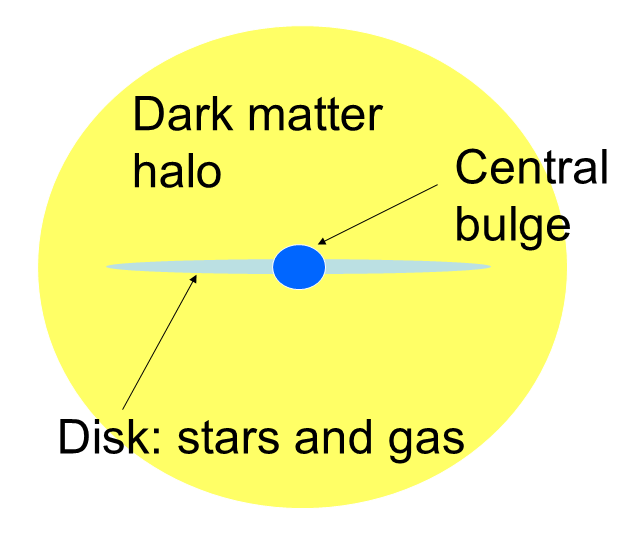
It is a similar situation for rotation curves of spiral galaxies. The inner stars and the outer most gases in a spiral galaxy (like shown above) as determined from their observed Doppler red- and blue-shifts move faster than the expected value from Newtonian physics. So it is posited that the galaxy is enveloped in a halo of invisible DM, as shown in the featured image at the beginning.
In Faulkner’s first lines of evidence (1. and 2.) above, the assumption is that the galaxies and cluster are billions of years old. Under that condition you would need to explain the cluster dispersion and spiral galaxy rotation curves. But if the universe is less than 10,000 years old then there is no case to answer. The structures could not dissipate in that time period. Therefore it may be giving away the farm by accepting that DM is the solution to a problem that does not exist.
But even if you do accept the old universe, which I don’t, there are other explanations, for the rotation curves without DM. Millions of stellar black holes, which do not emit light, and the effect of stellar drag on the dispersion or rotation curves have been offered. See Has the Dark Matter Mystery Been Solved?

The third line of evidence (3.), gravitational lensing of distant galaxies and quasars by foreground galaxy clusters is a consequence of general relativity. I do not dispute that gravitational lensing does occur but there is evidence that all the claimed lensing is not actually lensing.
Prof. Halton Arp was of the view that many of these Einstein crosses are not actually images of the same galaxy or quasar from behind the foreground galaxy or cluster but are in fact all separate quasars with very similar redshifts.
Quasars are not observed to exhibit the effects of time dilation as they should do in proportion to their redshift distances if their redshift is a measure of distance. One study over 28 years of 900 found no time dilation but if they are at such great distances as determined by the high redshifts they should exhibit time dilation. See Quasars Exhibit No Time Dilation and Still Defy a Big Bang Explanation.
The work of Halton Arp and others that showed strong correlation between parent galaxies that have ejected quasars from their active cores. Arp’s theory is that quasars were ejected from the active hearts of parent galaxies and their redshifts were largely intrinsic, not distance related. So they may appear with very similar redshifts around a parent galaxy of much lower redshift.
Prof. Arp and I worked with Chris Fulton, whom we co-supervised for his PhD, on this hypothesis and we showed extremely high correlations of quasars associated with parent galaxies. See Confirmed: Physical Association Between Parent Galaxies and Quasar Families.
Though Arp and Fulton held to an atheistic worldview and billions-of-years timescales. However, I can easily see that God created the parent galaxies with ejected quasars during Day 4 of creation week. And that all occurred less than 10,000 years ago. We see the evidence now after a very short passage of time compared to those alleged astrophysical timescales.
In short, none of the Faulkner’s three lines of evidence are robust evidence for the existence of DM. The counter arguments also highlight a point admitted by secular astronomers, that Dark Matter is a placeholder for unknown physics. So why accept unknown physics as many creationists do? Even some accept the big bang as a creation scenario. See More Than 50% US Evangelical Christians Do Not Believe in the Genesis History of Creation.
Nowhere in this discussion have I addressed how DM is invoked on every scale from star formation, to galaxy formation, to cluster formation to the initial early universe formation with just the right amount of black holes and stars and galaxies. Also for the growth or evolution of galaxy size. DM matter is used a theoretical control knob to create all these objects which under normal known physics would never occur. DM is truly a god of the gaps, the unknown god. See Is Dark Matter the Unknown God?
Other Related Reading
- Dark Energy May Not Exist | New Insight on the Cosmic Web?
- Dark Energy is the Emperor’s New Clothes
- Dark Energy and the Elusive Chameleon—More Darkness From the Dark Side
- Dark Matter Search Comes Up Empty
- Can Axions Cleanup the Problem of Fine-Tuning in the Universe?
Reference
- Faulkner, Danny R. (2023) “How Should Recent Creationists Respond to Dark Matter and Dark Energy?,” Proc. of the Inter. Conference on Creationism: Vol. 9, Article 8. DOI: 10.15385/jpicc.2023.9.1.4
https://digitalcommons.cedarville.edu/icc_proceedings/vol9/iss1/8 - J.G. Hartnett, The distance modulus determined from Carmeli’s cosmology fits the accelerating universe data of the high-redshift type Ia supernovae without dark matter. Found. Phys., 36, 6, 839-861, 2006.
- Rajendra P. Gupta. Testing CCC+TL Cosmology with Observed Baryon Acoustic Oscillation Features. The Astrophysical Journal, 2024; 964 (1): 55 DOI: 10.3847/1538-4357/ad1bc6
- Crawford, D.F., Observational evidence favors a static universe, Cosmology, 2011. https://arxiv.org/abs/1009.0953
- Foley, R.J. et al., A definitive measurement of time dilation in the spectral evolution of the moderate-redshift type Ia supernova 1997ex, J. 626:L11-L14, 2005.
- R. Povey, J.G. Hartnett and M.E. Tobar, “Microwave Cavity Search for Paraphotons,” Proc. Frontiers of Fundamental and Computational Physics: 10th International Symposium, Editors J.G. Hartnett, P.C. Abbott, AIP Conference Proceedings, 1246, pp. 149-153, 2010.
Free Subscribers
Subscribe to our Newsletters as a Free Subscriber and be notified by email. Just put your email address in the box at the bottom of your screen.
You’ll get an email each time we publish a new article. It is quick and easy to do and totally free. You only need do it once.
Premium Subscribers
Subscribe to our Newsletters as a Premium Subscribers at $5 USD/month or $30 USD/year (you choose).
Paid Premium Subscribers will get exclusive access to certain content I publish. That will only cost you a cup of coffee per month.
Also you’ll get access to download, for free, a PDF of my book Apocalypse Now. You can download it from a Premium members only post here.
And now you’ll get exclusive access to the chapters (in their initial draft form) to my new book with working title “The Physics of Creation”; plus eventually a PDF of the final compiled book.
This is how you can support my work. I have been publishing this website for 10 years now and up to 2024 I never asked for any support.
Press the button “Premium” on the front page to find a list of Premium content. Over time that list will grow. Thanks so much to all supporters.
At a minimum, please join as a Free Subscriber. It’ll cost you nothing. It may also help me beat the shadow banning of some posts.




 Bible Science Forum
3 responses to “Should Biblical Creationists Believe in Dark Matter and Dark Energy?”
Brother Hartnett, have you studied any alternate cosmologies that include the bizarre nature of plasma as an explanation for this observed data, like some proposed by Hannes Alfven, Eric Lerner, Anthony Peretti, Hilton Ratcliffe, etc., or folks that take electromagnetism more into account like those from the so called “plasma universe” or “electric universe”? I’ve been studying and researching this for a long time and it seems to me that some of what they argue makes more sense given the strange characteristics of plasma and electromagnetism which are NEVER discussed in astronomy articles (much to my shock). Instead all that is ever said is “gravity” and “dust and gas.”
LikeLike
Yes, I have studied some of those works. I know both Eric Lerner and Hilton Radcliffe. I met them both in 2008 at the 2nd Crisis in Cosmology Conference, Port Angeles, Washington state.
LikeLike
I have read some summaries from Faulkner without understanding them. However, I have remained suspicious of the existence of dark matter and dark energy. As you mentioned there is no need for these gods of the gaps if the universe is very young.
Thank you for confirming that suspicion and for the references that go into this in more detail.
LikeLike