
NASA/ESA/CSA/I. Labbe
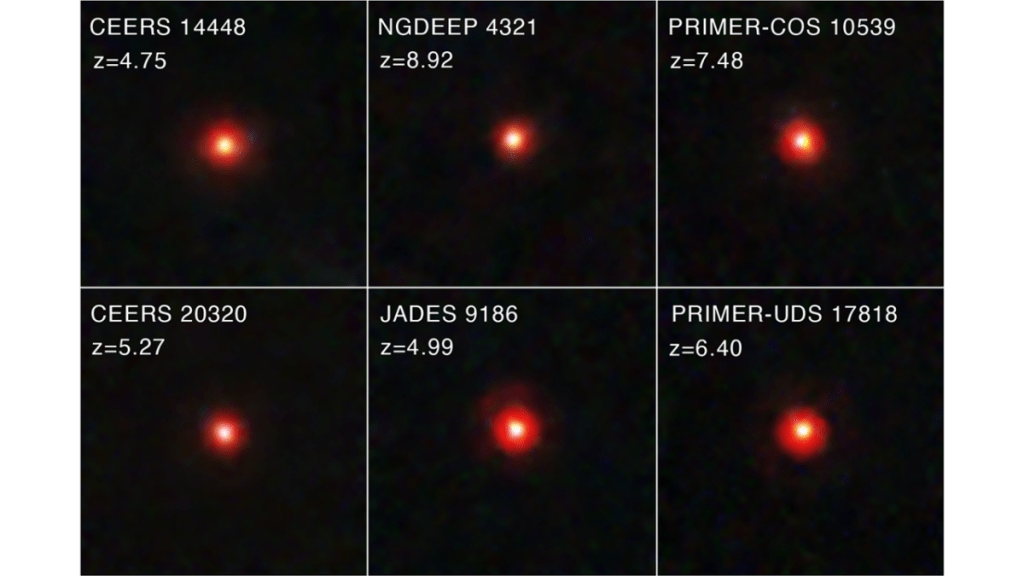
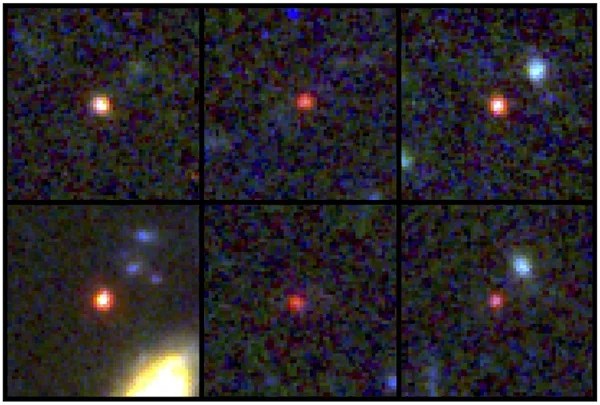
In 2022 six Little Red Dot (LRD) galaxies as they are affectionately called were discovered with the James Webb Space Telescope (JWST) in the redshift range of 7.4 ≤ z ≤ 9.1, which according to the standard ΛCDM cosmology places them allegedly 500–700 million years (Myr) after the Big Bang. The LRDs included one galaxy with a possible stellar mass of roughly 1011 solar masses, which is approximately the mass of the Milky Way galaxy.
The work was published in Nature (February 2023)1 where the Abstract reads
Galaxies with stellar masses as high as roughly 1011 solar masses have been identified out to redshifts z of roughly 6, around 1 billion years after the Big Bang. It has been difficult to find massive galaxies at even earlier times, as the Balmer break region, which is needed for accurate mass estimates, is redshifted to wavelengths beyond 2.5 μm. Here we make use of the 1–5 μm coverage of the James Webb Space Telescope early release observations to search for intrinsically red galaxies in the first roughly 750 million years of cosmic history. In the survey area, we find six candidate massive galaxies (stellar mass more than 1010 solar masses) at 7.4 ≤ z ≤ 9.1, 500–700 Myr after the Big Bang, including one galaxy with a possible stellar mass of roughly 1011 solar masses.
I discussed this finding previously and Michio Kaku’s reaction to it. See The James Webb Space Telescope Demolishes the Big Bang Hypothesis.
The problem with this is not the observations of the small reddish galaxies but using the false assumption of the ΛCDM cosmology forces on the believer an impossible conclusion. A piece on Astronomy.com outlines it.
There is a problem, however. These little red dots have too many stars, too early. Stars form out of hydrogen gas, and fundamental cosmological (“Big Bang”) theory makes hard predictions on how much gas is available to form stars.
To produce these galaxies so quickly, you almost need all the gas in the universe to turn into stars at near 100 percent efficiency. And that is very hard, which is the scientific term for impossible. This discovery could transform our understanding of how the earliest galaxies in the universe formed.
The implication is that there is different channel, a fast track, that produces monster galaxies very quickly, very efficiently. A fast track for the top 1 percent.
In a way, each of these candidates can be considered a “black swan.” The confirmation of even one would rule out our current “all swans are white” model of galaxy formation, in which all early galaxies grow slowly and gradually.
The choice is either believe the impossible has occurred and maintain the illusion that the standard ΛCDM cosmological model is correct but just needs a little modification or reject it completely because it has failed in an important prediction. That is the evolutionary growth of galaxies.
But astronomers do mot measure directly the mass of any galaxy. The can measure the angular size and redshift. Using these two parameters and “turning the knob” with the assumed parameters of the model they calculate what the absolute magnitude (luminosity) must be in the rest frame of the galaxy. From that they infer its mass.
They also shift the measured spectrum into the rest frame of the galaxy using the measured redshift. In these LRD galaxies that is from a few microns in the infrared to the UV. Then they make the assumption that high intensity UV emission means active star-formation.
The reason these objects were not previously seen is because the very low apparent magnitude and their emissions are primarily in the 1 to 2 micron range of the infrared. Thus they would be invisible to optical telescopes but the JWST is tuned to those wavelengths.
Now fast forward to 2024 (revised January 2025)2 and the same 6 Little Red Dots (LRDs) found in data from the James Webb Space Telescope in 2022 have been analyses further but also now there are 341 of them spanning the redshift range z∼2−11. This was reported on Astronomy.com:
Scientists simply don’t understand how so many stars and so much material can accumulate in so little time. When the news first broke, there were six of the objects. Now, JWST has revealed 341 of them. Kocevski’s update to the LRD investigation has been accepted for publication in The Astrophysical Journal. (my emphases add)
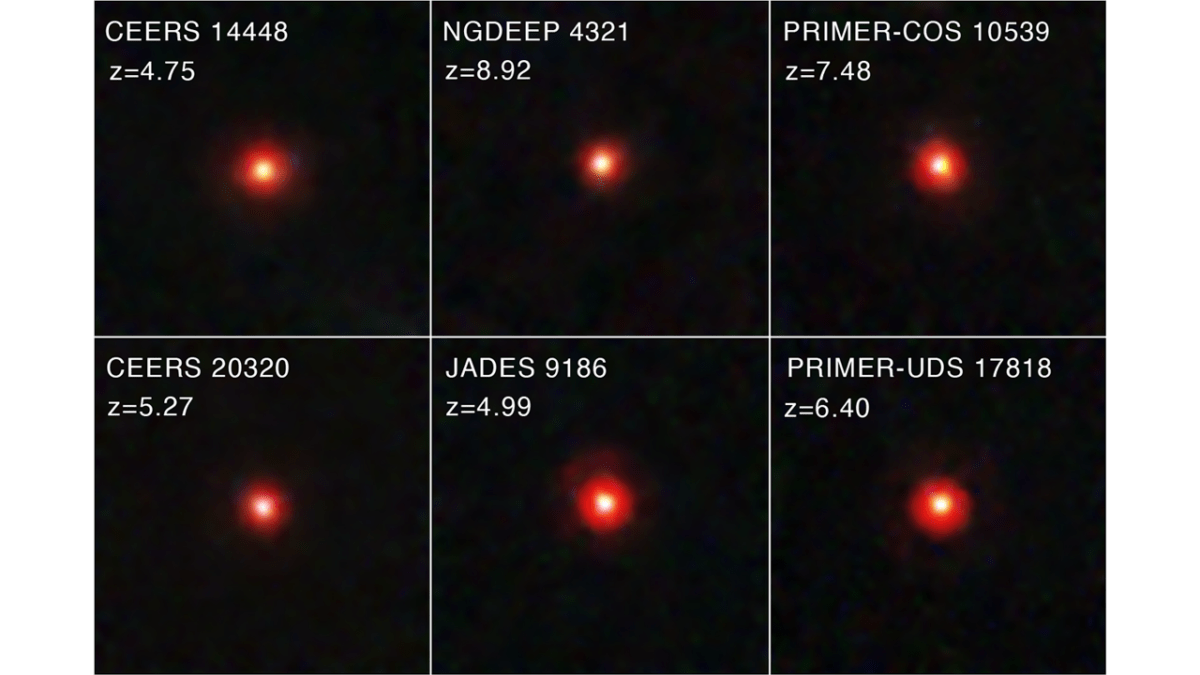
Kocevski was able to further probe the brightest of these objects and confirm that most of these — 81 percent of his subset — are active galactic nuclei, or AGN. That means they have central black holes that are actively gobbling material, causing them to heat up and glow even brighter than all their stars can account for.
If most LRDs are AGN, that can explain much of their “universe-breaking” reputation. AGN far outshine normal galaxies, so it could mean they are more moderately sized after all. But even so, the large numbers of them are surprising. There are far more of them — 10 to 100 times more — than other surveys have indicated, whether they are quasars, AGN, or some other form of active black hole. (my emphasis added)
This is how the standard model is to be rescued by positing that they are AGNs or even quasars (meaning they contain massive black holes emitting a lot of energy from their ergospheres). But still the large numbers of them so early in the alleged big bang universe just should not be.
This is an ad hoc band-aid to rescue the standard model. Ironically though if they are identified as AGNs — 17 LRDs show broad emission lines consistent with AGN activity — or quasars, it creates another problem for the big bang.
The work by Halton Arp, Geoffrey Burbidge and others on AGNs and quasars showed strong evidence that they are often associated with parent galaxies from which they have been born.3 This has recently been confirmed4 by Fulton and Arp (2012)5 and Fulton, Arp and Hartnett (2018)6.
That being the case, the measured high redshifts of these LRDs are not a reliable indicator of their Hubble distances nor of their age on a timeline after the putative big bang. Therefore no conclusions can be drawn on their absolute luminosities, nor on their physical size.
This would actually eliminate the ‘black swans’ but for the big bangers creates another problem. If the LRDs redshifts are not cosmological, but intrinsic according the Arp model of quasar and AGNs, as all high redshifts would indicate, then the whole paradigm of Hubble distances for them is refuted.
If their measured redshift does not give a Hubble distance then the analysis on their alleged UV spectra implying high star formation rates cannot be relied upon either.
However I predict that no matter what discoveries are made at extremely high redshift and therefore ever closer to the time of the alleged big bang the standard ΛCDM model will be patched with auxiliary hypotheses to keep the illusion alive.
This is and always has been a worldview issue. The researchers’ worldview informs what they will or will not accept as an interpretation of the evidence before them. There is no independent way to confirm any interpretation so more data (I call it stamp collecting) is assembled to outweigh any alternate conclusion.
But if the universe is not expanding, which I don’t believe it is,7,8 there was never a big bang anyway.
References
- Labbé, I., van Dokkum, P., Nelson, E. et al. A population of red candidate massive galaxies ~600 Myr after the Big Bang. Nature 616, 266–269 (2023). https://doi.org/10.1038/s41586-023-05786-2
- Dale D. Kocevski et al., The Rise of Faint, Red AGN at z>4: A Sample of Little Red Dots in the JWST Extragalactic Legacy Fields, last revised 20 January 2025, https://arxiv.org/abs/2404.03576
- Galaxy-Quasar Associations
- Confirmed: Physical Association Between Parent Galaxies and Quasar Families
- C.C. Fulton and H.C. Arp, “The 2dF Redshift Survey. I. Physical association and periodicity in quasar families”, Astrophys. J. 754:134, (2012)
- C.C. Fulton, H.C. Arp, J.G. Hartnett, “Physical association and periodicity in quasar families with SDSS and 2MRS”, Astrophysics & Space Science 363:134 (2018)
- Is the Universe Really Expanding — the Evidence Revisited
- Is There Definitive Evidence for an Expanding Universe?
Free Subscribers
Subscribe to our Newsletters as a Free Subscriber and be notified by email. Just put your email address in the box at the bottom of your screen.
You’ll get an email each time we publish a new article. It is quick and easy to do and totally free. You only need do it once.
Premium Subscribers
Subscribe to our Newsletters as a Premium Subscribers at $5 USD/month or $30 USD/year (you choose).
Paid Premium Subscribers will get exclusive access to certain content I publish. That will only cost you a cup of coffee per month.
Also you’ll get access to download, for free, a PDF of my book Apocalypse Now. You can download it from a Premium members only post here.
And now you’ll get exclusive access to the chapters (in their initial draft form) to my new book with working title “The Physics of Creation”; plus eventually a PDF of the final compiled book.
This is how you can support my work. I have been publishing this website for 10 years now and up to 2024 I never asked for any support.
Press the button “Premium” on the front page to find a list of Premium content. Over time that list will grow. Thanks so much to all supporters.
At a minimum, please join as a Free Subscriber. It’ll cost you nothing. It may also help me beat the shadow banning of some posts.






 Bible Science Forum
Leave a reply to John Gideon Hartnett Cancel reply