
Recent observational evidence in extragalactic astronomy brings into question the nature of quasar redshifts. Very high redshifts are being detected in extragalactic objects that are assumed to be very distant and young while also exhibiting properties that are characteristic of more mature galaxies such as our Milky Way.
According to the hypothesis of Halton Arp and Geoffrey Burbidge, the redshifts of quasars include a discrete intrinsic component related to their age after ejection from a parent galaxy. See figure below.

The intrinsic redshifts exhibit periodicity according to Karlsson with integer values as multiples of 0.089 in log scale. Also Burbidge originally observed redshift periodicity at integer multiples of 0.061 in linear scale.

The Introduction of a new research paper Mal et al (2024)1 published in Research in Astronomy and Astrophysics, has an excellent summary of the situation in astronomy.
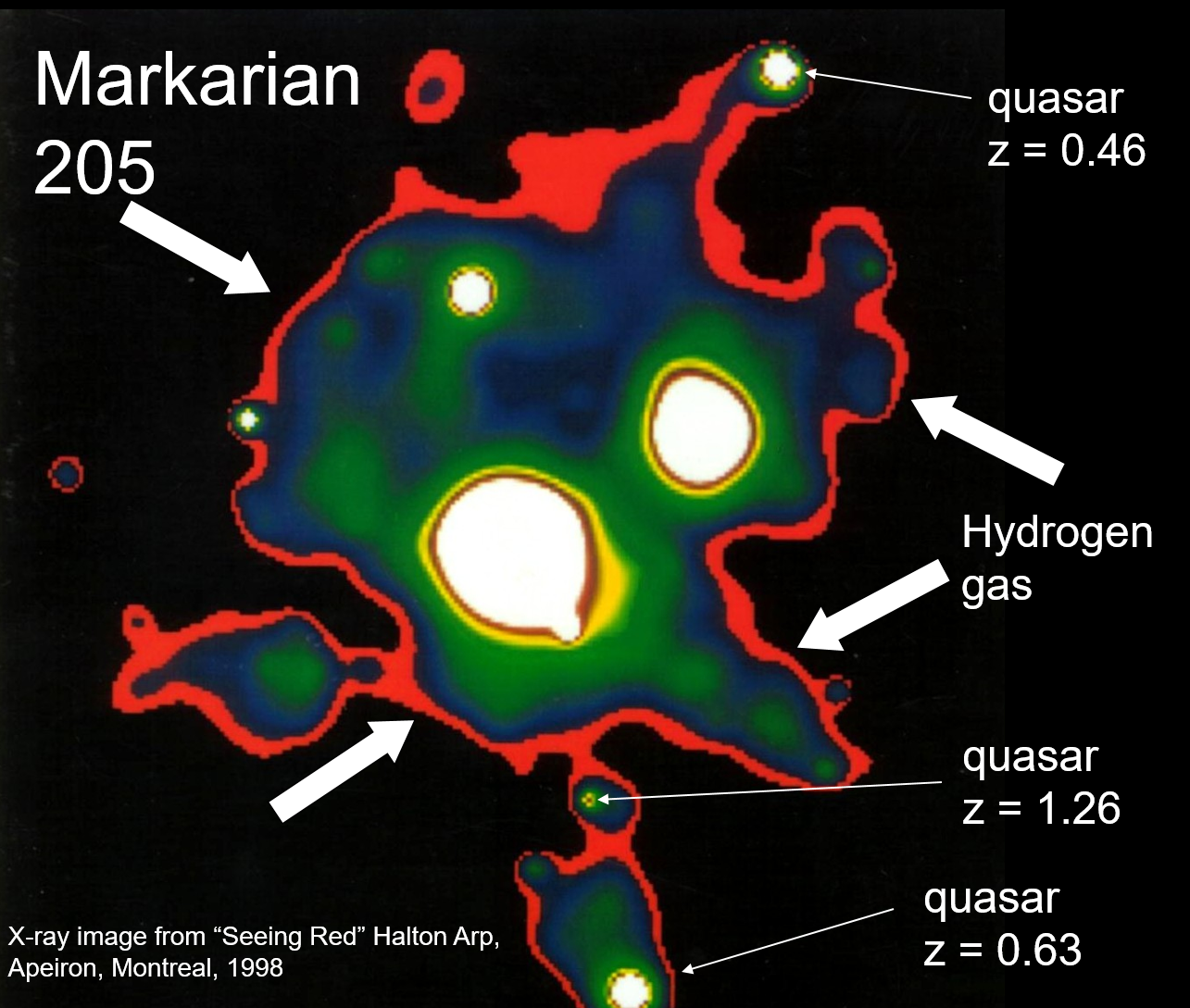
Hoyle & Narlikar (1966) observed the physical association of quasars and galaxies by noting numerous instances of a quasar and a galaxy in close astrometric proximity but with different redshifts, for instance, a quasar with z = 2.114 very close to the nucleus of the galaxy NGC 7319 with z = 0.022. Arp observed many such pair cases in which filaments connect the objects, including prominent ones (e.g., NGC 4319 and MRK 205; NGC 3067 and 3C 232). Some quasars exhibit jets of unknown nature (e.g., 3C 345 in the vicinity of NGC 6212), while in some cases moving structures are radio sources accompanied by optical jets.1
López-Corredoira & Gutiérrez (2004) observed two emission line objects with redshifts greater than 0.2 in the optical filament apparently connecting the Seyfert galaxy NGC 7603 with z = 0.029 to its companion NGC 7603B with z = 0.057, a possible example of anomalous redshift. These findings lead to the conclusion that quasars are ejected from galactic nuclei and that quasar redshift is largely an intrinsic parameter.
Mal et al (2024)1 used a method of Singular Value Decomposition based periodicity estimation, which is known to be superior for noisy data sets, especially when the data contain multiple harmonics and overtones. The authors chose that as their primary tool for analysis of the quasar-galaxy pair redshift data from the Sloan Digital Sky Survey Data Release 7 (SDSS DR7).
They observed a fundamental periodicity of 0.051 with a confidence interval of 95% in linear scale the site-available SDSS DR7 quasar-galaxy pair data set. They independently generated quasar-galaxy pair data sets from both 2dF and SDSS and found fundamental intrinsic redshift periodicities of 0.077 and 0.089, respectively, in log scale with a confidence interval of 95%. These results build on the work of Fulton and Arp (2012)2 and Fulton, Arp and Hartnett (2018)3.
What does it mean? It means that the standard Hubble redshift-distance relation for all high redshift astrophysical objects is wrong. If that is wrong then it brings into doubt the entire edifice upon which the standard big bang cosmology is based.
Reference
- Arindam Mal, Sarbani Palit, Christopher C. Fulton, and Sisir Roy, “Quantized Redshift and its significance for recent observation,” Res. Astron. Astrophys. 24 095014 (2024), DOI 10.1088/1674-4527/ad6db5
- C.C. Fulton and H.C. Arp, “The 2dF Redshift Survey. I. Physical association and periodicity in quasar families”, Astrophys. J. 754:134, (2012)
- C.C. Fulton, H.C. Arp, J.G. Hartnett, “Physical association and periodicity in quasar families with SDSS and 2MRS”, Astrophysics & Space Science 363:134 (2018)
Related Reading
- Galaxy-Quasar Associations
- The Distances to Quasars
- Halton Arp—Big-Bang-Defying Giant Passes Away
- Confirmed: Physical Association Between Parent Galaxies and Quasar Families
Free Subscribers
Subscribe to our Newsletters as a Free Subscriber and be notified by email. Just put your email address in the box at the bottom of your screen.
You’ll get an email each time we publish a new article. It is quick and easy to do and totally free. You only need do it once.
Premium Subscribers
Subscribe to our Newsletters as a Premium Subscribers at $5 USD/month or $30 USD/year (you choose).
Paid Premium Subscribers will get exclusive access to certain content I publish. That will only cost you a cup of coffee per month.
Also you’ll get access to download, for free, a PDF of my book Apocalypse Now. You can download it from a Premium members only post here.
And now you’ll get exclusive access to the chapters (in their initial draft form) to my new book with working title “The Physics of Creation”; plus eventually a PDF of the final compiled book.
This is how you can support my work. I have been publishing this website for 10 years now and up to 2024 I never asked for any support.
Press the button “Premium” on the front page to find a list of Premium content. Over time that list will grow. Thanks so much to all supporters.
At a minimum, please join as a Free Subscriber. It’ll cost you nothing. It may also help me beat the shadow banning of some posts.





 Bible Science Forum