
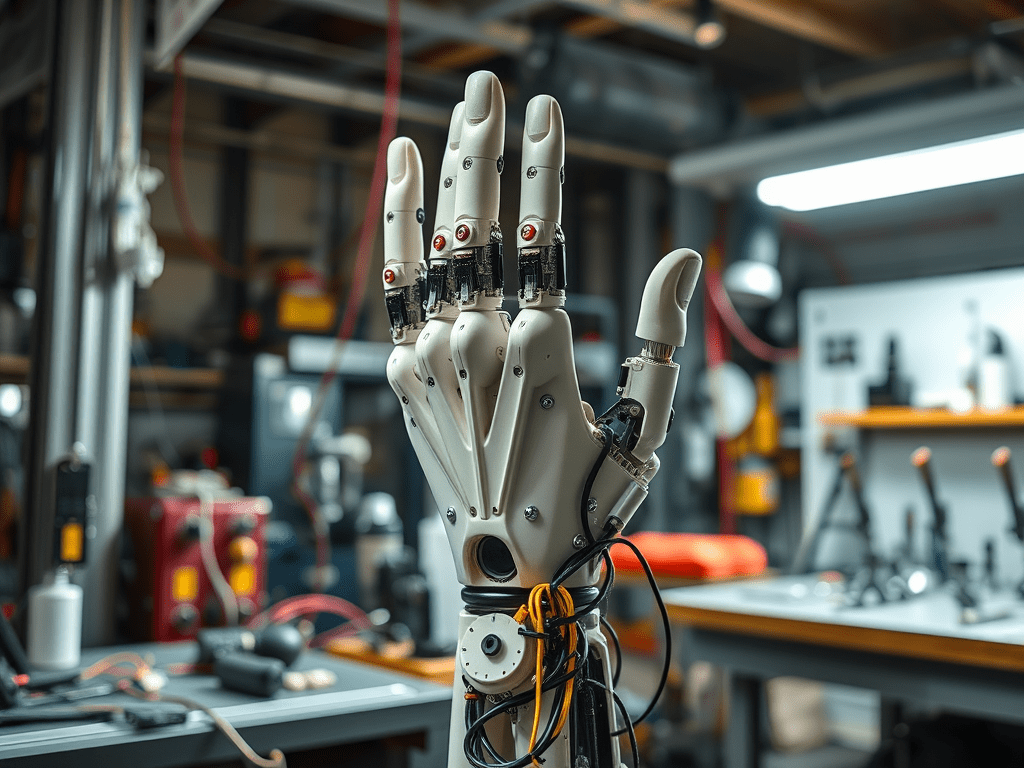

Human hands, with four fingers and an opposable thumb, are a truly amazing and unique creation of the Master Craftsman. His design surpasses all that has been developed by humans in their quest for artificial hands on artificial humans. Even with modern space-age science and engineering and the availability of the existing human hands, copies of them on humanoid robots built with motors, sensors, wires and bearings remains one of the biggest challenges in the robotics world.
On Friday, we reported on Tesla’s Optimus humanoid robot program, which may fall well short of Elon Musk’s ambitious goal to pump out 5,000 robots by the end of the year.
It turns out the robots’ hands are among the big factors holding up production. In fact, some Optimus robots that are mostly complete have been sitting unused at a Tesla facility because they don’t have hands or lower forearms, we reported. Musk deserves some sympathy. Five-fingered hands are notoriously difficult for roboticists to get right, and many robotics companies steer clear of them, settling for simple pinchers instead.
To see why, consider the number of joints in a human hand. A hand and wrist can perform about 27 different movements (in robotics-speak, that’s 27 “degrees of freedom”). To put that in perspective, a robotic arm is considered pretty agile even if it has as few as seven degrees of freedom.
All those degrees of freedom add up to trouble for the roboticists designing the hands. More joints require separate motors to move them, and the motors need to be powerful enough to enable the robot to do useful work. For example, the humanoid robots of 1-year-old startup Foundation can carry up to 45 pounds using their hands and arms. Still, like many other robot hands, Foundation’s are not strong enough to pinch and unscrew a bottle cap, according to someone familiar with the company. [my emphases added]
Why Hands Are a Handful for Tesla’s Humanoid Robots, TheInformation.com
A robotic hand engineering specialist admitted the following:
“99.5% of work is done by hands,” said Jay Li, who worked on hand sensors for Tesla’s Optimus line before he co-founded Proception in September to develop robotic hands.
“The industry has been so focused on the human form, like how they walk, how they move around, how they look,” he noted. But humanoid companies have overlooked the importance of hands, he said. Hands are hard to get right. Think about the mix of pressure and deftness it takes to peel an orange (and not mash it to a pulp in the process).
The San Francisco-based Proception is developing a glove embedded with sensors that people can wear while they perform their jobs. This data will train the models that power its hands to operate autonomously. The company has already received interest in ordering its hands from multiple AI labs and plans to make its first sales in the fourth quarter of this year, said Li. Eventually, it expects to make the whole human robot, Li said.
These efforts underscore the steep challenge of making robots that have the physical dexterity and mental responsiveness of humans. Coordinating the movement of many joints at once to turn a knob is hard for robots, as is picking up and using tools, which can require a flexible palm, notes Stark.
The next time you see a company release a video of a humanoid robot, watch the hands. [my emphases added]
The Startups Developing Robot Hands; OpenAI’s Revenue Hopes, TheInformation.com
Watch this YouTube video from Proception.ai
This gives you some idea of what 27 degrees of freedom means. The dexterity of human hands are evidence of the Creator. He created them that we might build and labour to feed ourselves and our families and those in need.
28 He who has been stealing must steal no longer, but must work, doing something useful with his own hands, that he may have something to share with those in need.
Ephesians 4:28 NIV
Any human copies will always be a poor imitation of the Creator’s original design. He built us from scratch; weaving all the components together in the womb.
13 For you created my inmost being; you knit me together in my mother’s womb. 14 I praise you because I am fearfully and wonderfully made; your works are wonderful, I know that full well. 15 My frame was not hidden from you when I was made in the secret place, when I was woven together in the depths of the earth. 16 Your eyes saw my unformed body; all the days ordained for me were written in your book before one of them came to be. [my emphases added]
Psalms 139:13-16 NIV
No evolution was ever involved. From Creation magazine December 1990
What does the development of hands and feet in the human embryo tell us, then? In a six-week-old, 11-millimetre-long embryo, one can already see the regions from which the limbs will develop. Only one week later, the five-fold digitization of the hand is clearly visible, even though the feet are still like paddles. It takes another week for the feet to ‘catch up’ in this regard.
At 15 millimetres one already can see the later function of these limbs mirrored in their early movements. Motions of the upper limbs are ‘hugging’, whereas the lower limb movements are of a pushing, bracing nature. There is never the slightest hint of any climbing function.
At three months, the embryo, in spite of only weighing about 30 grams (little more than one ounce) can already make a fist and oppose the thumb. Its feet are spread-eagled, but in contrast to the hands, they never make any gripping motions.
It has been shown that at 16 weeks an embryo is able to grip a small rod firmly. At six months it can grip it so tightly as to be able to be lifted up by it. At this time the foot is a fully formed standing/walking structure (although to mother at this time ‘kicking’ is probably the word that most readily springs to mind!).
The long refuted notion that human embryos pass through different stages of evolution in their embryonic development in the womb with webbed toes and fingers is laughable. No such thing is observed.
At three months, the foot looks identical to that of a new-born baby. Human beings do not give any sign in their embryonic development of anything other than an upright posture, two-legged walking, and a freely opposable, rotatable hand.
How are they going to implement anything like this even just in the imitation of the human hand?
The project to build the hand by Proception.ai requires training the Large Language Model (LLM) AI on real human hands via a hand with many embedded sensors.
Man’s desire to create in his own image leads to merely a bad copy of what the Master Creator already created.
These creations of man are only copies of those the Master Creator already has created. There is nothing novel there, only a copy. But even to achieve the copy is a task not yet fully appreciated by most in the robotics world.
The robot hands rely on sensors for pressure and temperature, motors and actuators and a myriad of connecting wires. And these thousands of sensors must be connected to a brain that can control all these movements.
Mankind has made a lot of tools, but none of them rival the usefulness and versatility of the human hand. Its structure and design give evidence of God’s creativity and allows us to do a wide variety of tasks—like typing, eating, and building skyscrapers.
Watch this short 2 minute video!
The finger design follows a Fibonacci sequence. The sum of the lengths of the first two bones in each finger equals the length of the next one. And this fact is very noteworthy: “A large amount of your brain is dedicated to controlling hand muscles. This means that grip control combinations are nearly infinite, and remarkably versatile.”
This is one of the biggest problems with AI. They can NEVER have all the data, because data is infinite, flowing from the mind of God, who can create anything new He wants to at any time.
Allowing for every combination of the 27 different movements (degrees of freedom) of the human hand means that there are of order 27! = 1028 combinations that the brain must control. That number, 27 factorial is 10 octillion, which, as you can see, is an extremely large number. But no doubt some combinations are not possible when certain movements are performed. Even so, I would think the number surely will be at least a quintillion. (See here.)
To get this right robotics makers will need the power of a supercomputer equal to the human brain to manipulate their artificial human hands, which we know is impossible. They would need to know the mind of God.
God has already done the job with the human design. And no wires are needed. Yet there are a myriad of sensors and muscles packed into the arms and hands to perform all the hand movements.
10 fear not, for I am with you; be not dismayed, for I am your God; I will strengthen you, I will help you, I will uphold you with my righteous right hand.
Isaiah 41:10 ESV
Of course God does not have physical flesh-and-blood hands. Scriptures like this shows us the importance of the hands; here used as a metaphor for God’s righteousness and strength.
Our hands are one of most important human characteristics that God has created to separate us from the rest of the animal kingdom, as well as AI.
In January 2016 a paper1 in a peer-reviewed open-access scientific journal PLOS ONE credits ‘the Creator’ for human hand design but the journal was forced to retract it after an outcry. Why? Because you cannot have the Creator being credited in a secular science journal. Ironically PLOS stands for Public Library of Science.
A team of four Chinese researchers published a paper that dealt with everyday topics such as how human hands grasp objects, and showed these actions, that we take for granted, require “complex biomechanical architecture”. But this would hardly have been controversial if not for its ‘unfortunate’ use of some extremely taboo language: the researchers in multiple places referred to the Creator.
The paper’s Abstract states:
The explicit functional link indicates that the biomechanical characteristic of tendinous connective architecture between muscles and articulations is the proper design by the Creator to perform a multitude of daily tasks in a comfortable way.
The Introduction includes:
Thus, hand coordination affords humans the ability to flexibly and comfortably control the complex structure to perform numerous tasks. Hand coordination should indicate the mystery of the Creator’s invention.
My added emphases in bold text. See creation.com for a full discussion.
In summary on this paper, the science showed the amazing design of human hands and gave credit where credit is due. But the Satanic atheistic misotheistic journal editors retracted the paper not based on the science but based on their prior held belief that all life evolved from pond scum over billions of years. And the suggestion is that human hands are the evolutionary outcome as we descended from the trees. But recent research by evolutionists challenges the view that humans diverged from chimp-like ancestors with hands adapted to swing from tree limbs. See article on AnswersinGenesis.org.
God’s designs for hands include primates both extant and extinct adapted to many different habitats and lifestyles. Such variation does not require an evolutionary explanation. Animal species do vary but only within their created kinds. The diversity documented in the study is consistent with this fact. Despite varying degrees of common designs shared with some apes, the human hand with its fully opposable thumb remains unique.
After the alleged millions of years of evolution the human hand with its fully opposable thumb remains unique. So now the engineers in the robotics world plan on doing what Darwin could not.
Hands down, the design and operation of the hands created by God, especially the human hands with opposable thumbs, and precise pincher precision, beat any robotics thus far.
Update 2025/11/2
Since this article was published on Health Impact News the Editor pointed out to me a press release this week of a new personal robot called “Neo” designed for people’s homes, as written about in the Wall Street Journal, which story you can read here under the title I Tried the Robot That’s Coming to Live With You. It’s Still Part Human.
Here is the video of the interview of the creator of this new robot that is supposedly going to be sold to the public next year as a personal assistant in homes. He calls that the early adopters program:
The creator admits that this robot cannot work without a human being controlling it behind the scenes, and they deal with the privacy issues of that person behind the scenes knowing everything about your private life in your home.
The creator of this robot said: “Biology actually did a pretty good job. It’s very hard to actually come up with something that works better. And believe me, we’ve tried.”
So he personifies “biology” rather than giving credit to God.
Robots will never replace humans, and here is a manufacturer of personal robots for the home saying the exact same thing as they finally admit that this is true, and that robots are just a tool that need humans to manage and operate them.
And of course, the control of these robots are all done through an app one has on their phone to communicate with an “operator” offsite, so that when your Internet goes down, or your electricity to run the Internet goes down, these robots become expensive lifeless statues.
Brian Shilhavy, Editor, HealthImpactNews.com
The term “robot” originates from the Czech word “robota,” meaning forced labor or drudgery. The word was popularized by Czech writer Karel Čapek in his 1920 play R.U.R. (Rossum’s Universal Robots), where it referred to artificial beings created to perform labor for humans.
But if the tasks are actually performed by humans, albeit behind the scenes, connected via VR glasses and communications links, then is the machine anything more than a glorified articulated mechanical tool? Only if the robot becomes fully autonomous could it relieve the human of the task of performing the forced labor. That goal seems to be a long way off. And the problem of the hands still has yet to be solved, if it ever can be.
References
- Ming-Jin Liu, Cai-Hua Xiong , Le Xiong, Xiao-Lin Huang, Biomechanical characteristics of hand coordination in grasping activities of daily living, PLOS ONE, 5 January 2016 | doi:10.1371/journal.pone.0146193. PLOS = Public Library of Science.
Related Reading
HealthImpactNews.com: Hands are the Downfall of Robotics – Man Has Failed to Duplicate what God has Created with Human Hands
Free Subscribers
Subscribe to our Newsletters as a Free Subscriber and be notified by email. Just put your email address in the box at the bottom of your screen.
You’ll get an email each time we publish a new article. It is quick and easy to do and totally free. You only need do it once.
Premium Subscribers
Subscribe to our Newsletters as a Premium Subscribers at $5 USD/month or $30 USD/year (you choose).
Paid Premium Subscribers will get exclusive access to certain content I publish. That will only cost you a cup of coffee per month.
Also you’ll be able to download, for free, a PDF of my book Apocalypse Now and also a PDF of my book Physics of Creation The Creator’s Ultimate Design for Earth.
You can download them from the link below.
This is how you can support my work. I have been publishing this website for 10 years now and up to 2024 I never asked for any support.
Press the button “Premium” on the front page to find a list of Premium content. Thanks so much to all supporters.
At a minimum, please join as a Free Subscriber. It’ll cost you nothing. It may also help me beat the shadow banning of some posts.




 Bible Science Forum
Leave a reply to 手是机器人技术的衰落——人类无法复制上帝用人手创造的东西 – Mandarinian Cancel reply