
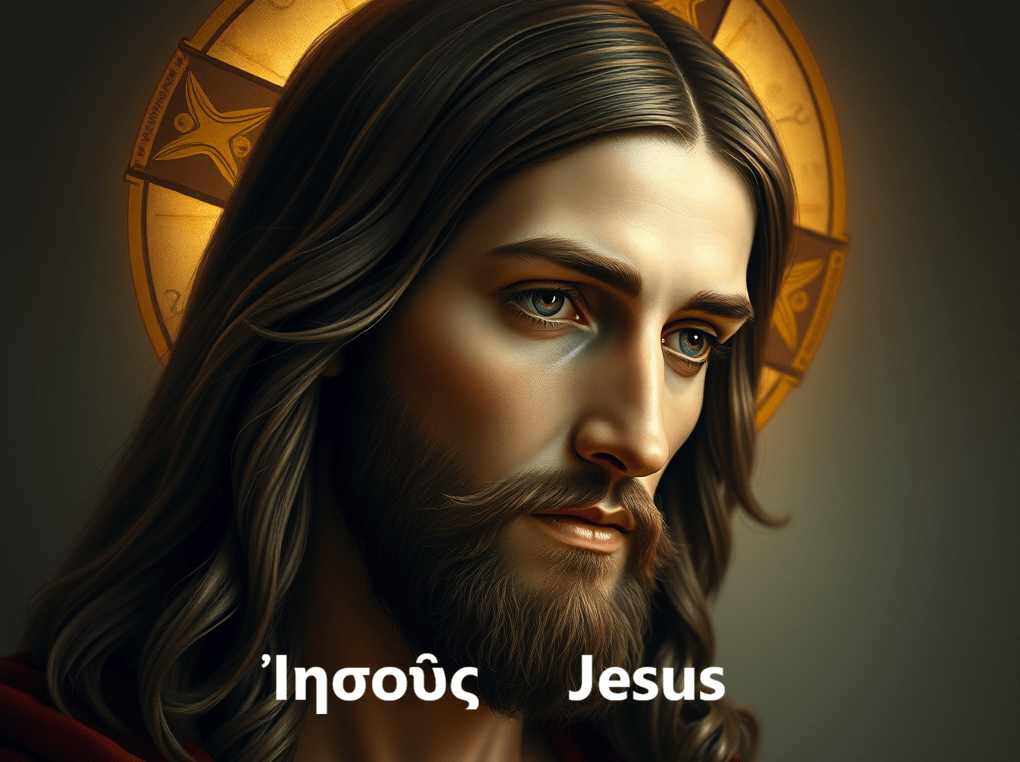
What’s in a name, you might ask? A lot apparently. This is something new I just learned today. Jesus was officially formally named by Gabriel the angel in the Greek language Ἰησοῦς, which was transliterated to Jesus in English. His name was never given in Hebrew as Yeshua.
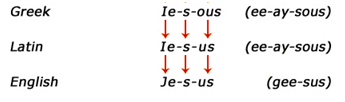
The following I quote JD Hall @LostMyHats on X.com.
Let me fact[check] you[r] claim that Israel was never Palestine, but first I have to factcheck your calling of Him “Yeshua.”
His name isn’t Yeshua:
When Matthew 1:21 records the angel’s words to Joseph, “you shall call his name Jesus (Ἰησοῦν), for he will save his people from their sins” he does so in Greek. The entire Gospel of Matthew is written in Greek, the lingua franca of the Roman Empire. His name wasn’t transliterated from Hebrew in that verse; it was given and recorded in the Greek form: Ἰησοῦς.
Had Matthew intended a Hebrew name, the text would have said Yehoshua or Yeshua. But it doesn’t. It gives the name in Greek form, as used in every surviving Greek manuscript of the New Testament.
The Holy Ghost inspired the Scriptures in Greek, then the name Ἰησοῦς is not a mistranslation or downgrade; it’s the canonical, God-breathed form of the name. Greek was chosen deliberately, and every New Testament writer, including the Jewish ones, used that same Greek name.
To re-cap for Jewish Supremacists who are often dumber and need more help:
•The angelic instruction was recorded as “Iēsous,” not “Yeshua.”
•The apostles preached in Greek using “Iēsous.”
But we should go further in this little de-brainwashing session. His name wasn’t just recoded as Jesus after the fact. It actually was Jesus. That’s how he was referred to by His contemporaries; Jews, Greeks, and Romans alike, within the multilingual world of first-century Palestine.
Palestine was not a purely Hebrew-speaking environment. It was a linguistic crossroads, with Greek, Aramaic, and Latin all in daily use. The average Jew under Roman rule knew Greek; most were fluent. Coins, inscriptions, and government decrees were written in Greek. Even the synagogue readings often came from the Septuagint.
Had someone yelled out, “Yeshua” in a crowd, Jesus wouldn’t have looked around. That wasn’t his name. He would have assumed they spoke to someone else.
[If] Matthew had wanted to preserve the Messiah’s name in Aramaic or Hebrew, he easily could have. We know that because he does exactly that several times in his Gospel.
In fact, when Matthew quotes Aramaic, he doesn’t transliterate it into Greek letters and hope readers “get it.” He explicitly preserves the words and then translates them for his audience.
His name isn’t Yeshua, and never was.
WAS JESUS FROM PALESTINE?
It’s actually a Zionist myth that Palestine wasn’t called Palestine until 135 AD. That’s Israeli propaganda, part of their ethnic cleansing campaign against Palestinians. I’ll explain:
Its root comes from the Philistines, known in official Egyptian records as “Peleset” – an early form of the word – in the Bronze Age, about 1200 BC.
And before Rome, Greek writers adopted the name for the region. In the 5th century BC, Herodotus explicitly refers to Palaistinē when describing the land between Phoenicia and Egypt, including Judea. So the name Palestine was given centuries before.
In Greek intellectual tradition, Aristotle references it as Palestine, showing this was common. So when Rome renamed Judea Syria Palaestina after the Bar Kokhba revolt, it was not coining a new term but deliberately reviving an ancient regional name.
Further, let’s get real. The Zionists who founded the modern Jewish ethnostate used the name Palestine, undermining whatever claim Israelis make that the name is illegitimate. These include Theodor Herzl, the World Zionist Organization, the Jewish Agency, etc. they all used “Palestine.” Heck, Jewish residents were officially designated “Palestinian Jews.”
So the reason “Palestine” is perfectly fine is because that’s its name.
It would be most accurate to say Jesus was from Galilee, but he sure wasn’t from “Judea” or a Jew in the regional sense, but that’s another can of worms.
Let me repeat that. The Holy Ghost inspired the Scriptures in Greek, then the name Ἰησοῦς is not a mistranslation or downgrade; it’s the canonical, God-breathed form of the name. His name Ἰησοῦς is the lemma. In morphology and lexicography, a lemma (pl.: lemmas or lemmata) is the canonical form, dictionary form, or citation form of a set of word forms. Fundamentally Christ’s name is Iēsous, which was transliterated to Jesus in English. His name isn’t Yeshua, and it never was. It is Iēsous.
There is no need to call Him Yeshua if you are speaking English like many seem to think they need to, especially those from the Hebrew Roots cult. It is as if they believe it is more correct or proper to use the Hebrew form Yeshua. But it looks like that is fake news.
And Jesus was from Galilee not from Judea, hence He was a Palestinian. His mother was of one of the tribes of Israel (likely Levi, because her cousin Elizabeth is described as “of the daughters of Aaron” the Levite (Luke 1:5)), and not of Judah. Jesus step-father Joseph was of the tribe of Judah (Luke 3:23+). But Jesus actual Father was not of any tribe. He was/is God, who, by the way, is not Jewish or a Hebrew.
Since Israeli tribal lineage was determined by the patriarchal line, by that classification, the man Jesus was not Israeli but Palestinian as determined by His place of origin. Nazareth was/is located in the Lower Galilee region of northern Israel. So He was Palestinian, but He could be designated a Palestinian “Jew” after His step-father from Judah. Thus Christ is called the lion of Judah (Genesis 49:9) in that sense.
Why not just call Christ, Jesus?
What a wonderful name!
Jesus, What a Wonderful Name
Some call it progress and we must conform
Or we will be left by the change
This New world religion, serves the god of their choice
But salvation sill comes in One Name
That name is Jesus, Sweet Rose of Sharon
Spotless and pure Lamb of God, Jesus, the Lion of Judah
The promised Emmanuel, God’s Son, Jesus my Lord and Creator
Who witnessed and conquered the grave,
Jesus this worlds only Savior, Jesus what a wonderful name
All the great leaders who sleep in their graves
One day will bow and proclaim
He’s Lord of all glory, the crowned King of kings
All creation will thunder His Name
That name is Jesus, Sweet Rose of Sharon
Spotless and pure Lamb of God, Jesus, the Lion of Judah
The promised Emmanuel, God’s Son, Jesus my Lord and Creator
Who witnessed and conquered the brave,
Jesus this worlds only Savior, Jesus what a wonderful name
That name is Jesus
What a wonderful name
Jesus, what a wonderful name
What a wonderful name
What a wonderful name
Jesus, what a wonderful name
Related Reading
- If His Name is Yeshua, Why Do We Call Him Jesus?
- Jesus is Personally Named in the Old Testament
- Christ is King | There is No Other Name Under Heaven Whereby We Must Be Saved
- Could Jesus Christ Be Called ‘THE Zionist’?
- Only Through Jesus Christ Can Anyone Know the Father
The Good News – the Gospel
- Do You Know Him?
- The Salvific Power of Christ
- How Do You Know You Are Saved?
- Can You Do Anything To Be Saved?
Free Subscribers
Subscribe to our Newsletters as a Free Subscriber and be notified by email. Just put your email address in the box at the bottom of your screen.
You’ll get an email each time we publish a new article. It is quick and easy to do and totally free. You only need do it once.
Premium Subscribers
Subscribe to our Newsletters as a Premium Subscribers at $5 USD/month or $30 USD/year (you choose). Cancel anytime.
Paid Premium Subscribers will get exclusive access to certain content I publish. That will only cost you a cup of coffee per month.
Also you’ll be able to download, for free, a PDF of my book Apocalypse Now and also a PDF of my book The Physics of Creation The Creator’s Ultimate Design for Earth.
You can download them from the link below.
This is how you can support my work. I have been publishing this website for 10 years now and up to 2024 I never asked for any support.
Press the button “Premium” on the front page to find a list of Premium content. Thanks so much to all supporters.
At a minimum, please join as a Free Subscriber. It’ll cost you nothing. It may also help me beat the shadow banning of some posts.



 Bible Science Forum
Leave a reply to Trevor Grace Cancel reply