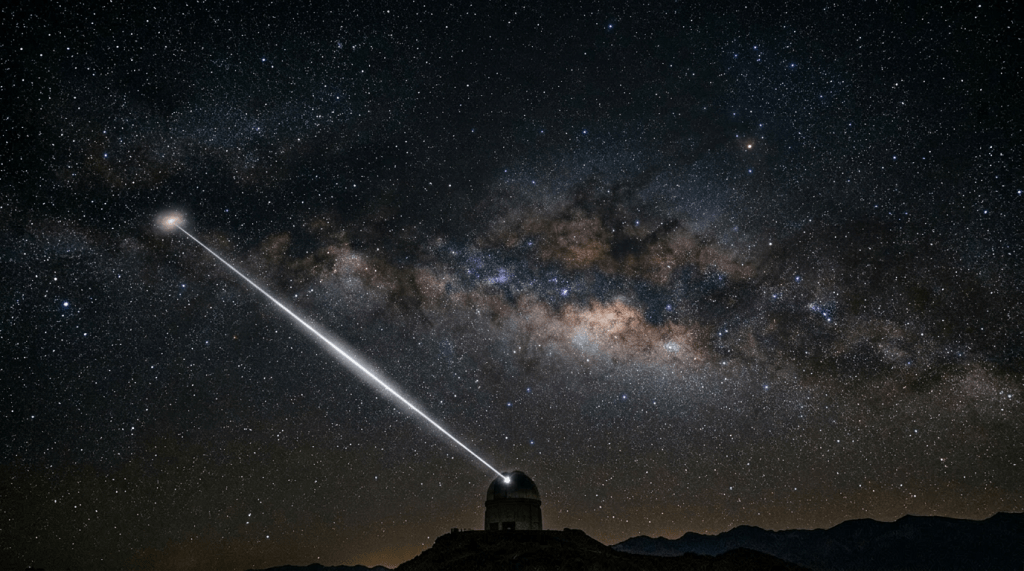
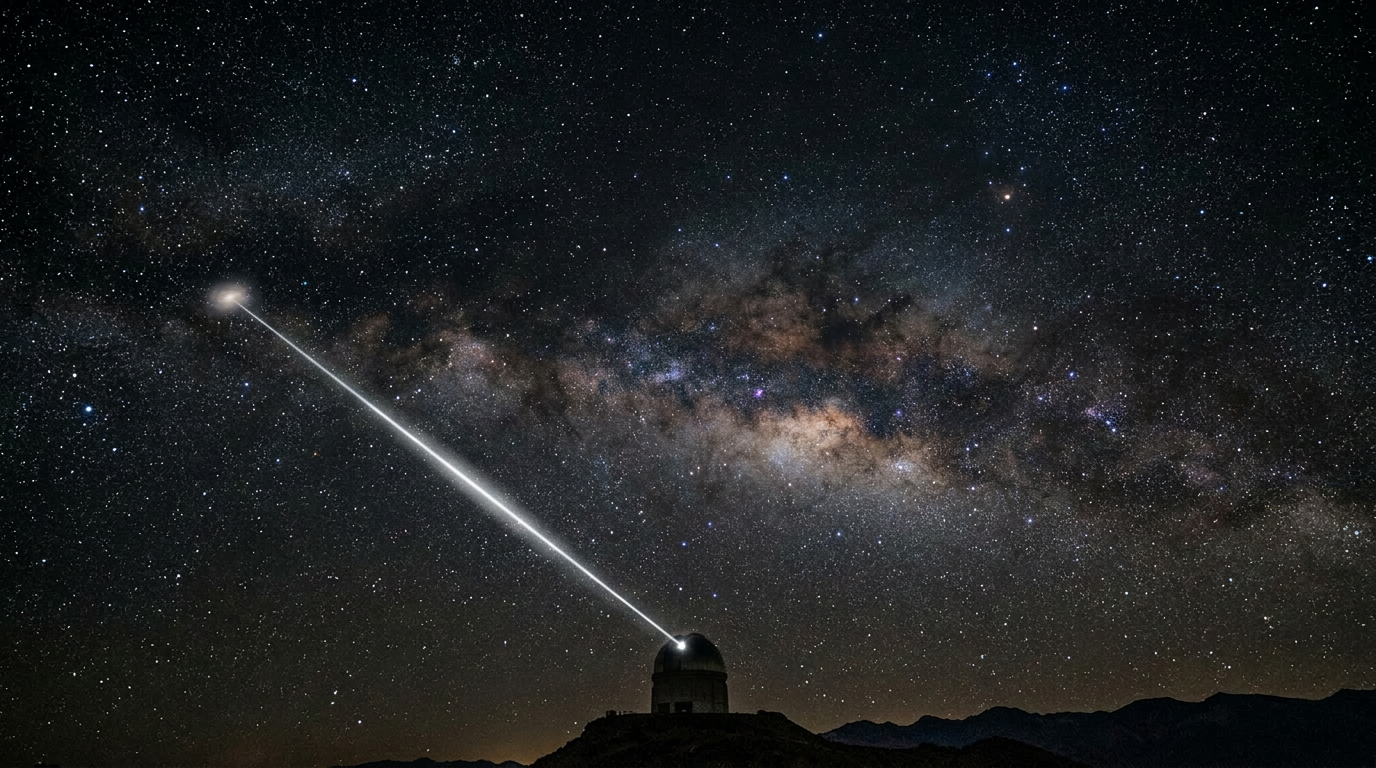
Meteor streaking across the star-filled Milky Way galaxy above an observatory dome silhouette
Figure 1: A light ray emitted by atoms in a distant galaxy seen by a large Earth telescope.

Recently I was discussing the one-way and two-way speed of light with a professional physicist friend of mine. The discussion revolved around how to measure the incoming one-way speed wherein I tried to stress the conventionality thesis.

The discussion started after he asked me about how do I resolve the young universe biblical timescale (less than 10,000 years) with measurements of galaxy light and their spectra seen in Earth telescopes from sources in the very distant universe, meaning billions of light-years away. Surely billions of light-years must mean billions of years of travel time. But of course that includes the inherit and usually unstated assumption that the light travelled at the canonical two-way speed of light c = 299,792.458 km/s. That means it is assumed to be isotropic, which means the same speed in all directions, because all that has ever been measured experimentally is the round-trip speed, the two-way speed of light reflected off a mirror, or some such device.

Watch this pretty good video explanation of why it is impossible to measure the one-way speed of light. And why it must be chosen by convention in order to calculate any physics.

Now back to the question my friend posed.

Imagine a ray of light coming from a distant source. The oscillations in the atoms produce radiation which we observe on Earth. Imagine that ray full of wave crests and troughs as the source atoms oscillate. They fill the space from the source to the observer with a contiguous stream. So that proves the one-way speed incoming to the observer is finite, otherwise if it was infinite (i.e. no travel time) there would be no time for those wave crests and troughs to accumulate. But we see the galaxies and see their spectra.

At the time we had the discussion I could not quickly see where the assumption was, and there always is one, so I asked Dr. Jason Lisle, who should be given all credit for introducing these concepts to the creationist community back in 2003. As an aside, I was the only referee on his original paper at that time, who saw the merit in it as a valid solution to the biblical creationist light-travel time problem. So his paper was published and the rest is history, but we are still arguing over it. It even gets a mention on rationalwiki.org.

Jason wrote the following:

I’m not sure why your friend is assuming that our ability to detect the oscillations of light waves proves that the speed is finite. Imagine a straight line connected from that galaxy to us – the line moves up and down simultaneously at both ends. That essentially represents light with an instant speed and thus an infinite wavelength. We would detect the oscillations simultaneously with their emission. What we actually measure is frequency of the oscillations – the wavelength is conceptually inferred from our stipulated one-way speed of light.

Jason Lisle
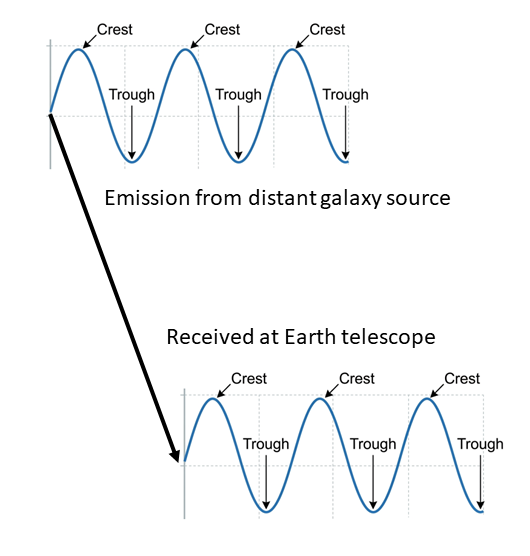
Figure 2: ASC — At the source galaxy the atoms emit light illustrated by these sinusoidal oscillations which are received at an Earth telescope without any time delay for the travel time through space. The x-axis here is time and the y-axis is amplitude of the oscillation.

Fig. 2 illustrates this issue. Assuming the Anisotropic Synchrony Convention (ASC) the black arrow indicates the instantaneous transmission of the beginning of the light emission from the distant source. As the atoms oscillate in the source they produce the same light signal that is received by the receiver. The rise and fall to the crests and trough represents the frequency of the emission. The instantaneous travel time means infinite speed and therefore infinite wavelength.

To say space fills with crests and troughs of the oscillating wave along the path of the black arrow is an a priori assumption of a finite light speed. In the usual case the assumption is choosing the Einstein Synchrony Convention (ESC). Therefore that is begging the question, even though the person may not realise that assumption was made.

For those interested in this topic you might find the following from Dr Lisle also interesting and relevant.

Phillip Dennis tried to disprove ASC (really, the conventionality thesis) in a paper he published at the ARJ. But I showed that he had begged the question by assuming equations that tacitly stipulate the one-way speed of light at the start. My response is here:
https://biblicalscienceinstitute.com/wp-content/uploads/2024/07/Dennis_Refutation.pdf

He then replied, but it was very clear that he hasn’t researched this topic because his arguments are already refuted in the literature – one of them in 1923! Anyway, I wrote a series of responses you might enjoy reading starting here:

https://biblicalscienceinstitute.com/refuting-the-critics/refuting-phillip-denniss-errors-in-physics-asc-and-philosophy-part-1

Parts 3 and 4 of the series refute Dennis’s failed attempts to refute the conventionality thesis from observations/experiments.

I strongly recommend Dr Lisle’s website: biblicalscienceinstitute.com

I also recommend you read the book by Max Jammer, Concepts of Simultaneity, Johns Hopkins University Press, 2006. The book is expensive so I would suggest you find it in a library if you plan on reading it.

It is amazing how much our thinking is conditioned by the worldview we have soaked in during our lifetimes.


Related Reading


Free Subscribers

Subscribe to our Newsletters as a Free Subscriber and be notified by email. Just put your email address in the box at the bottom of your screen.

You’ll get an email each time we publish a new article. It is quick and easy to do and totally free. You only need do it once.


Premium Subscribers

Subscribe to our Newsletters as a Premium Subscribers at $5 USD/month or $30 USD/year (you choose). Cancel anytime.

Paid Premium Subscribers will get exclusive access to certain content I publish. That will only cost you a cup of coffee per month.

Also you’ll be able to download, for free, a PDF of my book Apocalypse Now and also a PDF of my book The Physics of Creation The Creator’s Ultimate Design for Earth.

You can download them from the link below.

This is how you can support my work. I have been publishing this website for 10 years now and up to 2024 I never asked for any support.

Press the button “Premium” on the front page to find a list of Premium content. Thanks so much to all supporters.


At a minimum, please join as a Free Subscriber. It’ll cost you nothing. It may also help me beat the shadow banning of some posts.


Comments Welcome Below

12 responses to “Do Distant Light Emissions Prove a Finite One-Way Speed of Light?”

  1. I suggest that the thrust of the argument your physicist friend mentioned was not the speed of travel of the light waves as such, but rather the *number* of valleys and crests that must exist between two cosmically remote points, and the fact that electrons in atoms or whatever must have oscillated sequentially this number of times in order to create these valleys and crests regardless of which direction the light travels away from the oscillation. The fact that much the same valleys and crests that we detect here on earth must fill all of space is evident because we see that light which left a galaxy say 10 billion light years away has interacted (creating absorbtion lines) with galactic gas that it passed through that was say 5 billion light years away. This effect would not not only be happening and apparent at our location but must also be happening in all other locations – the vast majority of which we can only view somewhat perpendicular to the light travel direction. Thus the universe is full from edge to edge in every direction with crests and troughs, each one of which must have taken a finite time for an electron oscillation to generate. Thus at least 20 billion years worth of oscillations (and thus of universe history) is recorded in these crests and troughs.

    Suppose, by some miracle, we remained “frozen in time” with respect to the rest of the universe until ~6k years ago, while all these oscillations were occurring and filling the universe all around us with waves. This miracle does not mean that the universe is not billions of years old as its entire history is recorded and fills space in the form of valleys and crests. It simply means that we were frozen for 99.9999% of the universe’s external existence and have so recently just “woken up” to find ourselves in the middle of an already very old universe. In case you would like there to be no evidence that light has travelled in *both* directions perpendicular to our line of view for much longer than 6k years – you must realise that the evidence for that is overwhelming (including gas travel in the form of AGN jets such as Porphyrion or Alcyoneus >16Mly).

    Like

    1. On the first point of the intervening gas clouds, and light with the crests and troughs filling all space, from those intervening clouds, the exact same argument can be applied. The absorption or emission spectra result from the interaction with those gases in the cloud. Instantaneous travel to intervening cloud 1 or as many as you like and instantaneous transmission from cloud 1 or how ever many there are to Earth does not change the argument.

      Your second point, which is an age issue or how much process has occurred in the available Earth time since creation is different. If you argue that 10 billion years of process has occurred or for example AGN jets longer than 16Mly then you are right. They do not fit into a young universe. As is usually assumed the speed of light is isotropic and the measured round-trip speed, there could not be 16 million years available in the ASC model. But no one-way speed of light advocate is suggesting that that is the case.

      I could argue about the choice of cosmology to interpret linear size from the measured angular size of such very large claimed structures in the universe. But in the end there is a certain amount of mature creation in the ASC model. Afterall we could speak of the size of large galaxies which are even greater than 100,000 ly across to super structures a billion ly across. But the ASC model is not alone in that. Current observations of Little Red Dot “galaxies” are way too large for the standard LCDM model so soon after the alleged big bang.

      Like

  2. Although in general I agree with Dr Lisle’s ASC model, the instantaneous transmission bothers me. From Genesis 1:14-19 the creations of the moon, sun and stars had a full day for their light to reach the Earth. Dr Lisle references the “and it was so” in verse 15 to justify claiming the light reached the Earth instantaneously. However, verses 14 to 15 parallel verses 16 to 18 and verse 19 talks about the fourth day from evening to morning. So I think these verses imply that it took light from the various created sources up to one day to reach the earth. This would imply that the universe is finite.

    This is also how John Winnie, whom Dr Lisle references, describes the conventionality of simultaneity. Based on Hans Reichenbach’s notation Winnie restricts epsilon to the range 0 < epsilon < 1 requiring a much faster but still finite one way speed of light. Dr Lisle allows epsilon to be either equal to 0 or equal to 1 justifying an instantaneous one-way speed toward Earth.

    Since I don’t see either Genesis or the conventionality of simultaneity requiring instantaneous speed, I suspect there might be something wrong with the ASC model, but nothing that can’t be easily fixed.

    The Roman Space Telescope will be launched in September to go to the L2 position. I wonder if this would be far enough away from the Earth to be able to predict given the ASC model that some stars in the Milky Way would not be visible to this telescope even though they are visible from earth.

    Like

    1. I comment on your 4 paragraphs in order.
      1) The celestial bodies were created anytime during the 24-hour period of Day 4. I don’t agree that there is any implication there that the “first” light from those sources took 24 hours to reach Earth. It is not implied in the text. It also does not follow that the universe is finite from that. I believe it is for other reasons but not this.
      2) In the limit as Reichenbach’s epsilon approaches 1 is equivalent to epsilon = 1 for all intents and purposes. To speak of an infinity, here a speed of light equal to infinity, it is really speaking of the limit approaching infinity, as arbitrarily close to infinity as you like. So infinite speed is completely valid if we state it as zero travel time from source to observer. The speed is not instantaneous but the light transmission is.
      3) Do not lose sight of the conventionality thesis allowing the free choice of the one-way speed of light. The language of Genesis implies a certain choice, which is infinite speed. That is the result of all stars and galaxies being visible on Day 4 from Earth perspective.
      4) Right now James Webb Space Telescope is at the L2 point so this Nancy Grace Roman Space Telescope would be no different. I don’t know what you mean about an ASC model prediction here. ASC is a convention, you could choose equally well the ESC or any other. The outcome of the physics is the same. We observe the same universe regardless of that choice. The ASC model using the ASC convention makes no prediction about stars visible to one observer and not another.

      Like

      1. Regarding 4), Dr Lisle was able to make predictions about what the James Webb Space Telescope would see when looking at distant galaxies given the ASC model. His predictions were confirmed. What would Dr Lisle (or you) predict we should see using the Nancy Grace Roman Space Telescope (RST) (which has a wider field of view and would be searching our own galaxy) given the ASC model?

        My understanding of the conventionality of simultaneity is that within relativity theory we cannot tell how old the universe is. The ASC model, however, assumes the speed of light going to Earth is infinite and that the universe is less than 10,000 years old. If the ASC model best describes reality, this would mean (if I understand it correctly) that Earth is the best place in the universe to see the universe. I am wondering if this can be confirmed using the RST.

        Would we see fewer stars with the RST at L2 than we would with a comparable sized Earth based telescope? How far away would we have to be to see fewer stars given the ASC model?

        Like

      2. Frank I think in all cases the ASC model would expect mature creation even in the most distant galaxies. That is what the LRDs suggest anyway. I suspect the RST is tuned more into the IR and it will show a slightly different spectral view.

        Age of the universe and objects within it is not something that can be measured. Age of an object is totally model dependent. The ASC model basically states we see the galaxies as they are now. Only by a reference to an eye witness can we know true age. And in this case the Creator gave us His word from which we calculate it. We can thus confidently say all objects are < 10,000 years old. I think you understand that correctly.

        However the issue of location, i.e. Earth as the best place to see the universe, let me make a few points. Any hypothetical observer who uses the ASC will conclude that he sees the universe now. But there may be astrophysical evidence that indicates our cosmic location is favoured to see the universe around us. But that does not come from any model.

        Your last question(s) is not a fair comparison. The RST will “sees” at wavelengths that Earth based telescopes cannot. In addition the atmosphere attenuates and distorts the source signals, hence adaptive optics is used, but that has limitations. I suspect that, like the JWST, the RST will see more stars and extragalactic objects at longer wavelengths than Earth based telescopes can.

        Like

      3. Checking Wikipedia I see that there are Earth-based telescopes with segmented mirrors having a diameter of 10 meters (such a the Gran Telescopio Canarias) and the Roman Space Telescope has only a mirror diameter of 2.4 meters. These larger Earth-based telescopes should see more stars than RST can. I also understand that one of the RST’s goals is to provide a sky survey.

        One criticism of the ASC model is that it is unable to make predictions. Of course, the ASC, that is, the convention itself, can make no predictions, but the ASC model should be able to make predictions, because it adds in the assumption that the biblical chronology is correct.

        What you seem to be saying is that light leaving any star in any direction reaches its object instantaneously. Light going back to that star goes at half the two-way speed of light. Then Earth would not be in any favored position to see stars and there would be no point in comparing the sky survey from RST with a sky survey from Earth.

        Like

      4. Even the largest Earth-based telescopes are still subject to the absorption losses by the atmosphere. If you want to “see” in the IR, most of the Infrared Radiation is absorbed by the atmosphere so it is best observed by space based telescopes.
        https://imgs.search.brave.com/4Mmk8tOU0MkrdaO_1NERPngYDiEpPUIarNGpOUPegAM/rs:fit:860:0:0:0/g:ce/aHR0cHM6Ly93d3cu/aWNjLmR1ci5hYy51/ay9-dHQvTGVjdHVy/ZXMvR2FsYXhpZXMv/SW1hZ2VzL0luZnJh/cmVkL1dpbmRvd3Mv/dHJhbnNtaXNzaW9u/LmpwZw

        The ASC model can make predictions. It would predict mature creation/galaxies to the farthest distances in the universe. That is not primordial baby galaxies evolving from pop 3 stars of only H and He.

        There is no favoured location to observe the universe on grounds of the one-way speed of light. Only that space-based telescopes get a better view by virtue of there being no atmosphere.

        Liked by 1 person

  3. Dennis was wasting his time trying to refute Lisle’s chosen stipulation of infinite one-way light travel, and I made my opinion clear to the Answers Research Journal at the time. However, that does not make Lisle correct about his assumption that the universe is young. In fact, by choosing his stipulated timing convention, Lisle has modeled not a 14 billion year old universe, but rather a 28 billion year old universe. But certainly not anywhere close to a six thousand year old universe! Light is emitted from a hypothetical 14 billion light year distant galaxy isotropically (not anisotropically) around its surface area in its own frame of reference. That means that simultaneous to your witness of the light from that galaxy on earth, a hypothetical observer directly opposite you – 14 billion light years away on the far side of that galaxy – also sees its light. You swear you received your view of the galaxy instantly based on your choice of timing convention. Fine. I won’t take that privilege away from you. But you also can’t help but admit that it takes light from the galaxy 28 billion years to reach the far observer opposite you. This is all mathematically verified based on your choice of timing convention. Light travels to you instantly, but according to you it travels at 1/2 the speed of light towards him, taking 28 billion years. The age of the universe is not measured using a one-way speed of light (which is a naive view), but rather, a round-trip speed. Lisle’s universe is 28 billion years old.

    Like

    1. Randy, yes you are correct that the outgoing one-way light speed is 1/2c and as such would take 28 billion years to reach the point at the edge of the visible universe if the universe is static. But that is not relevant. As you agree it is conventional. That means a free choice. But the free choice Lisle made and many others before him is totally consistent with Einstein’s physics. The real issue here is the language of the Genesis account. It simply implies when God made the stars they were visible to Earth observers. The only way that could happen is by the author adopting the convention that has infinite one-way speed of light to the observer.

      Like

  4. Isn’t space-time relative? The space was created day 1. The stars created day 4 in such a way that all the light arrived on Day 4 space around earth? That doesn’t seem like a big issue to me regardless of the one-way speed of light. And the redshift I guess could still be a result of the vast distance light has to travel? Tired light or something?

    Like

    1. Steve

      It is not a big issue for me either. But it is for some. I think tired light is a possible redshift mechanism, but it comes in many forms.

      Like

Leave a comment

Trending