
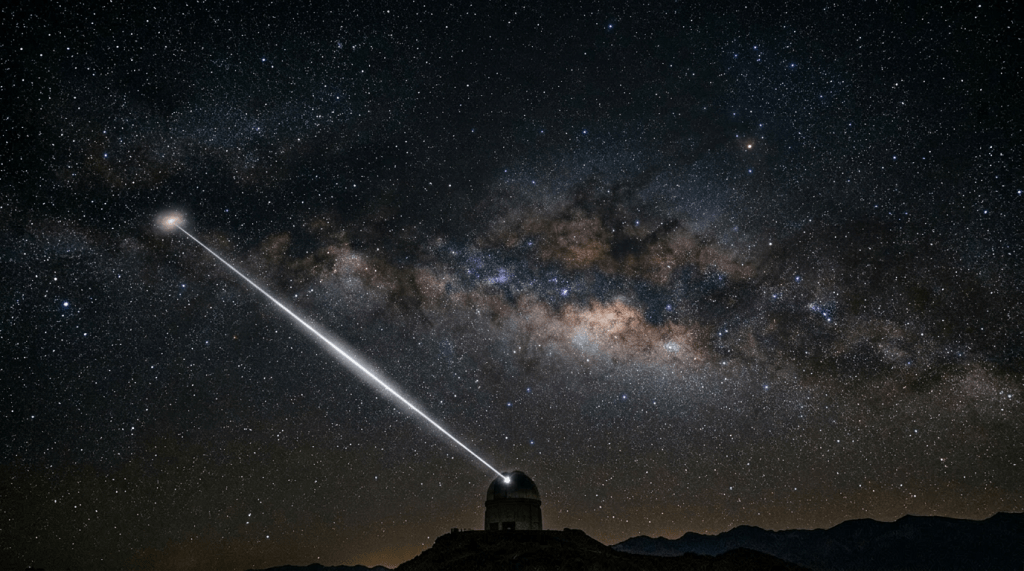

Recently I was discussing the one-way and two-way speed of light with a professional physicist friend of mine. The discussion revolved around how to measure the incoming one-way speed wherein I tried to stress the conventionality thesis.
The discussion started after he asked me about how do I resolve the young universe biblical timescale (less than 10,000 years) with measurements of galaxy light and their spectra seen in Earth telescopes from sources in the very distant universe, meaning billions of light-years away. Surely billions of light-years must mean billions of years of travel time. But of course that includes the inherit and usually unstated assumption that the light travelled at the canonical two-way speed of light c = 299,792.458 km/s. That means it is assumed to be isotropic, which means the same speed in all directions, because all that has ever been measured experimentally is the round-trip speed, the two-way speed of light reflected off a mirror, or some such device.
Watch this pretty good video explanation of why it is impossible to measure the one-way speed of light. And why it must be chosen by convention in order to calculate any physics.
Now back to the question my friend posed.
Imagine a ray of light coming from a distant source. The oscillations in the atoms produce radiation which we observe on Earth. Imagine that ray full of wave crests and troughs as the source atoms oscillate. They fill the space from the source to the observer with a contiguous stream. So that proves the one-way speed incoming to the observer is finite, otherwise if it was infinite (i.e. no travel time) there would be no time for those wave crests and troughs to accumulate. But we see the galaxies and see their spectra.
At the time we had the discussion I could not quickly see where the assumption was, and there always is one, so I asked Dr. Jason Lisle, who should be given all credit for introducing these concepts to the creationist community back in 2003. As an aside, I was the only referee on his original paper at that time, who saw the merit in it as a valid solution to the biblical creationist light-travel time problem. So his paper was published and the rest is history, but we are still arguing over it. It even gets a mention on rationalwiki.org.
Jason wrote the following:
I’m not sure why your friend is assuming that our ability to detect the oscillations of light waves proves that the speed is finite. Imagine a straight line connected from that galaxy to us – the line moves up and down simultaneously at both ends. That essentially represents light with an instant speed and thus an infinite wavelength. We would detect the oscillations simultaneously with their emission. What we actually measure is frequency of the oscillations – the wavelength is conceptually inferred from our stipulated one-way speed of light.
Jason Lisle
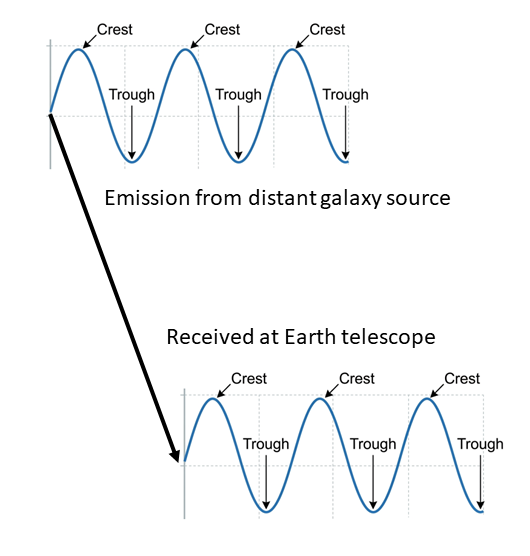
Fig. 2 illustrates this issue. Assuming the Anisotropic Synchrony Convention (ASC) the black arrow indicates the instantaneous transmission of the beginning of the light emission from the distant source. As the atoms oscillate in the source they produce the same light signal that is received by the receiver. The rise and fall to the crests and trough represents the frequency of the emission. The instantaneous travel time means infinite speed and therefore infinite wavelength.
To say space fills with crests and troughs of the oscillating wave along the path of the black arrow is an a priori assumption of a finite light speed. In the usual case the assumption is choosing the Einstein Synchrony Convention (ESC). Therefore that is begging the question, even though the person may not realise that assumption was made.
For those interested in this topic you might find the following from Dr Lisle also interesting and relevant.
Phillip Dennis tried to disprove ASC (really, the conventionality thesis) in a paper he published at the ARJ. But I showed that he had begged the question by assuming equations that tacitly stipulate the one-way speed of light at the start. My response is here:
https://biblicalscienceinstitute.com/wp-content/uploads/2024/07/Dennis_Refutation.pdfHe then replied, but it was very clear that he hasn’t researched this topic because his arguments are already refuted in the literature – one of them in 1923! Anyway, I wrote a series of responses you might enjoy reading starting here:
Parts 3 and 4 of the series refute Dennis’s failed attempts to refute the conventionality thesis from observations/experiments.
I strongly recommend Dr Lisle’s website: biblicalscienceinstitute.com
I also recommend you read the book by Max Jammer, Concepts of Simultaneity, Johns Hopkins University Press, 2006. The book is expensive so I would suggest you find it in a library if you plan on reading it.
It is amazing how much our thinking is conditioned by the worldview we have soaked in during our lifetimes.
Related Reading
- The Conventionality Thesis on the Synchronisation of Clocks Separated by Distance
- Questions on the Conventionality Thesis and the One-Way Speed of Light
- Are We Really Observing the Universe in Real Time?
- Einstein’s Physics Says There is No Biblical Creationist Starlight Travel-Time Problem
- New Cosmologies Converge on the ASC model
- Can We See Into the Past?
Free Subscribers
Subscribe to our Newsletters as a Free Subscriber and be notified by email. Just put your email address in the box at the bottom of your screen.
You’ll get an email each time we publish a new article. It is quick and easy to do and totally free. You only need do it once.
Premium Subscribers
Subscribe to our Newsletters as a Premium Subscribers at $5 USD/month or $30 USD/year (you choose). Cancel anytime.
Paid Premium Subscribers will get exclusive access to certain content I publish. That will only cost you a cup of coffee per month.
Also you’ll be able to download, for free, a PDF of my book Apocalypse Now and also a PDF of my book The Physics of Creation The Creator’s Ultimate Design for Earth.
You can download them from the link below.
This is how you can support my work. I have been publishing this website for 10 years now and up to 2024 I never asked for any support.
Press the button “Premium” on the front page to find a list of Premium content. Thanks so much to all supporters.
At a minimum, please join as a Free Subscriber. It’ll cost you nothing. It may also help me beat the shadow banning of some posts.





 Bible Science Forum
Leave a comment