

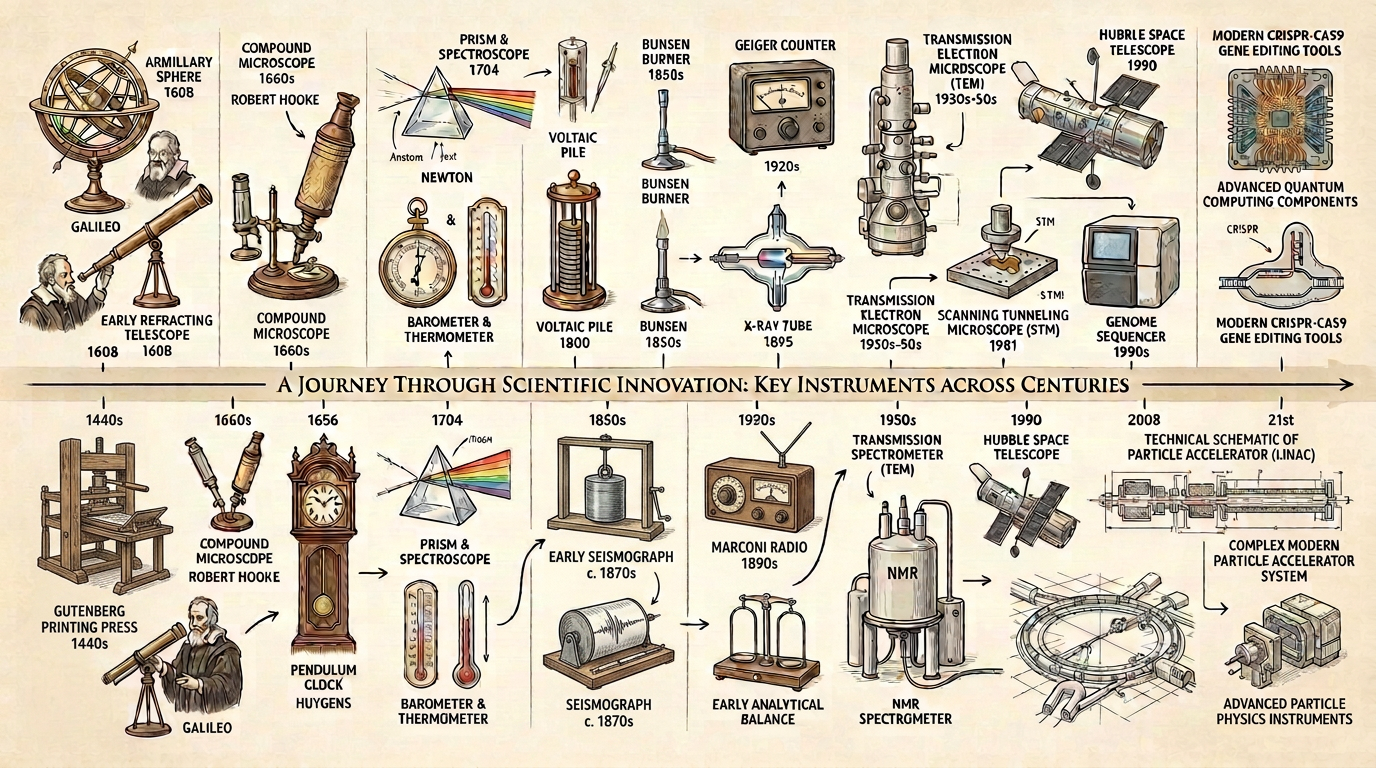
The 16th century saw an explosion research and development, which we call the Scientific Revolution. That rapid development in scientific thinking I believe was due to the inspiration of the Holy Spirit in men of God — believers in Christ — who sought an understanding of God’s creation.
Isaac Newton
Isaac Newton was the brilliant physicist and mathematician who revolutionized our understanding of the universe with his laws of motion and universal gravitation as well as optics. Perhaps he was the greatest physicist who ever lived if we define that by his contribution to our understanding of the laws of physics.
Newton was an ardent believer in Jesus Christ and attended Trinity College, Cambridge, ostensibly preparing to become an Anglican minister, but staying for more than 35 years teaching, and developing his scientific theories over a few of those years but the mostly studying the Bible. His theological writings vastly outnumbered his scientific works. Newton believed in God the Father as the sole creator and Jesus Christ as His divine Son.
Michael Faraday
Michael Faraday was a chemist and physicist who established the concept of the electromagnetic field in physics. His main discoveries include the principles underlying electromagnetic induction, diamagnetism, and electrolysis. He was one of the most influential scientists in history upon whom many others who followed him built.
Physicist Ernest Rutherford said, “When we consider the magnitude and extent of his discoveries and their influence on the progress of science and of industry, there is no honour too great to pay to the memory of Faraday, one of the greatest scientific discoverers of all time.”
Michael Faraday was a devout Christian belonging to the Sandemanians, a small, strict nonconformist sect that emphasized a literal interpretation of the Bible and apostolic simplicity. He served as a deacon and twice as an elder in his congregation, maintaining a deep commitment to his faith throughout his life.
Faraday’s religious beliefs profoundly influenced his scientific work, leading him to view the universe as a divinely ordained order governed by consistent laws. He believed that the “book of nature” and the “book of God’s word” shared the same author, which fostered his conviction in the unity of forces (such as electricity and magnetism) and shaped his conceptualization of fields and lines of force. Despite this deep integration of faith and science, he explicitly rejected natural theology as a means to spiritual truth, maintaining that religious knowledge came solely from Scripture rather than scientific reasoning.
James Clerk Maxwell
James Clerk Maxwell was also one of the greatest scientists who ever lived and developed the classical theory of electromagnetic radiation. He was a devout evangelical Presbyterian who underwent a significant conversion experience in 1853 while studying at Cambridge University. He remained a committed Christian throughout his life, eventually serving as an elder in the Church of Scotland and maintaining a deep, personal relationship with the Bible.
Maxwell viewed his scientific work as a religious endeavor, believing that studying the natural world was a way to glorify God and understand the “mind of Christ.” He rejected positivism and the idea of a “God of the gaps,” arguing instead that the intelligibility and order of the universe were direct reflections of a rational Creator. His faith provided the philosophical foundation for his groundbreaking work in electromagnetism and thermodynamics, as he believed that the uniformity of natural laws stemmed from a unified divine will.
The Scientific Revolution
The evidence shows that the foundation and early leadership of the Scientific Revolution was the result of those who believed in the Christian worldview. Jesus Christ is unchanging (Hebrews 13:8) and so are His laws which define His creation. Biblical scholars held such a view like James Clerk Maxwell which motivated their search for an understanding of God’s creation.
The foundation was laid in the 16th century by notables such as Francis Bacon who has been called the father of empiricism. Following on from the 13th century scholar Roger Bacon, he was a foundational figure in the development of the scientific method.
Read Exploring the Foundations of the Scientific Revolution!
The philosophy of Archimedes, from the 3rd century BC, is defined by a rigorous integration of pure mathematics and practical engineering, where theoretical precision served to explain and harness the physical world. He valued logical proof and geometric rigor above all, famously refusing to write treatises on mechanics because he viewed the practical applications of engineering as “ignoble and vulgar” compared to the purity of geometry. But science progressed very little after Archimedes (died c. 212 BC) until 1500 AD.
Seventeen centuries after him Francis Bacon argued that knowledge should be derived from inductive reasoning and careful observation of nature, rejecting the deductive logic of Aristotle’s Greek way of thinking that dominated his era.
Below I have collated and curated a chronological summary of the most transformative scientific discoveries and measurements of approximately the past 400 years, organized by era and field, with the scientists credited for each breakthrough. Some are theories which need observational experimental evidence.
You’ll note that the start of the modern Scientific Revolution in the 16th century through the18th century was mostly led by scientists with a Christian worldview. And most of those were biblical creationists who took seriously the historicity and scientific details of God’s creation as described in the Bible.
A Developing Trend
In the 18th century those who were not Christians seem to hold to a deist worldview still believing that the order in the universe was due to creation by an Intelligent Mind though they did not consider Him a personal God that they could know. There was a developing trend there.
In my Tables below I have written in bold text the names for all confessing Christians of any denomination (Catholic, Orthodox, Protestant, Lutheran, Evangelical etc), but not Unitarians (U), Deists (D), Quakers (Q), Mormon (M), Pantheists (P). I use normal text if they were non-believers (A for Atheists and Agnostics, J for Judaism, B for Buddhists) or their faith is not known. I denoted TE for theists who believed God used the big bang to create the universe and/or Darwinian evolution to create all species.
By the 19th century especially after Darwin published his “On the Origin of Species” (1859) a further trend away from faith in the Creator God developed.
The trend developed further after Georges Lemaitre (1927) and Edwin Hubble (1929) advanced their expanding universe hypothesis leading to what Fred Hoyle called a “big bang”. Then again after George Gamow and his graduate student Ralph Alpher developed the foundational theory of big bang nucleosynthesis through Alpher’s doctoral dissertation (1948).
In my table below I do not include these as discoveries because anything to do with the past, that is, the origin of the universe and the origin of life and evolution of plant and animal species, is not operational science but forensic speculation. I also have avoided claims that are still hotly debated one way or another.
By the 20th century there are few major discoveries made by Bible believing Christians. There are some but most scientists held/hold to Atheist, Agnostic or Deist worldviews. And several of the Christians believe in Theistic Evolution.
Over the centuries, especially after Darwin, the trend among the scientists, sampled here by major discovery, has been away from faith in Christ and the historicity of the Genesis account. Perhaps the sample is biased by the nature of those who go into science. However the decrease in the bold text names as one looks through the centuries is very obvious.
Ancient & Medieval (260 BC –1500 AD)
In the period between the year 260 BC to 1500 AD there were very few major scientific discoveries. But in the Medieval period the foundations were set by men of faith who saw the rules governing physical world as the outcome of a rational Creator.
| Year | Discovery | Scientist(s) |
|---|---|---|
| ~260 BC | Principles of levers and buoyancy | Archimedes |
| ~200 BC | Measured diameter of the Earth | Eratosthenes of Cyrene |
| ~200 BC | Measured distance to the Sun | Aristarchus of Samos |
| ~ 700 | Escapement mechanism for clocks | Yi Xing (B) |
| ~1267 | Empirical science | Roger Bacon |
| ~1440 | Movable type printing press | Johannes Gutenberg |
Scientific Revolution (1500–1700)
| Year | Discovery | Scientist(s) |
|---|---|---|
| 1543 | Heliocentric (Sun-centered) universe | Nicolaus Copernicus |
| 1543 | Modern human anatomy | Andreas Vesalius |
| 1595 | First compound microscope | Hans Janssen & Zacharias Janssen |
| 1598 | Law of falling objects | Galileo Galilei |
| 1600 | Scientific Method | Francis Bacon |
| 1608 | Refracting telescope | Hans Lippershey |
| 1609 | Improved refracting telescope and showed other planets have moons (Jupiter’s moons) | Galileo Galilei |
| 1609 | Planets’ true orbits (elliptical orbits) | Johannes Kepler |
| 1619 | Analytic geometry and the Cartesian coordinate system | René Descartes |
| 1628 | Human circulatory system | William Harvey |
| 1643 | Air pressure with barometer | Evangelista Torricelli |
| 1653 | Pascal’s law (transmission of fluid-pressure) | Blaise Pascal |
| 1660 | Hooke’s law (elasticity) | Robert Hooke |
| 1662 | Boyle’s law (gas pressure) | Robert Boyle |
| 1665 | Cells | Robert Hooke |
| 1666 | Universal gravitation | Isaac Newton |
| 1672 | Accurate distance to the Sun | Giovanni Cassini |
| 1678 | Wave theory of light | Christiaan Huygens |
| 1680 | Bacteria | Antonie van Leeuwenhoek |
| 1686 | First biological definition of species | John Ray |
| 1687 | Laws of motion | Isaac Newton |
18th Century (1700–1800)
| Year | Discovery | Scientist(s) |
|---|---|---|
| 1704 | Optics | Isaac Newton |
| 1735 | Taxonomy system (classification of life) | Carl Linnaeus |
| 1735 | Marine chronometer (H1) | John Harrison |
| 1738 | Fluid pressure / lift (Bernoulli’s principle) | Daniel Bernoulli |
| 1751 | Lightning is electrical | Benjamin Franklin (D) |
| 1758 | Comets have predictable orbits | Edmond Halley (D) |
| 1770 | Gulf Stream | Benjamin Franklin (D) |
| 1772 | Nitrogen | Daniel Rutherford |
| 1774 | Oxygen | Joseph Priestley (U) & Antoine Lavoisier |
| 1779 | Photosynthesis | Jan Ingenhousz |
| 1781 | Uranus (expanding the solar system) | Frederick W. Herschel |
| 1789 | Law of conservation of mass | Antoine Lavoisier |
| 1792 | Erosion and weathering | James Hutton (TE) |
19th Century (1800–1900)
| Year | Discovery | Scientist(s) |
|---|---|---|
| 1800 | Infrared radiation | Frederick W. Herschel |
| 1800 | Battery (voltaic pile) | Alessandro Volta |
| 1801 | Ultraviolet radiation | Johann Wilhelm Ritter (D) |
| 1801 | Chloroform anesthesia | James Young Simpson |
| 1806 | Electrochemical bonding | Humphry Davy (D) |
| 1808 | Atoms | John Dalton |
| 1809 | First electric light (arc lamp) | Humphry Davy (D) |
| 1811 | Molecules | Amedeo Avogadro |
| 1814 | Gulf Stream mapping | Alexander von Humboldt (P) |
| 1820 | Electromagnetism | Hans Christian Ørsted (P) |
| 1824 | Dinosaur fossils | William Buckland & Gideon Mantell |
| 1831 | Electromagnetic induction, diamagnetism, and electrolysis | Michael Faraday |
| 1832 | Self-inductance and electromagnetic induction | Joseph Henry |
| 1832 | Earth’s magnetic field | Carl Friedrich Gauss (D) & Wilhelm Weber |
| 1835 | Bayes’ theorem (statistical inference) | Thomas Bayes (published 1763) |
| 1837 | Ice age | Louis Agassiz |
| 1837 | Analytical Engine (computer) | Charles Babbage |
| 1843 | Calorie / mechanical equivalent of heat | James Prescott Joule |
| 1847 | Conservation of energy | Hermann von Helmholtz |
| 1848 | Doppler effect | Christian Doppler |
| 1848 | Absolute temperature scale | Lord Kelvin (William Thomson) |
| 1851 | 2nd law thermodynamics | Lord Kelvin (William Thomson) |
| 1854 | Terrain theory | Claude Bernard (A) & Antoine Béchamp |
| 1855 | All cells arise from pre-existing cells | Rudolf Virchow (anti-evolutionist) |
| 1856 | Germ theory | Louis Pasteur |
| 1858 | Natural selection (not Darwinian evolution) | Charles Darwin (A) & Alfred Russel Wallace |
| 1864 | Theory of electromagnetism | James Clerk Maxwell |
| 1865 | Laws of inheritance (genetics) | Gregor Mendel |
| 1865 | Definition of entropy | Rudolf Clausius |
| 1868 | Helium | Pierre Jules Janssen & Norman Lockyer |
| 1869 | Periodic table of elements | Dmitri Mendeleev (D) |
| 1870 | Deep-sea life | Charles Wyville Thomson (TE) |
| 1873 | Van der Waals forces | Johannes Diderik van der Waals |
| 1876 | Chemical thermodynamics | Josiah Willard Gibbs |
| 1877 | Statistical definition of entropy | Ludwig Boltzmann (D) |
| 1879 | Incandescent light bulb | Thomas Edison (D) |
| 1880 | Piezoelectricity | Pierre & Jacques Curie |
| 1880 | Modern seismograph | John Milne |
| 1882 | Cell division (mitosis) | Walther Flemming |
| 1887 | Michelson-Morley experiment (no aether) | Albert A. Michelson (A) & Edward Morley |
| 1887 | Polyphase A.C. power supply | Nikola Tesla (P) |
| 1887 | AC induction motor | Nikola Tesla (P) |
| 1890 | Maunder Minimum (sunspots) | Edward Walter Maunder |
| 1892 | Viruses | Dmitri Ivanovsky |
| 1895 | X-rays | Wilhelm Conrad Röntgen |
| 1895 | Wireless telegraphy (radio) | Guglielmo Marconi |
| 1896 | Radioactivity | Henri Becquerel |
| 1897 | Electron | J.J. Thomson |
| 1898 | Telegraphone (magnetic recording device) | Valdemar Poulsen |
| 1898 | Virus as distinct entity | Martinus Beijerinck |
| 1898 | Hormones | John Abel, William Bayliss & Ernest Starling |
| 1898 | Mitochondria | Carl Benda |
20th Century (1900–2000)
| Year | Discovery | Scientist(s) |
|---|---|---|
| 1900 | Quantum theory | Max Planck (D) |
| 1901 | Radioactivity (systematic study) | Marie Curie (A) & Pierre Curie (A) |
| 1901 | ABO blood groups | Karl Landsteiner |
| 1902 | Atmospheric layers | Léon Teisserenc de Bort |
| 1902 | Statistical mechanics | Ludwig Boltzmann (D), James Clerk Maxwell & Josiah Willard Gibbs |
| 1904 | Argon | William Ramsay & Lord Rayleigh (John William Strutt) |
| 1905 | Special relativity / E=mc² | Albert Einstein (D) |
| 1905 | Photoelectric effect (dual nature of photons) | Albert Einstein (D) |
| 1905 | Explained Brownian motion | Albert Einstein (D) |
| 1907 | Radioactive dating | Bertram Boltwood |
| 1908 | Geiger counter | Hans Geiger |
| 1909 | Genetic mutations / gene- chromosome mapping | Thomas Hunt Morgan (A) |
| 1911 | Atomic nucleus (Rutherford model) | Ernest Rutherford (A) |
| 1911 | Superconductivity | Heike Kamerlingh Onnes |
| 1912 | Cosmic rays | Victor Hess |
| 1912 | Continental drift | Alfred Wegener |
| 1913 | Atomic model (Bohr model) | Niels Bohr (A) |
| 1913 | Isotopes | Frederick Soddy (A) |
| 1914 | Neurotransmitters | Henry Dale & Otto Loewi |
| 1915 | General theory of relativity | Albert Einstein (D) |
| 1916 | Black holes (theoretical) | Karl Schwarzschild |
| 1920 | Proton | Ernest Rutherford (A) |
| 1921 | Insulin isolation | Frederick Banting & Charles Best |
| 1923 | Nature of galaxies | Edwin Hubble (A) |
| 1925 | Quantum mechanics (matrix/wave formulations) | Werner Heisenberg & Erwin Schrödinger (D) |
| 1925 | Pauli exclusion principle | Wolfgang Pauli (D) |
| 1926 | Wave mechanics (Schrödinger equation) | Erwin Schrödinger (D) |
| 1926 | Liquid-fueled rocket | Robert H. Goddard |
| 1927 | Uncertainty principle | Werner Heisenberg |
| 1927 | First quartz clock | Warren Marrison & J.W. Horton |
| 1927 | Electronic television (TV) | Philo Farnsworth (M) |
| 1928 | Penicillin | Alexander Fleming |
| 1929 | Antimatter | Paul Dirac (A) |
| 1929 | Redshifts and Hubble’s law | Edwin Hubble (A) & Milton Humason |
| 1930 | Strong nuclear force | Ernest Rutherford (A) |
| 1931 | Radio astronomy | Karl Jansky |
| 1932 | Neutron | James Chadwick (A) |
| 1933 | Cell structure (electron microscopy) | Albert Claude |
| 1933 | Beta decay (theory) | Enrico Fermi (A) |
| 1934 | Induced radioactivity | Enrico Fermi (A) |
| 1934 | Genes control metabolism | George Beadle (A) & Edward Tatum |
| 1937 | Strong nuclear force (theory) | Hideki Yukawa (B) |
| 1938 | Earth’s solid inner core | Inge Lehmann |
| 1938 | Metabolism / Krebs cycle | Hans Krebs |
| 1939 | Nuclear fission | Lise Meitner & Otto Hahn |
| 1939 | Nuclear fusion (stellar energy source) | Hans Bethe |
| 1939 | Blood plasma storage | Charles Richard Drew |
| 1942 | First nuclear reactor | Enrico Fermi (A) |
| 1944 | First man-made object (rocket) to reach space | Wernher von Braun |
| 1945 | First electronic computer (ENIAC) | John Mauchly & J. Presper Eckert |
| 1946 | Stellar nuclear synthesis | Fred Hoyle (A) |
| 1947 | Semiconductor transistor | John Bardeen, Walter Brattain & William Shockley |
| 1947 | Pion discovered (confirmed Yukawa theory) | Hideki Yukawa (B) |
| 1948 | First atomic clock (ammonia molecules) | Harold Lyons |
| 1948 | Instant photography (Polaroid Land Camera) | Edwin H. Land |
| 1949 | Radiocarbon dating method | Willard Libby |
| 1950 | Jumping genes (transposons) | Barbara McClintock (A) |
| 1951 | Nuclear fusion (stellar processes) | Lyman Spitzer |
| 1953 | Structure of DNA | James Watson (A), Francis Crick (A) & Rosalind Franklin (A) |
| 1955 | First accurate atomic clock (caesium-133 beam) | Louis Essen & Jack Parry |
| 1957 | Seafloor spreading | Harry Hess |
| 1959 | Gravitational redshift | Robert Pound & Glen Rebka |
| 1960 | First working laser | Theodore Maiman |
| 1963 | Quasars | Allan Sandage (TE) & Maarten Schmidt (A) |
| 1964 | Cosmic microwave background radiation | Arno Penzias (TE) & Robert Wilson (TE) |
| 1967 | Pulsars | Jocelyn Bell Burnell (Q) & Antony Hewish |
| 1969 | Apollo 11 Moon landing | Neil Armstrong & Buzz Aldrin |
| 1969 | Magnetic Resonance Imaging (MRI) | Raymond Damadian |
| 1971 | Black holes (modern concept) | John Archibald Wheeler (U) |
| 1971 | Computed tomography (CT) scanner | Godfrey Newbold Hounsfield |
| 1983 | Weak nuclear force carriers | Carlo Rubbia |
| 1995 | Exoplanets (planets around other stars) | Michel Mayor (A) & Didier Queloz (A) |
21st Century (2000–2015)
| Year | Discovery | Scientist(s) |
|---|---|---|
| 2003 | Human Genome Project completed | Craig Venter (A) & James Watson (A) / international consortium |
| 2005 | Dinosaur soft tissue | Mary Schweitzer (TE) |
| 2012 | Higgs boson | CERN / ATLAS & CMS collaborations; Peter Higgs (A) |
| 2012 | CRISPR-Cas9 gene editing | Jennifer Doudna & Emmanuelle Charpentier |
| 2015 | Gravitational waves | LIGO collaboration (Barry Barish, Kip Thorne (A), Rainer Weiss (J)) |
Forgive me if I have not included some significant scientific discovery or development. If so, let me know in the Comments and I can include it.
Brief Summary by Field
Astronomy & Physics: Heliocentrism (Copernicus), gravity (Newton), electromagnetism (Maxwell), relativity (Einstein), quantum mechanics (Planck, Heisenberg, Schrödinger), redshift / galaxies (Hubble, Humason), black holes (Schwarzschild, Wheeler), gravitational waves (LIGO), and the Higgs boson (CERN).
Chemistry & Matter: Conservation of mass (Lavoisier), atoms (Dalton), periodic table (Mendeleev), radioactivity (Curie), nuclear fission (Meitner/Hahn), DNA structure (Watson/Crick/Franklin).
Biology & Medicine: Cells (Hooke), germ theory (Pasteur), natural selection (Darwin/Wallace), genetics (Mendel), penicillin (Fleming), insulin (Banting/Best), the human genome (Venter/Watson), and CRISPR (Doudna/Charpentier).
Earth & Environment: Earth’s solid inner core (Inge Lehmann), continental drift (Wegener), seafloor spreading (Hess), and an Ice age (Agassiz).
These many discoveries represent the pillars upon which modern science, medicine, and technology rest. In the later centuries many have been the result of collaborative teamwork rather than lone geniuses, reflecting how science has developed from individual insight in the 16th century to large-scale international effort in the 21st century
But it was those individual insights inspired by the Holy Spirit in the minds of Christian men of God that started this revolution in science approximately 400 years ago. Let’s not lose sight of that.
Related Reading
- Exploring the Foundations of the Scientific Revolution
- True Science and Science Falsely So-Called
- What Can the Bible Teach Us About Science?
- The Lawgiver is the Biblical Creator God
- Job 38 and a Flat Earth
- Beliefs of a Few Nobel Prize Winners
Free Subscribers
Subscribe to our Newsletters as a Free Subscriber and be notified by email. Just put your email address in the box at the bottom of your screen.
You’ll get an email each time we publish a new
Premium Subscribers
Subscribe to our Newsletters as a Premium Subscribers at $5 USD/month or $30 USD/year (you choose). Cancel anytime.
Paid Premium Subscribers will get exclusive access to certain content I publish. That will only cost you a cup of coffee per month.
Also you’ll be able to download, for free, a PDF of my book Apocalypse Now and also a PDF of my book The Physics of Creation The Creator’s Ultimate Design for Earth.
You can download them from the link below.
This is how you can support my work. I have been publishing this website for 10 years now and up to 2024 I never asked for any support.
Press the button “Premium” on the front page to find a list of Premium content. Thanks so much to all supporters.
At a minimum, please join as a Free Subscriber. It’ll cost you nothing. It may also help me beat the shadow banning of some posts.






Leave a Reply