
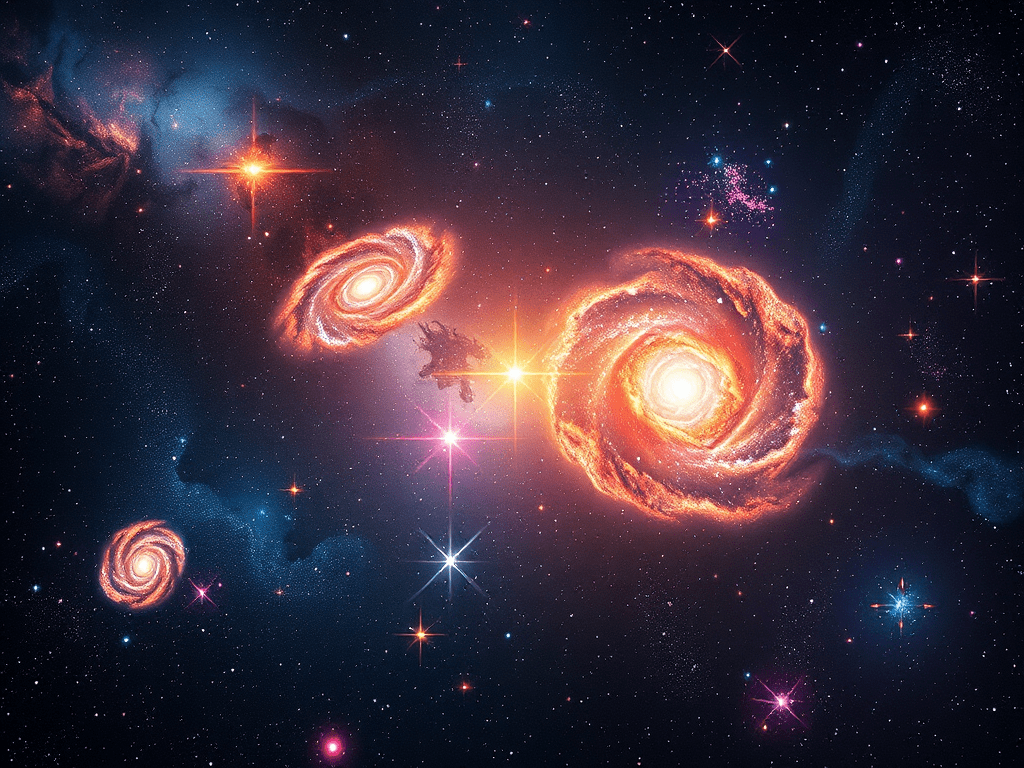

It is estimated that there are trillions of galaxies in the observable universe. In every direction we look with the largest telescopes we see more and more galaxies, each comprised of billions of stars.
Galaxies are seen in all different forms and shapes. Like collecting stamps from different countries, astronomers catalog these along with their observed properties to test models of the evolution of galaxies, and the large-scale structure (cosmology) and history (cosmogony) of the cosmos.
The following are a few of the big questions that may be asked:
- Does the universe have a centre and an edge?
- Is our galaxy in a special or privileged location in the cosmos?
- Is the universe observed to be expanding?
- Are galaxies observed evolving?
- What do we really know about the cosmos?
To answer these questions we need to understand the limitations of science. I recommend you read my piece The Love of Science is Idolatry.
I sometimes get into these philosophical cogitations so please bear with me.
I am reminded of a discussion I once had in 2013 at the University of Adelaide with someone from the press office after I published a theoretical physics paper on Carmelian cosmology. In that paper I showed that the same observational data would fit a finite bounded cosmology but with a centre and an edge. See The Universe: Finite or Infinite, Bounded or Unbounded.
Here is a quote from that piece:
In that paper I show a solution of Einstein’s field equations in Carmeli’s Cosmological General Relativity (CGR), where our galaxy is at or cosmologically near the center of a finite yet bounded spherically symmetrical isotropic universe.
The new solution I found describes an expanding “white hole” with the observer at the origin of the coordinates, the unique center of the Universe, ie. our galaxy is somewhere near the center, cosmologically speaking. Only philosophically can this solution be rejected.
Let me translate that for you.
I used a different solution to Einstein’s field equations in Carmeli new theory and it fitted to the same observational data as Carmeli’s standard solution, which is a unbounded expanding universe with no centre or edge. That is the usual viewpoint in standard big bang cosmology.
The woman from the press office came to my office and we talked about this new paper. But when she realised that it described a finite universe with our galaxy at the unique centre and not the standard big bang cosmology, which is with no centre or edge, she quickly packed up her notebook and headed for the door.
Cosmologist George Ellis wrote:
People need to be aware that there is a range of models that could explain the observations. For instance, I can construct you a spherically symmetrical universe with Earth at its center, and you cannot disprove it based on observations… you can only exclude it on philosophical grounds.
In my view there is absolutely nothing wrong in that. What I want to bring into the open is the fact that we are using philosophical criteria in choosing our models. A lot of cosmology tries to hide that.
Gibbs, W.W.: Profile: George F.R. Ellis: Thinking globally, acting universally. Sci. Am. 273(4), 50–55 (1995)
You see these ruminations are all linked to one’s philosophical worldview. Based on that worldview one decides to believe or disbelieve in any given cosmology of the universe.
The new 2013 theoretical paper also demonstrated that the universe is underdetermined. That is Cosmology’s Fatal Weakness—Underdetermination. There are many theories or models that could potentially describe the same observational data. Therefore there is no way to distinguish with the “stamp collection” which theory is correct.
By the way I gave up on Carmeli’s cosmology some years ago for a few reasons. I came to the view that the universe is not expanding but Carmeli’s cosmology describes only an expanding universe.
The notion of the expanding universe and the application of the standard LCDM cosmological model has led to many contradictions and many fudge factors. I have written extensively on that here.
But this is one of the points I am trying to make in this piece. We can pick and choose because there is no unique description of the universe. The reason for this is philosophical and not empirical.
All models presented in order to make sense of the “stamp collection” are with the bias of the presenter. There are none free from his/her belief system. Now that sounds like religion. Well, it is!
The only difference between me and most of the rest is that I recognize this and I choose my worldview (and hence cosmology/cosmogony) using the biblical description from the book of Genesis.
Therefore the answers to Questions 1 and 2 are open to the preference of the observer. You can choose. I would say that I believe the Creator put us somewhere near the centre of His creation but no cosmology could uniquely tell us that.
And Question 3 is impossible to answer in any definitive way. All evidence is equivocal. The same observer biases are involved in selecting the observational data. See my review. Is the Universe Really Expanding — the Evidence Revisited.
But even the issue of an expanding universe involves an understanding of what the redshift of galaxies means. It is observed but what is its cause? See Is There Definitive Evidence for an Expanding Universe? Nor do the biblical texts require the universe to be expanding. Read Does the Bible Really Describe Expansion of the Universe?
It would be circular reasoning to say the universe is expanding because most galaxies exhibit redshifts and the magnitude of their redshifts are proportional to their distance from us. Redshift is used to measure distance within the assumed cosmology. If the cosmology is assumed to be expanding then there is the circularity.
Question 4 also is subject to similar circular reasoning. Evolution in size assumes a cosmology also. Growth of a galaxy is allegedly shown by its absolute magnitude (brightness) but to know that you have to know how distant it is, which in turn is linked to the chosen cosmology and redshift. Really it is just Cosmic Storytelling.
There is another big assumption in the philosophy here. It is called the Cosmological Principle!
Underneath all cosmological theorizing is the assumption that there is no privileged location in the universe, that no matter where you might to hypothetically place an observer he will see essentially the same structure of the universe, on a sufficiently large enough scale. This take us back to the press office reporter at Adelaide University.
On a sufficiently large enough scale is also circular reasoning. And it is an untestable assumption. But observational data suggests the universe distribution of galaxies is not isotropic and not homogeneous.
There is a north-south disparity in concentration of observed galaxies. We see a greater concentration of galaxies in one direction compared to the opposite direction. The solution to that, they say, is that we must not be seeing all the galaxies and hence this is observer bias. More circular reasoning.
Another aspect of the Cosmological Principle is that the laws of physics are the same everywhere in the universe, so that we may apply our models everywhere. But this is also contradicted by the insertion into the models of “made up stuff” like Dark Matter and Dark Energy, which are unknown locally in the solar system.
The need for these fudge factors are an admission that the big bang cosmological model is wrong and/or that the assumption of the physics being the same everywhere is wrong.
Therefore testing models on the cosmos in an attempt to determine its large scale structure and, very importantly, the history of the universe is based squarely on the belief system of the researchers. It is religion and not science. Read Cosmology is Not Science!
So Question 5: What do we really know about the cosmos? Nowhere as much as most textbooks and research papers would have you believe.
To succeed in research in that field of study you have to be in the club, the big bang club. You have to parrot the nonsensical anti-biblical worldview of the universe creating itself out of nothing else you cannot be successful.
“A Universe from Nothing: Why There Is Something Rather than Nothing” is a non-fiction book by the physicist [big bang cosmologist] Lawrence M. Krauss, initially published on January 10, 2012, by Free Press. It discusses modern cosmogony and its implications for the debate about the existence of God.
Wikipedia
This is the worldview issue on full display. It’s not science!
The claim is that Krauss’ book is non-fiction when there is nothing but empty philosophizing because of his rejection of the Creator. It discussed modern cosmogony, which is the origin of the universe, and of course without the Creator. The Krauss universe made itself!
On the last question also see The Cosmological Principle and Geocentrism.
The only worldview that makes sense, in my opinion, is that God created the universe essentially as we see it today. It has changed very little in the last thousands, not billions, of years. We see it all in real time. There are no billions of years of evolutionary history.
Now that may bring up many new questions, especially how do we see the universe now?
See Can We See Into the Past? and the video presentation Video: Can We See Into the Past?
However, I do recognize that this is philosophy and not science. This also applies to all models whether be from atheists or theists, big bang cosmologists or biblical creationists, or anyone else.
Related Reading
- What Can the Bible Teach Us About Science?
- Science the New Religion
- Operational and Historical Science: What Are they?
Free Subscribers
Subscribe to our Newsletters as a Free Subscriber and be notified by email. Just put your email address in the box at the bottom of your screen.
You’ll get an email each time we publish a new article. It is quick and easy to do and totally free. You only need do it once.
Premium Subscribers
Subscribe to our Newsletters as a Premium Subscribers at $5 USD/month or $30 USD/year (you choose).
Paid Premium Subscribers will get exclusive access to certain content I publish, which I expect to be about 4 exclusive posts per month. That will only cost you a cup of coffee per month.
Also you’ll get access to download, for free, a PDF of my book Apocalypse Now. You can download it from a Premium members only post here.
And now you’ll get exclusive access to the chapters (in their initial draft form) to my new book with working title “The Physics of Creation”; plus eventually a PDF of the final compiled book.
This is how you can support my work. I have been publishing this website for 10 years now and up to 2024 I never asked for any support.
Press the button “Premium” on the front page to find a list of Premium content. Over time that list will grow. Thanks so much to all supporters.
At a minimum, please join as a Free Subscriber. It’ll cost you nothing. It may also help me beat the shadow banning of some posts.



 Bible Science Forum