
The title of a recent Scientific American piece, dated 1 September 2026, asked this question “Have we finally found dark matter?”, and subtitled it with “The world’s biggest dark matter search saw a particle it cannot explain”. So what have they found and is it a candidate for an elusive dark matter particle?
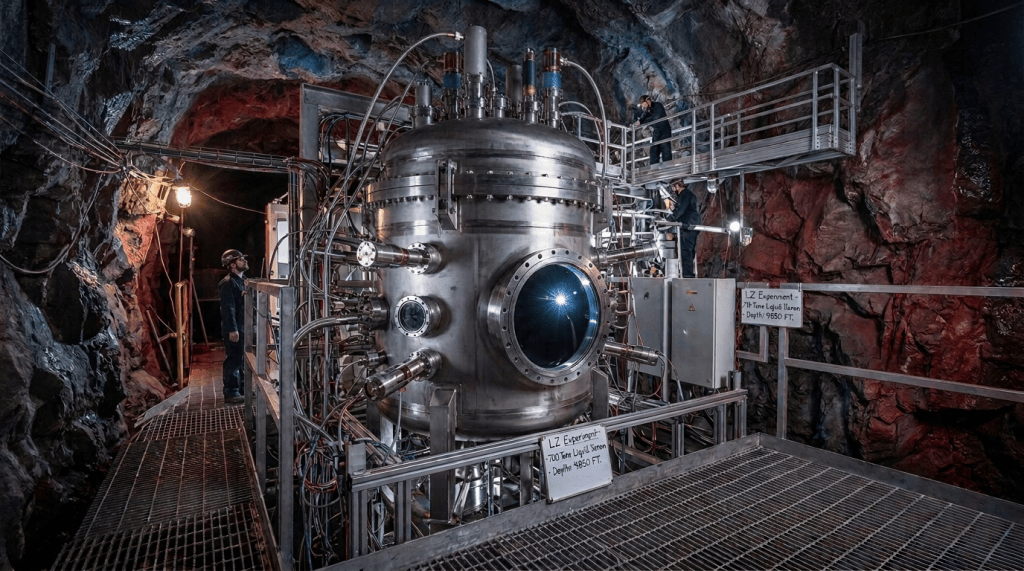
On June 16, 2023, 39 seconds after 3:22 P.M. and one mile beneath the Black Hills of South Dakota, there was a sudden flash of light.
It happened in a dark, sealed tank of extremely cold liquid in a cavern where miners once chiseled gold from the walls. Caught by the tank’s many cameras, the flash also sent an electric charge through hair-thin wires submerged in the liquid.
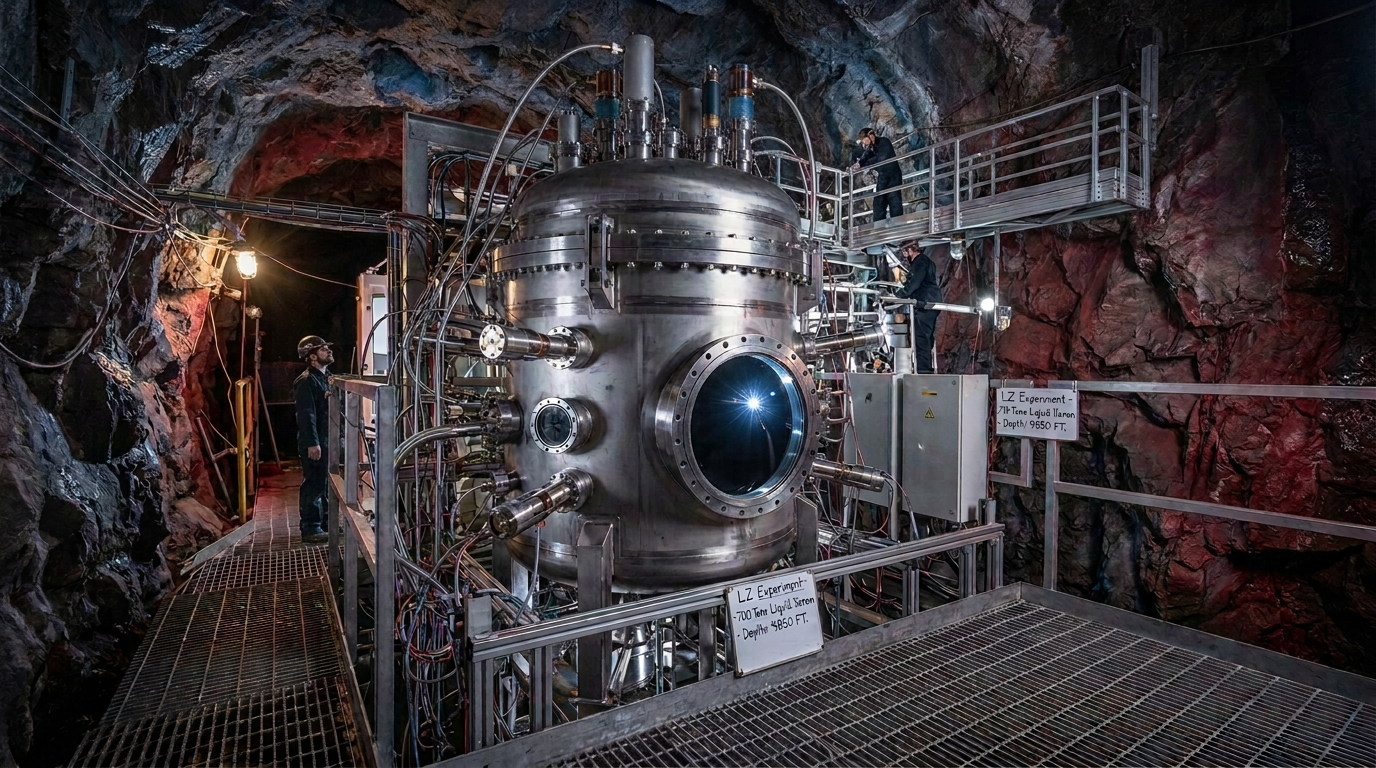
The tank is the centerpiece of the LUX-ZEPLIN (LZ) experiment, one of several ongoing attempts by physicists to snare and study dark matter, a shadowy something they suspect is everywhere—yet somehow seems nowhere to be found. They’ve sought it for the past 40 years by placing detectors in some of Earth’s most silent and secluded spaces, places where dark matter’s whispers might register. But every time so far, they’ve come up empty, with every burst of light or surge of electricity having a more ordinary explanation.
Scientific American article [my emphasis added]
The claim is that this flash of light detected and recorded three years ago is different. The charge and a flash of light together seem to indicate a violent collision between some unknown particle and the nucleus of one of the detector’s atoms.
That is the best hope anyway. Why wait three years to release this data? Perhaps they have been analysing all the data; searching through it for a signal that matches the expectation of a DM particle.
But the collision is inconsistent with the kind of dark matter signal they’ve been searching for. That is, it’s a total mystery. After four to five decades of nothing, a new mystery.
According to the project’s best estimates, the flash’s chances of being a statistical fluke are about half a percent (which is still far above the 0.00003 percent threshold used by particle physics experiments to hail a discovery).
A 0.5% chance of it being a statistical fluke or a false positive is a pretty good confidence level at 2.6-sigma but in particle physics a much stricter 5-sigma standard is used, corresponding to a 1 in 3.5 million chance (approximately 0.00003%) that the result is a statistical fluke. So this alleged DM particle detection is still a long way from that.
Also the experiment or some other experiment would need to repeat the detection with the same signal from the same type of putative DM particles to establish its existence. One dubious detection, or claimed detection, a DM particle does not make.
Why Dark Matter?
Dark Matter is putative matter that by definition very weakly interacts with other matter but has mass and therefore gravitates. It does not scatter light so it cannot be seen and thus is called dark.
It was initially proposed to solve the problem of ‘fast stars’ seen in spiral galaxies. The signature was seen in the rotation curves of galaxies that did not appear to obey Newtonian physics. The stars in the outer regions of the galaxies, and even the gases there, moved too fast, much faster that a calculation from Newtonian physics would allow. That calculation used the visible matter, mostly in the galactic core, to determine how fast the stars should move tangentially.
Edge on one could detect blue shifted stars on one side and redshifted on the other. See graphic below. Applying the assumption of Doppler motion to be the cause of the red or blue shifted light emissions from the stars and gases led to the result that the stars moved too fast.
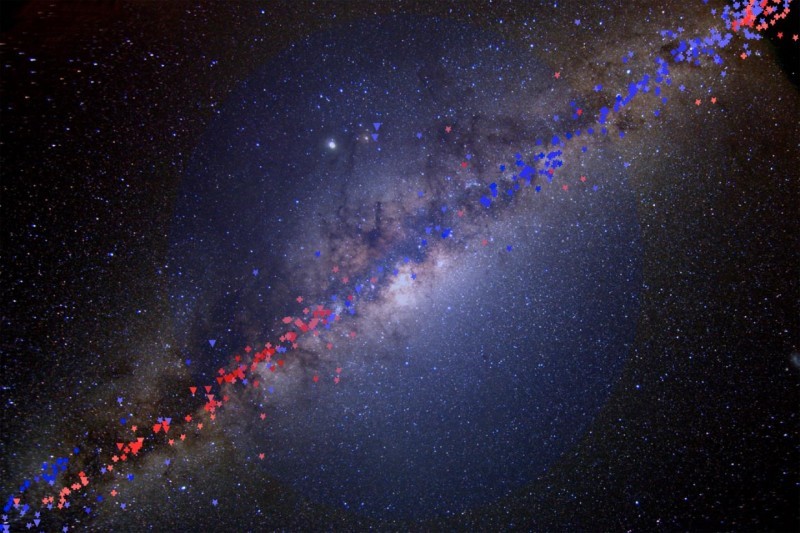
Some biblical creationists accept that because of these fast stars DM is a viable explanation. See blue halo representing unseen DM in the galaxy shown above. DM in that halo would solve the problem.
But Dark Matter is invoked everywhere in cosmology and astrophysics not only for an explanation of galaxy rotation curves but also for the formation of stars and galaxies. See 1. below.
In my view Dark Matter is merely a place holder for some unknown physics, and it does not necessarily need to be new physics. But it should be physics that is experimentally testable in the local lab.
In relation to the spiral galaxies several solutions not involving DM have been suggested. One is the influence of stellar drag which has not been allowed for in the physics used. See 2. below.
A biblical creationist explanation for the fast stars in galaxies could be a time issue. Biblically the galaxies are less than 10,000 years old and we observe them in real time. Since the universe was created less than 10,000 years ago the speed of the stars under standard assumptions has had very little impact on the structure of galaxies. They have not had time to fly apart.
The physics of Einstein leads to the fact that by convention we may choose an infinite incoming one-way speed for light from the cosmos without any scientific contradiction. See 3. below. That means we are seeing the stars as they are now in real time. See 4. below.
From an old universe and/or big bang evolutionary perspective something must have held those galaxies together for the past ten plus billion years. Thus DM matter makes sense even though we cannot see it. But such a universe is unbiblical — it is inconsistent with the Genesis creation account.
Dark Matter is therefore a ‘god of the gaps’ invoked to solve all sorts of astrophysical problems with the origin of stars, galaxies, clusters, superclusters, and the universe itself. See 5. and 6. below.
Dark Energy also is a placeholder for unknown physics, which in my estimation is on even more shaky ground than Dark Matter. DE only can be derived from cosmology. See 7.-9. below.
Conclusion
So in conclusion what can we say about this announcement of a detection of a DM particle? Note that this is operational science, which must be repeatable, yielding the same result. See 10. below.
Scientists have not yet confirmed a definitive discovery of dark matter, but recent results from the LUX-ZEPLIN (LZ) experiment represent the most compelling evidence to date.
In September 2026, researchers announced that the LZ detector, located nearly a mile underground in South Dakota, recorded a single high-energy particle interaction on June 16, 2023, that cannot be explained by known background noise.
This anomalous event, detected within a 220-day dataset, has a statistical significance of 2.6-sigma, meaning there is approximately a 0.5% chance the signal is a fluke.
If the event was caused by a putative Dark Matter particle, it might be a candidate for the much sought after very heavy Weakly Interacting Massive Particle (WIMP) with a mass of at least 200 times that of a proton.
Other experimental efforts to detect WIMPs include the search for products of WIMP annihilation, including gamma rays, neutrinos and cosmic rays in nearby galaxies and galaxy clusters; direct detection experiments designed to measure the collision of WIMPs with nuclei in the laboratory, as well as attempts to directly produce WIMPs in colliders, such as the Large Hadron Collider at CERN. As of 2026, none of these efforts have shown success. See 11.-12. below.
While exciting, this single event with the LZ detector falls way short of the 5-sigma threshold required for a formal discovery in particle physics, and much more data, that is, repeated detections, are needed to confirm the finding.
I, for one, won’t be holding my breath on this one.
Related Reading
- Why is Dark Matter Everywhere in the Cosmos?
- Has the Dark Matter Mystery Been Solved?
- How Fast Does Information Travel to Earth from the Outer Most Reaches of the Cosmos?
- Are We Really Observing the Universe in Real Time?
- Stars Just Don’t Form Naturally— ‘Dark Matter’ the ‘God of the Gaps’ is Needed
- Is Dark Matter the Unknown God?
- Should Biblical Creationists Believe in Dark Matter and Dark Energy?
- Dark Energy May Not Exist | New Insight on the Cosmic Web?
- Dark Energy is the Emperor’s New Clothes
- The Love of Science is Idolatry
- Dark Photons and the Illusion of Dark Matter
- Dark Matter Search | SUSY’s Long Fall From Grace
Free Subscribers
Subscribe to our Newsletters as a Free Subscriber and be notified by email. Just put your email address in the box at the bottom of your screen.
You’ll get an email each time we publish a new article. It is quick and easy to do and totally free. You only need do it once.
Premium Subscribers
Subscribe to our Newsletters as a Premium Subscribers at $5 USD/month or $30 USD/year (you choose). Cancel anytime.
Paid Premium Subscribers will get exclusive access to certain content I publish. That will only cost you a cup of coffee per month.
Also you’ll be able to download, for free, a PDF of my book Apocalypse Now and also a PDF of my book The Physics of Creation The Creator’s Ultimate Design for Earth.
You can download them from the link below.
This is how you can support my work. I have been publishing this website for 10 years now and up to 2024 I never asked for any support.
Press the button “Premium” on the front page to find a list of Premium content. Thanks so much to all supporters.
At a minimum, please join as a Free Subscriber. It’ll cost you nothing. It may also help me beat the shadow banning of some posts.



 Bible Science Forum
Leave a comment