
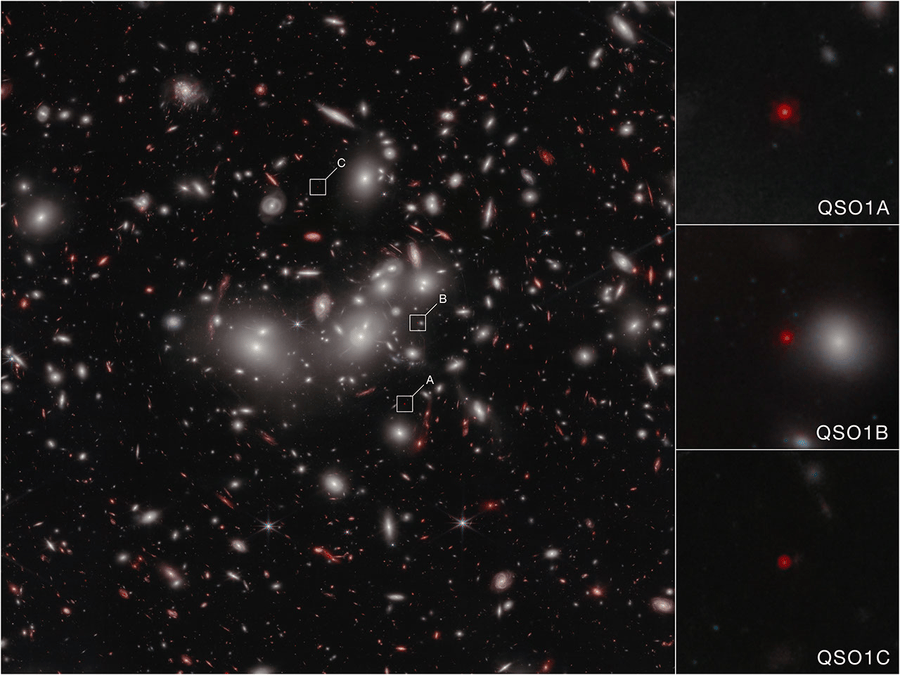
Image: NASA, ESA, CSA, Lukas Furtak (Ben-Gurion University); Image Processing: Alyssa Pagan (STScI)
In general terms, standard big bang cosmology posits a history beginning hundreds of millions of years after the origin of the universe, with early star formation from primordial gas composed only of hydrogen and helium. Those early stars allegedly condensed into the first small “baby” galaxies. These then grew in size, accumulating new stars as they formed from the existing gas in the galaxy. Eventually, these baby galaxies grew into large “mature” galaxies with 10 billion or more stars. Therefore, the earliest galaxies should be small and the later ones large.
According to the story, as the stars evolved along with the growth of the galaxies, some large stars reached a critical mass, went supernova, and eventually formed black holes. The black holes merged together at the hearts of the massive galaxies and, over time, accumulated more mass by gobbling up stars and gas around them. Therefore, the biggest black holes should be in the centres of the largest, oldest “mature” galaxies.
But the James Webb Space Telescope has rewritten that story. That is admitted by NASA. In a piece entitled “NASA’s Webb Reveals Black Hole That Formed Before Its Galaxy – NASA Science” (published May 2026), NASA describes James Webb observations that are interpreted to tell a story contrary to what I just wrote above.
It is an admission that the theory has failed to explain the origin of massive galactic black holes in the universe. It is now a cosmic enigma.
The discovery of a supermassive black hole with more mass than its host galaxy at a time less than a billion years after the big bang contradicts the big bang story.
Like the age-old origins question, which came first, the chicken or the egg? In cosmology, …
Which comes first, the galaxy or the black hole? We don’t know, but scientists have long thought it could be the galaxy: Large stars within an existing galaxy consume their fuel and collapse to form black holes, which can gobble up surrounding material and merge over time to form more massive entities.
But it’s hard to figure out how black holes millions to billions of times the mass of the Sun, thousands of which have now been detected in the early universe, could have grown so quickly from such small seeds.
Now, researchers using NASA’s James Webb Space Telescope have detected clear evidence that some supermassive black holes were enormous from the beginning, forming without a stellar collapse phase, and without a significantly more massive host galaxy to feed them.
“This is a remarkable finding,” said Roberto Maiolino of University of Cambridge in the United Kingdom, co-author of studies published in Nature and the Monthly Notices of the Royal Astronomical Society. “It’s a paradigm shift, a total revisiting of the classical scenarios of how black holes form and grow.”
science.nasa.gov (my emphases added)
The details reveal that the Little Red Dot (LRD) object Abell 2744-QSO1, also known as QSO1, is an active galactic nucleus at a redshift of z = 7.04, which is not the highest redshift measured for these LRDs. When the standard cosmology is applied, this corresponds to a time about 700 million years after the alleged big bang.
It is the object’s redshift, apparent luminosity, and the standard cosmological theory that are used to determine how massive the object is and where it fits into the big bang timeline. Absolute luminosity is not observed but calculated from apparent luminosity. The problem is that circular reasoning is used.
To know the absolute or intrinsic luminosity, which tells you how bright and therefore how massive the galaxy is, you must rely on the assumed cosmology with an assumed matter density. But if the early universe is made up of these galaxies, they contribute most of the matter you want to measure. In addition, a quantity of dark energy must also be assumed.
Then, with the redshift of the object and these assumed fudge factors (dark energy and dark matter) plugged into the theory, you calculate a certain value for how much dimming has occurred due to an expanding universe. That then allows you to calculate the absolute luminosity and hence the mass of the luminous portion of a galaxy under investigation.
If the galaxy then appears to be too bright, too luminous, for the standard theory, you turn the knob of galaxy evolution. It might be that it evolved faster than the theory expected, making its absolute luminosity larger than expected. This is the usual story for the LRD galaxies: They are too big, too massive, too soon after the big bang. That’s a cosmic enigma.
In the case of this LRD known as QSO1, a supermassive black hole was detected by the Keplerian motion of the gases around the nucleus of the LRD. How? The Doppler motion of the gases was measured spectroscopically. This means a dynamical measurement inferred from the speed of the circulating gases, and thus an enclosed mass was calculated to be about 50 million times our Sun’s mass. With the calculated radius of the enclosed mass, the matter density was determined, and from that it follows that it has to be a supermassive black hole.
But the speed of the gases orbiting the central active nucleus depends on their radial distance from the centre of the object. Using the standard big bang cosmology, a conversion has to be made from angular size to radial distance. That is, it is model dependent. If the galaxy is actually much closer to us, the observers, the angular size of the host galaxy would be different. And that depends on the details of the assumed parameters, especially the dark energy and dark matter content of the universe.
Now, the mass of stars surrounding QSO1 was inferred from the calculated intrinsic luminosity of the galaxy, which led to a black-hole-to-stellar-mass ratio greater than two.
In other large local galaxies where supermassive black holes are inferred to exist at their centres, the black-hole mass is usually only a tiny fraction of the host galaxy’s total mass. But if the host galaxy is actually closer, and not at the assumed redshift distance, its intrinsic luminosity would be much less and therefore its mass also much less.
I previously reported on this new enigmatic object, CEERS-U-100588, provisionally named “Capotauro,” observed with a photometric redshift of z = 32, far greater than any previously measured, and greater than this QSO1 with a redshift of z = 7.04.
[Capotauro] is characterized by a significant absence of light in certain wavelengths and a pronounced drop in others. Its paucity of light and spectral peculiarities make it an enigmatic object, defying conventional classifications and sparking debate about whether the standard cosmological model might need adjustments, although another study suggests otherwise for galaxies up to redshift z = 30.
Wikipedia (my emphasis added)
According to standard big bang theory, a galaxy with a redshift of about z = 32 puts it in a universe only about 90 million years after the beginning. But that is impossible, because calculations based on its apparent luminosity and redshift mean it must be ridiculously massive, if you believe the theoretically derived calculation of its absolute magnitude. As it turns out, that object may in fact be a misidentified brown dwarf star in our galaxy. See James Webb Space Telescope | Extremely High Redshift Failure.
However this QSO1 has now opened up new questions. For the cosmology community, it is an important example to study to understand how massive black-hole seeds formed in the early universe. So, without recognising the obvious—that the theory is wrong—it is accepted as an early universe example of galaxy formation, but with a black hole that is contrary to expectation of the theory.
And if you really cannot be certain how massive the QSO1 host galaxy is, because it might not be at the assumed redshift distance, how can you know the black-hole-to-stellar-mass ratio?
The unusually large ratio between the black-hole mass and the surrounding stellar mass places strong constraints on models for the object’s origin. The 2026 dynamical measurement found a black-hole-to-stellar-mass ratio greater than two, several orders of magnitude above the relation observed in nearby galaxies. Together with the extremely low metallicity measured around QSO1, this suggests that the black hole formed from a relatively massive seed and was observed during an early stage of its growth.
Possible formation mechanisms include a direct-collapse black hole formed from a massive gas cloud, or a primordial black hole formed in the early universe. Neither interpretation is established. Conventional direct-collapse models have difficulty producing the observed ratio of black-hole mass to surrounding dynamical mass and often require environmental conditions not observed around QSO1, while a primordial origin would require substantial subsequent accretion or merging to reach the measured mass of approximately 50 million solar masses. The object’s near-pristine environment therefore provides an important constraint on models of early supermassive-black-hole formation.
Wikipedia (my emphases added)
So this has spun off a lot of theoretical modelling to find a way that these conditions could produce such a large black hole with very few surrounding stars so early in the putative big bang universe.
It was a surprise for the standard theory—story—and no formation mechanism has been established. But there is no rejection of the standard cosmology either, just a search for a patch, to patch up the standard model with a new feature that needs explanation.
Two potential mechanisms are offered:
- a direct-collapse black hole formed from a massive gas cloud, or,
- a primordial black hole formed just minutes after the big bang.
Option 1. The collapse of a cloud of primordial hydrogen/helium gas is an impossibility without invoking the existence of copious amounts of dark matter. Only then could the cloud collapse, overcoming the Jeans limit—that is, the limiting pressure of compressed hot gases—to form a star which somehow evolves to form a supermassive black hole.
Option 2. To suggest a primordial black hole formed just minutes after the big bang means that you need an initial matter/energy non-uniformity creating a gravitational instability, such that the existing matter falls into a deep gravitational well, producing a black hole. Theoretically, the way to do that is to assume a very high initial dark matter content, a massive seed. In fact, primordial black holes are a form of dark matter, which tells you that the physics is unknown and a black hole (seed) is needed to form a black hole.
I highlighted a sentence from that Wikipedia piece:
“[T]his suggests that the black hole formed from a relatively massive seed and was observed during an early stage of its growth.“
This tells you how galaxy evolution is automatically assumed to explain the observations. It is accepted as a given. It is like saying we observe diverse animal species, so Darwinian evolution must have occurred. Or as Professor Richard Dawkins once said, “Evolution has been observed. It’s just that it has not been observed while it’s happening.”* Which, of course, makes no sense at all. (*Bill Moyers interviews Richard Dawkins, Now, 3 December 2004, PBS network.)
I could paraphrase Dawkins and write: “Supermassive black-hole galaxy evolution has been observed. It’s just that it has not been observed while it’s happening.”
Whether QSO1’s black hole evolved from a “heavy seed” that formed within the first second of the big bang or somewhat later from the collapse of a giant cloud of gas, it was almost certainly born big, and may be in the early stages of building a galaxy around it.
science.nasa.gov
The old story is thrown out! “Born big” means it didn’t build over time by accumulating mass from a “baby” galaxy around it. Instead, it is like giving birth to a fully grown naked adult, with very little clothing.
So the research team is now in the process of analyzing similar objects to find out whether supermassive black holes actually do predate the galaxies where they currently reside. That rewrites the standard big bang story.
One more feature discovered in QSO1 gets the astronomers very excited.
The IFU composition maps [generated by James Webb Near Infrared Spectrograph data] supported these results, showing that the gas throughout QSO1 is almost entirely hydrogen and helium, with very little of the heavier elements like oxygen that would be expected in a galaxy rich with stars and stellar debris. With a metallicity less than 0.5% of the Sun, QSO1 is one of the most pristine galactic environments ever measured.
science.nasa.gov (my emphases added)
Astronomers call any element other than hydrogen and helium a metal. So this galaxy has very low levels of other elements compared to the Sun. That is evidence, they say, for an early universe pristine environment, which should only have hydrogen and helium and very little else.
Are other galaxies observed with less than 1% of the metal content of the Sun?
Dwarf galaxies, particularly dwarf spheroidal and dwarf irregular galaxies, are the primary systems with metallicities around 0.5% to 1% of the Sun’s. For example, the Leo I dwarf spheroidal galaxy has a metallicity of approximately 1% that of the Sun, as do other dwarf spheroidal galaxies.
The standard explanation for this is more storytelling.
There is a well-established mass–metallicity relationship where massive galaxies retain enriched gas to become metal-rich, while low-mass dwarf galaxies lose enriched gas via supernova winds, resulting in very low metallicities.
Of course, no one sees the dwarf galaxies losing enriched gas and becoming lower in metallicity, that is, a lower density of elements like oxygen.
So what if the host galaxy of QSO1 is a low-mass dwarf galaxy, which has been misidentified like Capotauro was—yet not a brown dwarf star but a dwarf galaxy instead? What if in fact it is a quasar with a high intrinsic redshift of around 7?
I suspect that most LRDs are really quasars with high intrinsic redshifts. That means they are not the most distant objects in the universe. They may be much closer and much smaller than is inferred from the standard model and their redshifts.
This putative supermassive black hole detection currently remains an enigma for standard cosmology, forcing its proponents to rewrite the story once again.
Related Reading
- The James Webb Space Telescope Demolishes the Big Bang Hypothesis
- Little Red Dots | Primordial Black Holes or Big Bang Failures?
- James Webb Space Telescope | Little Red Dot Galaxies are a Big Big Bang Problem
- James Webb Space Telescope | Extremely High Redshift Failure
- The Distances to Quasars
- Four High Redshift Quasars Puzzle Astronomers
- Confirmed: Physical Association Between Parent Galaxies and Quasar Families
Free Subscribers
Subscribe to our Newsletters as a Free Subscriber and be notified by email. Just put your email address in the box at the bottom of your screen.
You’ll get an email each time we publish a new article. It is quick and easy to do and totally free. You only need do it once.
Premium Subscribers
Subscribe to our Newsletters as a Premium Subscribers at $5 USD/month or $30 USD/year (you choose). Cancel anytime.
Paid Premium Subscribers will get exclusive access to certain content I publish. That will only cost you a cup of coffee per month.
Also you’ll be able to download, for free, a PDF of my book Apocalypse Now and also a PDF of my book The Physics of Creation The Creator’s Ultimate Design for Earth.
You can download them from the link below.
This is how you can support my work. I have been publishing this website for 12 years now and up to 2026 I never asked for any support.
Press the button “Premium” on the front page to find a list of Premium content. Thanks so much to all supporters.
At a minimum, please join as a Free Subscriber. It’ll cost you nothing. It may also help me beat the shadow banning of some posts.




Leave a Reply